Comments
  Print
Print  Mail
Mail  Large Medium Small
China and South Korea should aim for free trade agreement without Japan
South Korean President Park Geun-hye has successfully concluded her historic state visit to China known as the "journey of faith". Her visit was fruitful because the Republic of Korea signed a series of cooperation agreements to further enrich the strategic partnership, increase mutual trust and lay a solid foundation for strong relations between the two sides in the future.
In fact, Park's successful visit to China has not only strengthened bilateral relations, but also reshaped relations among the Northeast Asian economic giants Japan, South Korea and China. It may therefore affect their moves toward a free trade agreement.
There has been slow progress in the China-Japan-ROK FTA negotiations. Since mid-November last year, when Chinese, Japanese and South Korean trade ministers announced the official launch of FTA talks, there has been only one round of negotiations, dealing with FTA institutional arrangements, negotiating areas, scope and mode.
The three countries haven't yet set formal deadlines for the FTA negotiations. Perhaps they all know it won't be a smooth ride, at least in the short term.
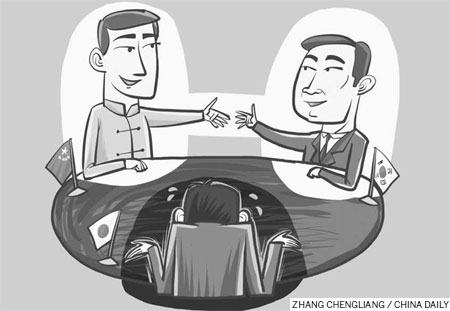
The crux of the FTA negotiations is Japan. While China strategically attaches great importance to the FTA building, and is actively promoting it in a timely manner, in a way the key rests in the hands of the Japanese. However, the Japanese have so far not maintained a positive and cooperative attitude. Japan is likely to become a drag on the FTA negotiations because of the recent geopolitical relations with China and South Korea. The FTA process urgently needs a favorable atmosphere to go forward.
As an intergovernmental institutional arrangement, successful FTA negotiations between countries need to be based on stable political mutual trust. However, Sino-Japanese and South Korean-Japanese relations have run into rough weather, because of territorial disputes. This mistrust has become a major roadblock, directly undermining their willingness to continue negotiations.
The Japanese government also lacks the determination to abandon its inefficient protection mechanism over its agricultural producers. Agricultural opening-up is undoubtedly the top challenge for the FTA negotiations. Japan is worried about the impact of cheap agricultural products from China on its market, while the liberalization of agricultural trade is an ace for China and an important bargaining power for non-agricultural product liberalization.
When Japan and South Korea substantially reduce tariffs on agricultural products, China can drastically cut tariffs on non-agricultural products. For China, if Japan does nothing to its tariff barriers on agricultural products and other "sensitive goods", the expansion effect of FTA trade will be very limited.
Japan is also overwhelmed by other FTA negotiations. At present, apart from the China-Japan-ROK FTA negotiations, Japan is also participating in the US-led Trans-Pacific Partnership and the ASEAN-led Regional Comprehensive Economic Partnership. In addition, Japan and the EU's Economic Partnership Agreements negotiations started in April.
Given such a large number of FTA negotiations, the Japanese are making a "multilateral bet", so as not to miss any opportunity to be involved in developing international rules in their national interests.
At the same time, considering the Japan-US military alliance and its need for political counterbalance against China, the Japanese government has prioritized the US-led TPP, because it believes joint participation by Japan and the US can guarantee future prosperity in the Asia-Pacific region and the development of a framework for a new economic order. It can also become a rule-making foundation for the RCEP and the future Asia-Pacific trade agreement (APEC FTA).
The rapid rise of China has led to an irrational mentality in Japan. After nearly 20 years of economic decline Japan has lost its hegemony in the Asian economy. Its strong sense of superiority is pushing it to an "opposing" stance over China-related issues.
China has actively advocated the FTA negotiations, but the Japanese government is not willing to recognize and accept Chinese dominance in the process. That has undoubtedly become another major obstacle affecting the negotiation process.
Therefore, China and South Korea should build a bilateral FTA first. Japan can join in later. This could be a new breakthrough to creating an FTA.
Since May 2012, China-ROK bilateral FTA negotiations have completed six rounds. South Korean President Park's successful visit to China will, no doubt, have injected new impetus into the previous stalemate in negotiations.
 Models at Ford pavilion at Chengdu Motor Show
 Brilliant future expected for Chinese cinema: interview
 Chang'an launches Eado XT at Chengdu Motor Show
 Hainan Airlines makes maiden flight to Chicago
 Highlights of 2013 Chengdu Motor Show
 New Mercedes E-Class China debut at Chengdu Motor Show
 'Jurassic Park 3D' remains atop Chinese box office
 Beauty reveals secrets of fashion consultant
Copyright 1995 - . All rights reserved. The content (including but not limited to text, photo, multimedia information, etc) published in this site belongs to China Daily Information Co (CDIC). Without written authorization from CDIC, such content shall not be republished or used in any form. Note: Browsers with 1024*768 or higher resolution are suggested for this site.
License for publishing multimedia online 0108263 Registration Number: 20100000002731