Reform, not incentives, to drive expansion


Innovation in the investment system will be the driver for the economy rather than policy incentives, said a top official in Shanghai, as the city draws up reform plans ahead of the establishment of its free trade zone.
Yang Xiong, mayor of Shanghai, said the pilot free trade zone is as significant as the Pudong New Area to the world's second-largest economy.
"However, this time it's not about policy incentives, but about forming principles that will bridge global standards," he said, adding that these principles could be duplicated elsewhere in the country.
"The focus of the new free trade zone will be to facilitate investment rather than just achieve good trade figures, as China explores deeper reforms in its investment system," Yang told the deputies of the Shanghai People's Congress on Thursday.
On July 3, the State Council, or China's cabinet, approved a plan to set up a free trade zone in Shanghai. The area is expected to be an experimental field for reforms in the financial sector and other sectors, in a bid to release what Premier Li Keqiang regards as the biggest boost for future growth.
Yang said that initial research showed there are more than 90 detailed reform measures ready to be launched in the free trade zone, most of which will focus on innovations to the system.
One example is a change in customs supervision, which will allow non-taxed goods to enter the border. Other measures may include replacing the current approval system for investment with a registration system, he said.
Experts said that reforms might also include a foreign exchange management project.
"The full convertibility of the yuan, a larger quota for foreign exchange settlements, and free flow of foreign capital: such reforms will be carried out in the free trade zone soon," said Zhang Hanlin, head of World Trade Organization research with the Beijing-based University of International Business and Economics.
Imports and exports within the free trade zone will be able to be settled in yuan, Zhang said.
The Shanghai FTZ will likely be formally established in October, Time Weekly reported recently, citing a source close to the matter.
"The priority at the moment is the legal system," Yang said, adding that the reform measures will involve the modification of a dozen laws.
He said the FTZ will be a key task for Shanghai in the second half and in years to come, but he admitted it will not be an easy task.
Shanghai again stands on the frontline of China's reform process, as the city's half-year performance epitomized the country's economic transformation, and the FTZ pilot project is expected to point out the next steps in terms of reform measures for the country.
In the first six months, Shanghai's GDP increased 7.7 percent, 0.5 percentage point faster than in the first half of last year, while the city's consumer price index grew 2.3 percent year-on-year, 1.3 percentage points slower than a year before.
The city's performance seems to be on the right track pointed out by Li, who asked for economic growth to stay above the bottom line and inflation to be within the upper limit.
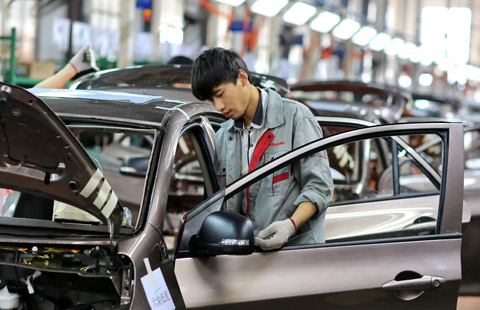
But such transformation does not come at no cost, as Shanghai's industrial sector has been contracting for five consecutive years, adding further pressure to increase the income levels of ordinary citizens.
The city also bore the brunt of recent economic volatility, including the liquidity crunch in June, which sent the interbank borrowing rate to an all-time high of 13.4 percent, and depressed the Shanghai Composite Index to 1,849 points in the last trading day of June, the lowest level since late 2008.
"As one of the most open cities, Shanghai embraced the direct impact from external factors," Yang said.
"The economy has shifted from high-speed growth to steady growth, and so should our mind-set," he said. "Growing at a lower speed is not something to be afraid of, but the transformation in the growth model should be implemented," he said, adding that 7.5 percent growth is a reasonable level for the transformation and upgrade process of the economy.