Japan exports to China lowest in 4 years


Japanese exports to China in the first half of this year decreased to the lowest level in four years amid strained ties between the top two economies in Asia as well as China's economic slowdown.
Despite the depreciation of the yen against the Chinese yuan, Japan's exports to the Chinese mainland declined 16.7 percent year-on-year to $61.43 billion in the January-June period. In the same period, the United States replaced the Chinese mainland as Japan's biggest export market, the first time in five years, with exports valued at $65.56 billion, according to the Japan External Trade Organization.
"Japan's decreasing exports to China mainly came from weak demand in China, which was caused by deteriorated bilateral ties as well as slower economic growth in China," said Li Xiangyang, director of the Institute of Asia-Pacific Studies under the Chinese Academy of Social Sciences.
After the "purchase" of part of China's Diaoyu Islands in the East China Sea in September, Japan's ties with China soured, which took a toll on the sales of Japanese brands.
"Japanese exports to China are part of the East Asian production network within which Japanese companies in China are a major force. Sluggish sales of Japanese products in the Chinese market hit Japanese shipments to China," Li said.
Yoichi Maie, director of China research at the Japan External Trade Organization, was quoted as saying on Thursday that easing infrastructure development in China led to Japan's particularly weak exports for construction and mining equipment, which fell 61.6 percent year-on-year.
Meanwhile, weaker private consumption in China accounted for a 47.7 percent drop in exports of digital cameras and other audiovisual equipment.
Yao Haitian, a researcher from the Institute of Japanese Studies at the Chinese Academy of Social Sciences, added that Japan's decelerating exports to China reflected the strained political ties between the two economies because improved market demand in the US and the European Union did not drive Japanese companies in China, part of the East Asian production network, to increase buying from Japan.
He also noted that Japan's shipments to other major markets, including the US, the Association of Southeast Asian Nations and the EU, also declined.
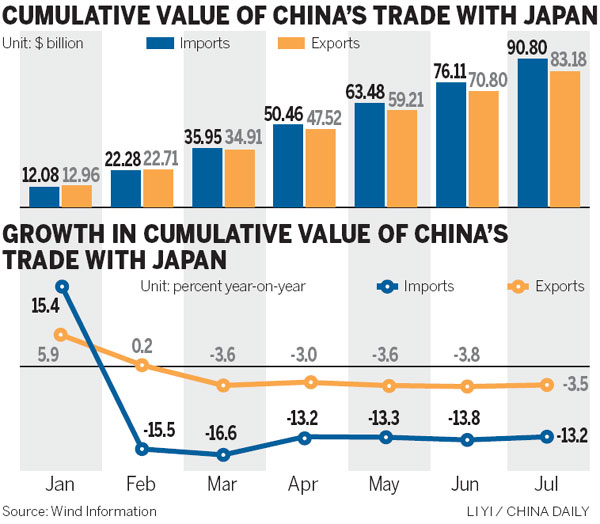
Although China's statistics of bilateral trade differed from their Japanese counterparts, they both revealed declining shipments between the two countries. The first half saw China's imports from Japan slump 13.8 percent year-on-year to $76.12 billion, according to China's General Administration of Customs. China's exports to Japan dropped 3.8 percent year-on-year to $70.81 billion in the same period.
The Japan External Trade Organization's data showed that Japan's imports from the Chinese mainland dropped 6.1 percent year-on-year to $85.84 billion in the first half, while the trade deficit with China was recorded at $24 billion, up 38.1 percent year-on-year.
Li from the Chinese Academy of Social Sciences, said Japan's shrinking imports from China were mainly caused by rising costs in China and depreciation of the yen, which weakened the competitiveness of Chinese goods.
"Throughout 2013, bilateral trade between China and Japan will not be satisfactory because Japan made no pragmatic moves to improve bilateral trade ties," he added.
"Meanwhile, Japanese investors became more worried about the Chinese market. New investment favors the Southeast Asian markets because of insufficient confidence in the Chinese market, although Japanese investors in China did not withdraw their investments," Li said.
He added that Japanese shifting of investment to the Southeast Asian countries, mainly in labor-intensive industries, started before the islands disputes and was caused by rising costs in China.
The shift away from China to Southeast Asia is likely to continue as Japanese companies seek a safer political environment as well as lower labor and business costs, The Wall Street Journal quoted the Japan External Trade Organization Chairman Hiroyuki Ishige as saying.
"On the back of increasing China downside risk, Japanese corporate investment in ASEAN has accelerated in 2013, a clear difference from investment in China," said the 2013 Japan External Trade Organization Global Trade and Investment Report on Aug 8.
The organization's data showed Japan's direct investments in China for January to June fell 31.1 percent from the year before to $4.9 billion. China's Ministry of Commerce said foreign direct investment from Japan rose 14.37 percent from a year earlier to $4.69 billion in the first half.