The white elephant in the room


Study shows excessive infrastructure investment negatively impacts economy
Whether China's largely State-driven infrastructure construction is excessive is always a topic subjected to vehement debate at home and abroad. A recent study offered a new clue to the answer.
The study, commissioned by the Shanghai-based SIFL Institute and led by two researchers with the Antai College of Economics and Management of Shanghai Jiao Tong University, touched upon the issue by comparing China's infrastructure investment with its private productive capital.
 |
|
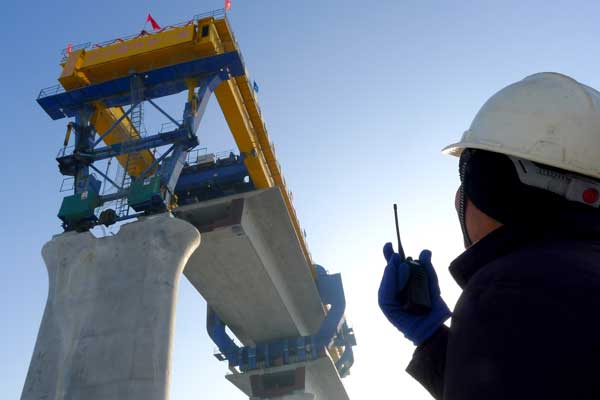
According to experts, it is reasonable for China to adopt an "infrastructure going ahead" strategy in its go-west campaign. The problem, however, is the breakneck infrastructure investment pace has not been followed with industrial investment growth, primarily led by the private sector.[Cai Zengle / for china daily] |
The study is built upon an assumption that there is an optimal allocation between the infrastructure investment and private productive capital. Any deviation from the balance leads to efficiency losses, thereby resulting in losses in GDP.
Huang Shaoqing and Shi Hao analyzed China's investment data during 1985 and 2011. In their calculation, infrastructure includes electricity, gas, water, transportation, warehousing and postal, water conservancy, environment and public utilities and information transmission. The remainder is counted as private productive capital.
The study found the largest loss occurred in 1997, when infrastructure investment was severely inadequate, causing losses amounting to 2.58 percent of GDP that year. This means that factor input could have generated more GDP if infrastructure and private productive capital went hand-in-hand.
Since 1998, the government has ramped up infrastructure investment by issuing bonds. The loss because of insufficient infrastructure investment has been gradually alleviated. In 2003, the cost was reduced to 0.64 percent of GDP that year.
The trend, however, has reversed since 2003. From 2003 to 2008, costs resulting from excess infrastructure investment in economically underdeveloped regions and insufficient investment in most developed coastal economies kept rising, reaching 1.31 percent of GDP in 2008.
At the end of 2008, China decided to roll out a large-scale stimulus package to avert the contagion effect of the global financial crisis. In the following two years, much of the credit spree flooded the infrastructure sector.
In other words, the infrastructure spending spree happened at a time when infrastructure in most regions was already over-built. Hence, the ratio of GDP losses has steadily risen from 2008's 1.31 percent all the way up to 2011's 1.85 percent — 872.4 billion yuan ($135.3 billion).