Navigating challenging markets:Alcoa CEO


In May, Alcoa announced cutbacks in production. What drove this decision?
Prior to our May announcement, Alcoa had 13 percent or 568,000 metric tons of idle smelting capacity.
And given current economic conditions, we announced in May a review of an additional 11 percent or 460,000 metric tons of smelting capacity to maintain our global competitiveness in a weak aluminum price environment and to achieve our goals of moving down the aluminum and alumina cost curves.
We are focusing our efforts on higher-cost facilities and plants that have long-term risk due to energy costs or regulatory uncertainties.
Since May, we have announced decisions to close or curtail 269,000 metric tons, which represent over 50 percent of the capacity under review.
In addition, we have invested in low-cost capacity such as our Saudi Arabia joint venture project, implemented cost reductions in our operations and made continued productivity improvements at all of our smelters.
While we are competitively positioning our upstream business to win in a challenging commodity market, we also are growing our value-added businesses to capture significant growth opportunities.
In the first half of 2013, more than half of Alcoa's revenues came from our value-added businesses, which supply high-tech aluminum products to the aerospace and automobile industries, among others. Global demand for aluminum across our end markets - including aerospace, auto, building and construction and industrial gas turbines - continues to grow, year after year, and Alcoa is well positioned to meet that demand.
Your company focuses on the downstream sector in China. Will you continue this strategy?
We have historically seen greater opportunities in the downstream business as China moves toward a more consumer-led economy, builds out its transportation infrastructure and looks for ways to reduce energy consumption.
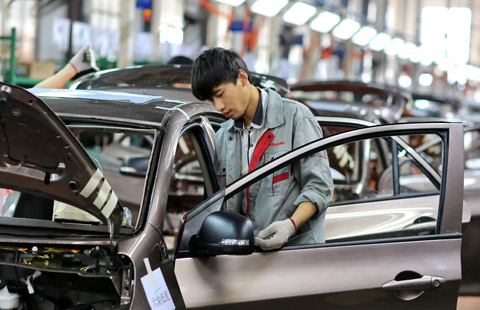
Our existing business supports the growing packaging, automotive and aerospace sectors. We see growing potential in the downstream, so in December 2012, Alcoa Wheel Products opened a new aluminum wheel production facility in Suzhou. This expansion creates a full wheel manufacturing, distribution, sales and service network in China to capture growth in the Chinese commercial vehicle market.
In the aerospace fastener market, we have a strategic and commercial agreement with Commercial Aircraft Corp. This agreement deepens Alcoa's existing partnership and reinforces Alcoa's presence in one of the world's fastest-growing aerospace markets.
We also see a tremendous opportunity to partner with China Power Investment to produce high-end fabricated aluminum products for the growing aerospace, automotive, commercial transportation, consumer electronics and packaging markets in China.
The Chinese government is focusing on sustainable development. What is your view on corporate social responsibility at a large multinational like Alcoa?
Sustainability is an integral part of Alcoa's operating practices and the product design and engineering we provide to customers.
As a business leader, I focus on driving our company's competitive advantages while mitigating risks. Alcoa's focus on sustainability - through increasing the energy efficiency of our operations, reducing greenhouse gas emissions and manufacturing environmentally friendly products, for example - is key to achieving our goals.
We focus on providing long-term benefits to all stakeholders including shareholders, employees, customers, suppliers and the communities in which we operate.
Through our sustainability efforts, we continue to show that the value of aluminum - lightweight, non-corrosive and infinitely recyclable.
In China, we are actively engaged with local government and business leaders to help the country meet its sustainability goals.
The Alcoa Foundation, for example, has sponsored the World Resources Institute's project to establish a comprehensive accounting and reporting infrastructure in the national power sector to support mandatory greenhouse gas reporting and emission trading schemes. The government of Jiangsu province has requested the institute's support to help them develop greenhouse gas reporting guidelines for coal-fired power plants, affecting over 90 percent of power generation in Jiangsu and 10 percent of power generation in China.