


 Comments
  Print
Print  Mail
Mail  Large Medium Small
Shanghai area throws up questions that apply well beyond its boundaries
A lot is expected from the Shanghai free trade zone, approved by the State Council five weeks ago and due to open office on Sept 29. There is no doubt it is a milestone in China's continued opening-up and a further sign of the new way the country's economy operates.
The zone is initially being run as a pilot project and it may be years before it becomes fully operational. Other candidates for free trade zones - Chongqing, Guangdong and Xiamen - should wait to see how things work out in Shanghai before prosecuting their cases further.
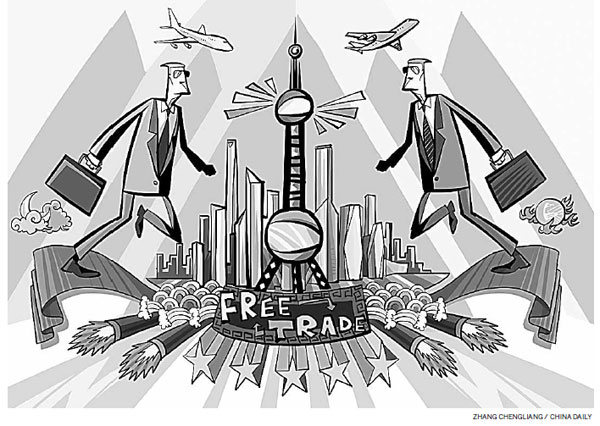
A lot of attention regarding the Shanghai zone has focused on financial liberalization, including the free convertibility of the yuan, a fully market-based yuan exchange rate mechanism and full liberalization of interest rates and offshore banking. However, bold and essential as they may be, those measures are not the primary characteristics of the zone.
It is, after all, a free trade zone rather than a free financial zone. It will retain all the basic functions of a conventional free trade zone, the most basic of these being that it lies behind the national frontier, but before the customs zone. So goods in this area can be moved in and out across the national border free of duty. On this basis, warehousing, logistics, processing, assembly and transit trade can be performed in an effective way. Because it makes trade easier, it may be able to muster many trading, shipping, warehousing, manufacturing, logistics, IT services, banking, legal and other related businesses, creating tens of thousands of jobs and performing as a regional business center.
However, it is much more than a conventional free trade zone. There are more than 1,200 free trade zones in the world, including 425 in 15 developed countries and 775 in developing countries. Those in Amsterdam, Dubai, Hamburg, Hong Kong, New York, Panama and Singapore are world-leading trade and financial centers. Shanghai already has bonded zones, at Pudong International Airport, and in Waigaoqiao and Yangshan.
The new Shanghai free trade zone is envisaged as a full market-based international economic zone. Tremendous changes have taken place in globalization over the past 20 years since the conclusion of the Uruguay Round of world trade talks. World trade flows are profoundly intertwined with research and development, product and technology innovation, investment, banking and financing, futures trading and a broad spectrum of services. In order to obtain and keep a competitive advantage in the world marketplace, the Shanghai free trade zone must base all its activities on full world market competition, with minimum government intervention and cost.
The first group of measures for liberalization may include allowing businesses, foreign or domestic, State-owned enterprises or private, to set up in the zone, with registration only so long as their activities are not proscribed.
When the measures are put into action they will pave the way for investment into the zone and for businesses wanting to set up there. This will include branches, subsidiaries or even regional headquarters of foreign trading, shipping, logistics companies, banks and insurance companies.
A key question is: What will be on the proscribed list. Drastic cuts in sector restrictions are a vital prerequisite.
To service the expected significant trade flows toward Asia, especially North Asia, because of trade facilitation, many R&D centers and manufacturing facilities are likely to set up operations in the zone. The tax incentives will need to be clearly spelled out.
To support trade and product flows, a market-based interest rates mechanism and private banks will need to come in quickly to reduce borrowing costs and to make available diversified financial resources for production and trade with a globally competitive edge.
Yuan convertibility will be introduced gradually for corporate outbound investment and offshore banking is likely to evolve quickly.
Meanwhile, quick steps will need to be taken to introduce bonded delivery of commodities futures and, when the zone is functioning fully, it will become a major commodities trading hub for East Asia.
The new free trade zone will test world trade rules and help the country keep up with regional free trade negotiations or agreements around the world. The US-led Trans-Pacific Partnership negotiations, to which China is not yet a party, is undoubtedly a major issue for China in global trade.
The Shanghai free trade zone, even if it involves many new trading rules likely to be part of the TPP, is first and foremost about China's national interest as it seeks fundamental changes in the way it develops, restructures and upgrades in the quest for sustainable and balanced economic growth.
That means China needs to closely follow the TPP negotiations and the latest changes in trade rules. But it should be in no hurry to join the negotiations. The multilateral trading system, represented by the World Trade Organization, prevails over all regional free trade arrangements and should be upheld. The most important thing for China to do is to work closely with other WTO members to obtain early results from the Doha Round at the ministerial conference in Bali, Indonesia, in December. In the context of regional trade arrangements, China has its own agenda.
Prospects for the Shanghai free trade zone, and possible similar zones in Chongqing, Guangdong, Xiamen and elsewhere, are bright. But the success of the Shanghai zone, initially covering about 29 square kilometers, needs to be able to transcend its borders.
One thorny issue that arises with more free trade zones concerns law. The application of certain national laws has been suspended in the Shanghai free trade zone, something that is likely to happen with other free trade zones, which will lead to a hotchpotch of laws applying to different parts of the country.
However, Shenzhen Special Economic Zone, opened in 1980, had special incentives, too, which have gradually expired, and the zone has served as a bridgehead for the whole country in bringing in world investment, markets and technologies.
Even with the Shanghai free trade zone in focus, an eye needs to be kept on what happens beyond its boundaries. No time should be lost in complementary reforms and further opening-up in the same direction, first of all in Shanghai and neighboring areas and then the rest of the country.
Once particular policies, regulations and laws have proved successful in the Shanghai free trade zone, they can be made national policies, regulations and laws.
The author is co-director at China US/EU Study Center, China Association of International Trade. The views do not necessarily reflect those of China Daily.
Copyright 1995 - . All rights reserved. The content (including but not limited to text, photo, multimedia information, etc) published in this site belongs to China Daily Information Co (CDIC). Without written authorization from CDIC, such content shall not be republished or used in any form. Note: Browsers with 1024*768 or higher resolution are suggested for this site.
License for publishing multimedia online Registration Number: 20100000002731 
