Comments
  Print
Print  Mail
Mail  Large Medium Small
Limited land resources
Earlier this month, Max Holtzman, senior advisor to the United States Secretary of Agriculture, told China National Radio that more than 90 percent of US-produced corn and soybeans are GM crops. He said that 20 percent of the corn and 40 percent of soybeans are exported, while the remainder is consumed domestically. Approximately 70 percent of all processed foods in the US market contain genetically modified ingredients and, to date, there has never been a safety incident associated with the consumption of GM foods, he added.
One of the 61 petitioners, Zhang Qifa, director of the National Key Laboratory of Crop Genetic Improvement at Huazhong Agriculture University, said delaying the commercial cultivation of GM rice would cause great harm to China and science. His comments echoed a statement by the scientists, who criticized the Ministry of Agriculture for dragging its feet over the issue.
"When two of our GM rice varieties were granted safety certificates by the Ministry of Agriculture in 2009, I was quite confident. But four years later, the ministry still hasn't rolled out any specific protocols for the commercialization of GM rice," said Zhang.
Currently, the safety certificates issued to Zhang's research team are the only ones to have been awarded in China, and he fears that the commercialization of GM rice in China is unlikely to make much headway once they expire in May next year.
Lin Yongjun, project leader of insect-resistant transgenic rice varieties at Huazhong Agricultural University, said the certificates were granted only after rigorous testing and inspection, including a 90-day experiment during which the rice was fed to rats, and tests carried out on three successive generations of rice to ensure product safety.
Zhang said the urgent need for the commercialization of GM foods corresponds to calls from academics keen to correct the imbalance between China's grain output and demand. Wu Kongming, an academician at the Chinese Academy of Engineering, said the situation is so grave that China cannot afford to postpone the development and adoption of GM technology.
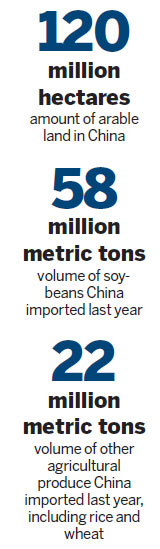
"China has 1.8 billion mu (120 million hectares) of arable land. The country imported more than 58 million metric tons of soybeans last year, and if rice, wheat, barley and canola are also included, imports totaled 80 million tons. It would take 800 million mu just to plant an equal amount of food. China is not rich in land resources, so we can't simply rely on traditional methods to meet our requirements. We must take advantage of modern high-tech agriculture," he said.
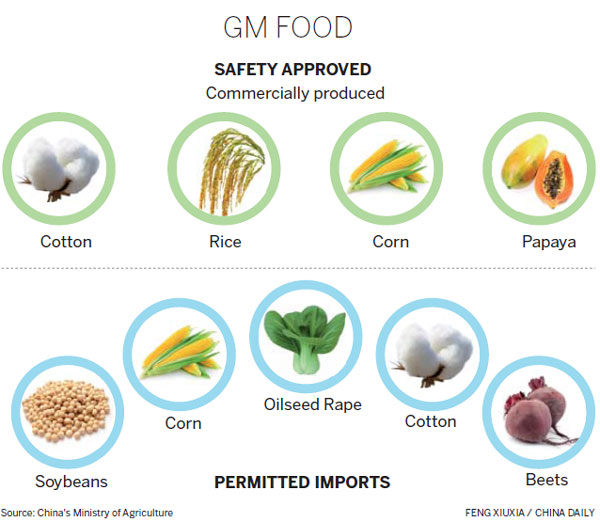
GM crops have a number of obvious advantages, including high yield rates and increased resistance to pests, which could result in more efficient use of land and a reduction in the use of pesticides. Cultivation of GM cotton and papaya has already been approved, but because those crops don't belong to the mainstream food groups, there has been less resistance to their use.
Rice, however, is a different matter because it is the staple food of most Chinese people. Although experts have emphasized that the State has issued safety certificates for two varieties of GM rice, many people still harbor doubts about its safety. Lin believes there is a crisis of public confidence and said that, given the number of food scandals in the country in recent years, many people are skeptical of safety claims.
Public doubt concerning the safety of GM foods was highlighted when Internet users overwhelmingly sided with Cui Yongyuan, a presenter at China Central Television, who engaged in an online spat with a proponent of modified foods last month.
Cui took exception to claims made by a well-known micro blog opinion leader, Fang Zhouzi, about the safety of GM foods. When Fang posted on Weibo, China's version of Twitter, that every Chinese should be granted the opportunity to eat GM foods, Cui was quick to respond, saying that he reserved the right to not eat GM foods and to question the science Fang proclaimed.
While acknowledging Cui's right not to eat GM foods, Fang pointed out that "science is science", and said the dissemination of unfounded rumors will hinder the development of agriculture in China.
 Robots kick off football match in Hefei
 Aerobatic team prepare for Aviation Convention
 China Suzhou Electronic Manufacturer Exposition kicks off
 'Squid beauty' and her profitable BBQ store
 A day in the life of a car model
 Vintage cars gather in downtown Beijing
 Asia Bike Trade Show kicks off in Nanjing
 Student makes race car for 4th Formula SAE of China
Copyright 1995 - . All rights reserved. The content (including but not limited to text, photo, multimedia information, etc) published in this site belongs to China Daily Information Co (CDIC). Without written authorization from CDIC, such content shall not be republished or used in any form. Note: Browsers with 1024*768 or higher resolution are suggested for this site.
License for publishing multimedia online 0108263 Registration Number: 20100000002731