

 Comments
  Print
Print  Mail
Mail  Large Medium Small
Legislation for fiscal and financial services to ensure that market plays decisive role in development and supplements governance
The Decision on Major Issues Concerning Comprehensively Deepening Reforms, a document on reform issued by the Third Plenum of the 18th Central Committee of the Communist Party of China, pays almost unprecedented attention to financial reform, saying: "The fiscal and taxation system is an important guarantee of State governance."
This is an innovative definition of finance. Both in China and Western countries, finance has long been defined only in economic terms - as an economic tool used by the government to implement macro-control. In a sense, finance almost equals "economic policy".
The document issued by the plenum has now broken the unwritten tradition by emphasizing the role of finance in "optimizing resource relocation, maintaining an efficient market, promoting social justice", and even "maintaining the nation's stability in the long run". This means China's decision-makers have recognized the social and political role of finance, that is, how a good financial system can satisfy people's needs and promote society's continuous progress.
The plenum document also describes the fiscal and taxation system as an essential supporting pillar of governance. According to the plenum, finance will support China's further development with not only money, but also a modern system, making it a guarantee of State governance.
The innovative definition makes clear the road map of financial reform. To maintain a healthy and stable finance as a guarantee of governance, the document lays down a principle, which is as brief as could be: "improve related legislation". Overall, China will follow the rule of law while implementing financial reform, and build a modern financial system that can meet the changing needs of development.
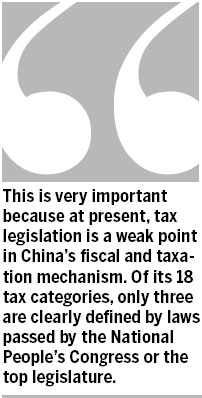
The most important prerequisite for the desired financial system is tax legislation, according to which all taxes will be levied according to law. This is very important because at present, tax legislation is a weak point in China's fiscal and taxation mechanism. Of its 18 tax categories, only three are clearly defined by laws passed by the National People's Congress or the top legislature, while the rest are defined by regulations issued by the State Council or the country's Cabinet. The reform will change this by strengthening legislation.
Tax legislation could have a wider and deeper impact. It could, for instance, influence the relationship between the NPC and the State Council. The State Council relies on the NPC's authorization when it comes to levying tax. The reform means the latter could withdraw authorization and limit the government's action to stricter supervision as part of the political mechanism reform.
The principle of "improve related legislation" comprises not only taxation laws, but also budget laws. Budget is one of the hottest topics in parliaments across the world with legislators debating how much money should be given to the government and how it should spend it. In the United States, the federal government could even be closed if the budget plan fails.
The NPC too holds a budget debate. But the debate is restricted mainly to discussions among various government departments and agencies on how to divide and spend fiscal funds, instead of representatives discussing how much money should be given to the government. Therefore, it's more like a competition among different departments to get funds than supervision of the departments.
Since budget will now be gradually regulated by law, government agencies in China will have to learn to earn and spend money according to law, which is a more convenient way for the people to supervise them.
The reform will not only redefine the relationship between the legislative and administrative branches of the government, but also influence the relationship between the central government and local governments. The plenum document says there is need to "motivate both the central and local levels of governments".
According to that principle, China's financial system will be gradually divided into two levels: central and local. While the central government will keep the same tax mechanism nationwide, local governments will have to implement financial reforms according to their size of population, land area, level of economic development and other factors, thus enjoying greater freedom in finance.
But greater freedom will come with greater responsibilities like environmental protection and social security. In this way, the central and local governments will be more motivated to serve the common goal of development.
In other words, financial reform is more than "reform of money" - it means the reform of several important relationships to better propel the country's economic development.
The author is deputy director of the Institute of Finance Science, affiliated to the Ministry of Finance. The article is an excerpt from his speech at a recent conference held by the China Institute for Reform and Development.
 Buick Riviera concept car at 2013 Auto Guangzhou
 FAW-VW all-new Golf at Guangzhou auto show
 VW donates more than 5k child safety seats
 Honda models at 2013 Guangzhou auto show
 Honda Jade at the 2013 Guangzhou auto show
 Toyota's new Reiz debuts at 2013 Auto Guangzhou
 Jimmy Lin Zhiying, models at Toyota pavilion
 Volvo all-new S60L world premiere at Guangzhou auto show
Copyright 1995 - . All rights reserved. The content (including but not limited to text, photo, multimedia information, etc) published in this site belongs to China Daily Information Co (CDIC). Without written authorization from CDIC, such content shall not be republished or used in any form. Note: Browsers with 1024*768 or higher resolution are suggested for this site.
License for publishing multimedia online Registration Number: 20100000002731