Comments
  Print
Print  Mail
Mail  Large Medium Small
The fifth round of the S&ED presents opportunity for China and the US to advance strategic and economic cooperation
The fifth Strategic and Economic Dialogue between China and the United States, to be held in Washington on Wednesday and Thursday, follows hot on the heels of the positive Sunnylands summit between President Xi Jinping and President Barack Obama, and promises to further advance cooperation between the two countries.
The US' new secretaries of state and the treasury, and China's new state councilor and minister of foreign affairs will head the two teams. These four representatives will probably continue this dialogue over the next four years, so it is important that they develop good personal rapport during their first meeting.
There will be a lot on the agenda. Beijing and Washington are both concerned about the nuclear programs of the Democratic People's Republic of Korea and Iran. But with China and US toughening their stance toward the DPRK, some signs have emerged that it is willing to participate in bilateral talks, and possibly the Six-Party Talks. Iran's newly elected president has also made some reconciliatory gestures that need to be responded to constructively. Given these latest developments, China and the US can craft a positive roadmap to reduce tensions.
The ongoing Syrian and Egyptian unrest are also likely to be high on the agenda. Though Beijing and Washington both want stability in Syria, they have quite different approaches to the crisis. Meanwhile, the unrest in Egypt is undermining social stability, which threatens the common interests of Beijing and Washington. Through the S&ED, China and the US can better communicate and coordinate policies. After all, countering terrorism and radicalism in these countries are in the interests of both China and the US.
Other strategic issues are related to the military-to-military relationship between China and the US and how the two countries see the "global commons" - space, cyberspace and maritime space. In particular, given the recent US accusations of cyberattacks by China and the revelations about the US National Security Agency's cyber spying, cyber issues will be a hot topic at the upcoming dialogue. The newly established cybersecurity working group is the right way to address the issue in a balanced manner and forge cooperation, including a draft principle and possibly a minimum code of conduct, within the framework of the Strategic Security Dialogue of the S&ED.
However, tensions between Beijing and Washington over maritime issues have lessened recently. Rather than pinning the blame on China for the disputes in the South China Sea, the US is seeking more cooperation with China, while China is ready to negotiate a code of conduct. The S&ED can boost this good momentum by promoting China-US maritime trust building and security cooperation.
Despite this, the US' "rebalancing" to the Asia-Pacific region and the mutual apprehension between Beijing and Washington remain striking issues. Though US Secretary of State John Kerry has expressed his reservations over the rebalancing, the US' move to deploy 60 percent of its global naval assets in the Asia- Pacific has naturally invited China's suspicion. In spite of its repeated claims that the move is not aimed at China, the recent US naval drill with the Philippines a short distance from Huangyan Island has alarmed China about the US' intent. In this context, the upcoming S&ED offers a fresh opportunity for the two militaries to address each other's concerns.
Economically, China and the US are facing both opportunities and challenges. With slower economic growth, the two countries will be less bothered by their ever-expanding trade imbalance, but it will be more difficult for China to appreciate its currency. Their economic slowdowns have pressed both countries to transform their growth model, making energy innovation a new area of collaboration, as well as competition. And while the US has set up barriers in the name of national security against Chinese investment, its own IT business enjoys free access to the Chinese market. Such an imbalance between business and security has to be addressed at the S&ED.
The two governments have set up a climate change working group within the Economic Dialogue. As the two largest economies and energy consumers, China and the US shoulder particular responsibility in addressing global climate change. With the transformation of each other's industrial structure, Beijing and Washington have taken a more proactive stance in meeting the challenge. Taking responsibility within their capacity is the right approach to collaboratively combating global warming.
There are many great opportunities ahead for China and the US. After pondering for a while over the impact of the Trans-Pacific Partnership, China seems more relaxed about it. Though obviously China is not ready to meet the many standards of the TPP, Beijing wants to raise its production, labor and service levels so they are more competitive. The latest round of the S&ED presents a chance for the two countries to communicate on how to upgrade global free trade to a higher stage.
The author is professor and associate dean of Institute of International Studies, Fudan University.
 4th World Internet Conference concludes
 Starbucks Reserve Roastery set to open in Shanghai
 Smile to get discounts in Tmall's unmanned supermart
 Top 10 richest Chinese women in 2017
 World leading internet sci-tech achievements released in Wuzhen
 Top tech CEOs take to the stage as Wuzhen Summit opens
 Major topics at 4th World Internet Conference
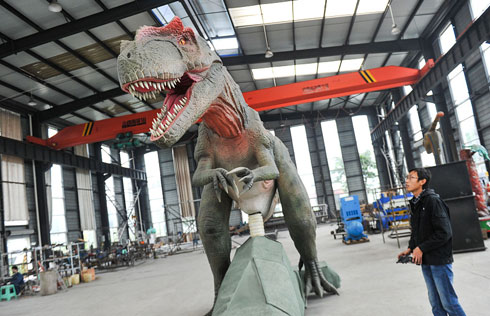 'Made in China' dinosaurs amuse the world

Copyright 1995 - . All rights reserved. The content (including but not limited to text, photo, multimedia information, etc) published in this site belongs to China Daily Information Co (CDIC). Without written authorization from CDIC, such content shall not be republished or used in any form. Note: Browsers with 1024*768 or higher resolution are suggested for this site.
License for publishing multimedia online 0108263 Registration Number: 20100000002731