Chinese companies blaze new trail in Ethiopia, taking on more projects
Big-ticket infrastructure projects have often been the preferred calling card for Chinese companies in overseas markets such as Africa. But with Africa entering a new round of development, many Chinese companies are changing tack and looking to participate in more developmental and societal projects.
Although there are roads, bridges, railway lines and various other government buildings that stand testimony to the Chinese capabilities, companies are now gearing up to participate in projects such as urban facilities, modern transportation and manufacturing.
Sun Guoqiang, general manager of CGC Overseas Construction Group, a Chinese construction major that has been in Ethiopia for more than 15 years, says that although there are still plenty of construction projects in Africa, his company will move away from the business in five to 10 years.
"We will focus on projects in areas such as manufacturing and agriculture and leave the construction business to local companies," he says.
The company has a sizable presence in well drilling and road construction businesses in Ethiopia. Its other main areas of operation include water supply and wind power projects.
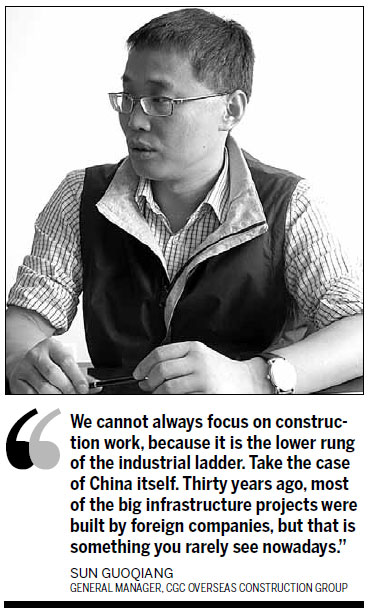
"We cannot always focus on construction work, because it is the lower rung of the industrial ladder," Sun says. "Take the case of China itself. Thirty years ago, most of the big infrastructure projects were built by foreign companies, but that is something you rarely see nowadays."
The real endeavor for the CGC Overseas Construction Group is to participate in projects that boost local employment and local communities in Africa. Water supply and wind power projects are examples of this extended involvement, Sun says.
Talking about the water supply projects, Sun says that the company has moved from just drilling wells in rural areas for farmers to executing complex urban water supply projects.
According to Sun, the Chinese company has built more than 60 percent of the $200 million water supply system project for Addis Ababa. The Ethiopian government, the World Bank and the Export-Import Bank of China have jointly financed the project.
In the road and bridge construction sector, the company has played a big role in boosting local employment. It employs around 300 Chinese workers and more than 5,000 local workers.
Dwelling further on this line of business Sun says that 10 years ago the capital city had only 700 kilometers of proper roads. Now it has 1,400 km.
"The city's plan is to have 2,100 km. I guess it still needs another 10 years to finish it," Sun says.
The company trains local workers during construction. Some excellent ones leave the company and start their own construction business. "This happens a lot in water drilling and asphalt pavement segments," Sun says.
To follow the government's policy, the company is subcontracting some of its construction projects to local companies.
Wind power is a new segment that the Chinese company is betting big on in Ethiopia. As a country located in the eastern highlands of Africa with an average altitude of more than 3,000 km, Ethiopia is one of those countries that are never short of wind. But very little of it has been put to commercial use.
The company has set up the first phase of a wind power project, 80 km south of Addis Ababa, with an installed capacity of 50 megawatts. The second stage of the project is under construction. When completed, it would generate more than 153 mW of power.
Unlike CGCOC, which is banking on diversification, the China Railway Engineering Corp is looking to leave a mark by creating a completely modern landscape for Addis Ababa.
In 2007, the Ethiopian government came up with a plan for a cross-shaped city transport system composed of two light train lines.
Although there were several big international bidders for the light train project, it was eventually awarded to China Railway Engineering Corp in September 2009. The Chinese company had already made a mark in Africa during the 1960s by building the Tanzania-Zambia Railway, a major symbol of China-Africa friendship.
"As far as I know, the city light train project in Ethiopia is the only project of such a kind that we are conducting in Africa," says Cai Qinghao, CREC project manager for the light train project.
Cai says that the company is also building roads and regular railways in Nigeria, Angola and Uganda, but none is as advanced as this project, which is more of an above ground version of city subway systems.
The designed length of the $475 million project is 31 km and construction has already started. The whole project is expected to be finished by 2015. When completed, the rail system is expected to reduce traffic congestion in Addis Ababa, a city with a population of nearly 3 million.
"The cross-shaped light railway system will help people to come in and go out of the city. It will also add a modern touch to the old city," Cai says, adding that some big Chinese cities such as Chongqing, Dalian and Shenyang all have similar city light train systems.
Cai, who has been in Africa for two years supervising the project, says the biggest difficulty he has encountered is lack of raw materials and industrial products. The rails, compartments, sleepers are all shipped from China by sea.
"Local manufacturing capability is low. We have to import virtually everything from China, including steel and machinery equipment," he says. "It increases costs and slows down the process. The only things that we get locally are food, cement and some stationery."
More than 400 Chinese managers and engineers work side-by-side with 3,000 local workers on the project. Locals working on the project consider it to be a good opportunity because the salary for a medium-level worker is about 2,000 to 3,000 birr ($100 to $150) a month, much better than opening a roadside shop selling daily necessities. "The project has also helped Ethiopia to have its own engineers and skilled workers," Cai says.
Copyright 1995 - . All rights reserved. The content (including but not limited to text, photo, multimedia information, etc) published in this site belongs to China Daily Information Co (CDIC). Without written authorization from CDIC, such content shall not be republished or used in any form. Note: Browsers with 1024*768 or higher resolution are suggested for this site.
License for publishing multimedia online 0108263 Registration Number: 20100000002731 

