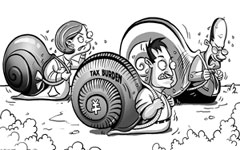
On the surface, there seems to be nothing wrong with this tax arrangement. The problem is that Chinese individuals have to pay income tax on the difference between the exercise price and the fair market value of the shares issued in the equity compensation scheme within one month. In other words, no matter how long they are willing to hold the newly purchased shares, they have to pay income tax just after the stock options are exercised or the restrictions on selling company stocks are released. To pay the income tax, some employees of listed companies rewarded with the equity-based compensation have taken great pains to sell at least some of their newly purchased stocks, which increases the volatility of short-term stock price fluctuations at the expense of long-term growth.
 |
 |
It does not have to be this way. The tax arrangement in the United States provides another option. For instance, the US tax benefit for stock options is that on exercising the option the individual does not have to pay ordinary income tax. Instead, if the shares are held for 1 year from the date of exercise and 2 years from the date of grant, then the profit made on the sale of the shares is taxed as long-term capital gains. Long-term capital gains are taxed in the United States at lower rates than ordinary income. In 2013 the long-term capital gains recognized are taxed at a maximum 15 percent or 0 percent if the individual is in the 10 percent or 15 percent income tax brackets. In comparison to ordinary income tax rates, which may be as high as 35 percent, it is the most favorable tax treatment.
With the increasing amount of Chinese companies rolling out equity incentive schemes for employees in the next decade, it is inevitable that this form of compensation will soon become the norm in all Chinese remuneration packages. High technology companies in China usually face more financial constraints. They need to enjoy tax advantages and access to more and better financing options. Thus, why not provide them with a better option: granting them more tax benefits in incentive stock schemes if their employees hold restricted shares or exercised stock options for a longer period?
Of course, to help Chinese companies to achieve sustainable development, preferential tax treatment should also be offered to producers in the development of low carbon manufacturing as well as manufacturers that are accomplishing industry transformation and upgrading.
Therefore, further reform of China's tax system should be encouraged and implemented to provide a more effective solution for attaining domestic innovation and industrial upgrading. Policymakers should not be conservative in this.
The author is assistant professor in finance, Nottingham University Business School, China.

Copyright 1995 - . All rights reserved. The content (including but not limited to text, photo, multimedia information, etc) published in this site belongs to China Daily Information Co (CDIC). Without written authorization from CDIC, such content shall not be republished or used in any form. Note: Browsers with 1024*768 or higher resolution are suggested for this site.
License for publishing multimedia online 0108263 Registration Number: 20100000002731