|
Editor's note: Sometime we come across terms that are either hard to understand or difficult to relate with our everyday life. In an effort to help our readers, we are launching a new series today where we try to explain the meaning and relevance of some of the most important economic indicators. If there is any term that leaves you baffled, please share with us in the comment section and we will try to tackle it. |
|
2014 GDP growth target: about 7.5% |
|
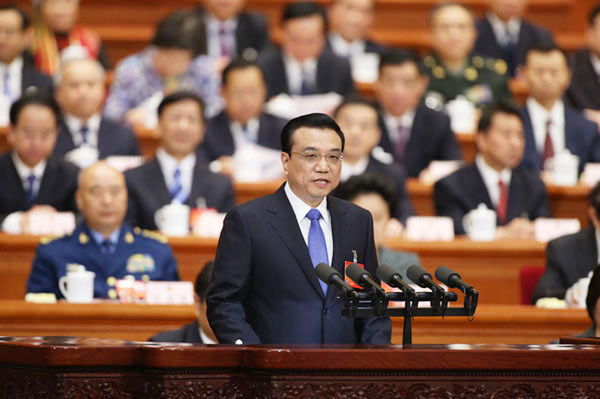
At the Second Session of the 12th National People's Congress in Beijing on March 5, 2014, Premier Li Keqiang announced that the government has set gross domestic product (GDP) target at 7.5 percent for the year. Given that the global economy is facing headwinds and the Chinese economy is itself slowing down, he has provided a leeway to the government by adding that the 7.5 percent figure is not set in stone and that there is a possibility that the country may post a higher or lower number in 2014. Although the 7.5 percent target is pretty impressive, especially when compared to the poor GDP figures the advanced countries are seeing, it is still short of the growth China was witnessing just a couple of years ago. |
|
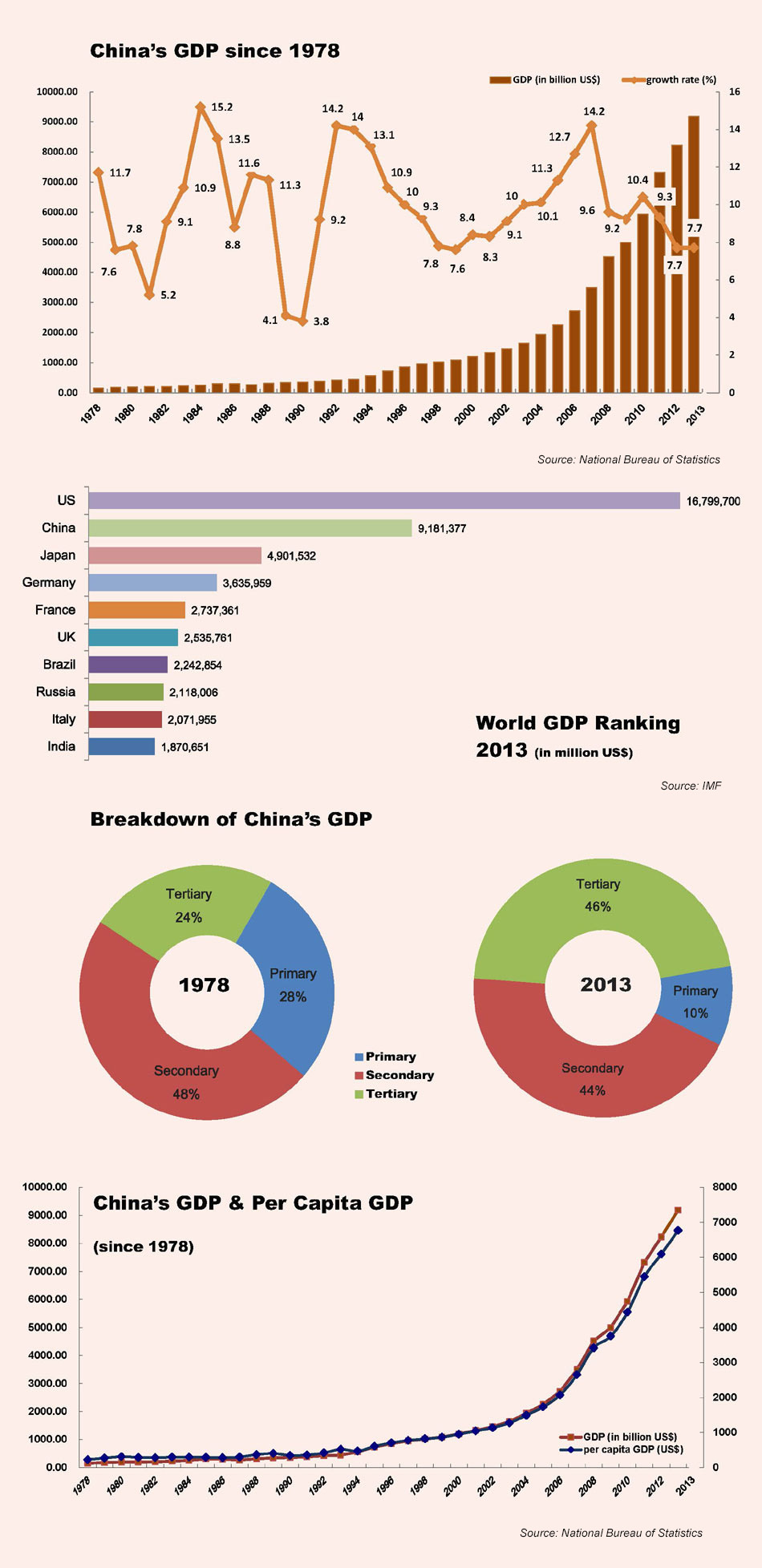
China's GDP growth since 1978 |
|
 |
|
So what is GDP and why is it so important? |
|
It is one of the major indicators that reveal the health of the economy. It represents the total value of all goods and services produced over the year. Since it defines production and growth of the whole economy, it has a huge impact on everyone living in the country. For instance, when the GDP is good, wages are high, unemployment is low and trade activity booms. It is also crucially important for the government as it uses the data to announce policy or decide how much it can afford to spend on public services, such as hospitals, schools and housing. Economic figures aren't as abstract as you might think. Every penny you earn or spend, every product you manufacture, and every financial decision you make all contribute to data calculation and government policies that in turn have direct influence on your economic activities and then the whole economy at large. GDP growth is an intrinsic driver of national employment. Recent statistics show that just 1 percent increase in GDP can translate into 1.3 to 1.5 million new jobs in China, owing to the booming service sector in the country. The 1 percent increase in GDP was adding 1 million new jobs just a few years ago. That means a GDP growth of 7.2 percent is needed for 10 million new jobs with a registered urban unemployment rate at about 4 percent. |
|
How is it calculated? |
|
Simon Kuznets was the first economist to create the first true GDP estimate, which he delivered to the United States’ Congress in 1934. Since then, government statistical offices all around the world have been producing GDP estimates. Three methods are used to arrive at these estimates. First is to add up all the money spent in the year. Second is to add up all the money earned in the year. And third is to add up all the value added in the year. Some countries, such as the United Kingdom, combine all three methods into a single GDP number, whereas the United States uses only the spending figure to estimate the GDP. China, meanwhile, calculates gross domestic product after taking into account three factors: production, income and expenditure. |
|
Mirror of true growth? |
|
GDP number is important, but not as much as many people think. In many countries, including China, that figure can be easily inflated for various reasons to the tune that national GDP doesn't equal the totaled number of all provinces. Premier Li once said that he measures economic performance through rail freight, power consumption and loans - indicators that actually have nothing to do with the GDP figure but mirror true economic activities. GDP cannot gauge such aspects as the quality of economic growth, public services, people's well-being, total national wealth, environment, etc. Therefore, a high GDP growth rate doesn't necessarily mean a strong economy or a high quality of life. So, whatever you spend, produce or sell is taken into consideration while calculating the national GDP that in turn reveals whether the country's economic health is improving or going down and that helps the government decide policies and allocate resources. That's the role of the GDP. |
Copyright 1995 - . All rights reserved. The content (including but not limited to text, photo, multimedia information, etc) published in this site belongs to China Daily Information Co (CDIC). Without written authorization from CDIC, such content shall not be republished or used in any form. Note: Browsers with 1024*768 or higher resolution are suggested for this site.
License for publishing multimedia online 0108263 Registration Number: 130349