|
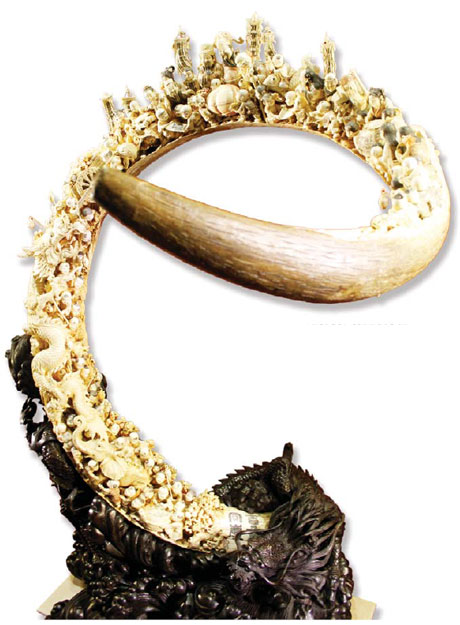
Chu Chung-shing's masterpiece Thousands of Arhats for Our Prosperous Country. The 500-kilogram, 4.65-meter carving took more than a decade for Chu Chung-shing and a select team of craftsmen to finish. Photos by Doug Meigs / For China Daily Asia Weekly |
Skilled craftsmen have started to use prehistoric materials to preserve traditional Chinese carving techniques as ivory ban continues
Chinese craftsmen have been carving ivory since ancient time. But in the modern era, illegal poaching and the slaughter of African elephants have endangered the now controversial art form.
Instead, ivory from extinct wooly mammoths is helping China's ivory carvers to sustain their historic craftsmanship. Mammoth tusks are exempt from the ivory trade ban, which the Convention on International Trade in Endangered Species of Wild Fauna and Flora implemented in 1989. The treaty only regulates trade in living creatures; mammoths have been extinct for thousands of years.
Although stocks of prehistoric ivory frozen in the Arctic permafrost are limited, imports of Russian wooly mammoth ivory has created an alternative medium for China's traditional ivory carving - which the central government declared a national intangible cultural heritage in 2007.
Chu Chung-shing built his early career on elephant ivory. The 56-year-old master carver says he hasn't touched elephant ivory since the CITES ban.
"I can carve on any materials. I don't need to break the law to make a living," he says, surrounded by a vast display of his mammoth ivory works at the Hong Kong Convention and Exhibition Center.
Chu's current preference is obvious - mammoth ivory. A committee under the Chinese People's Political Consultative Conference supervised his special Hong Kong exhibit late last year.
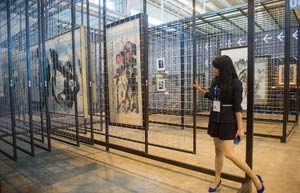
Glistening white mammoth tusks stretched from spotlighted pedestals around the convention hall. Intricate Buddhas, mythological figures, maidens and wildlife emerged from the enormous specimens. More than 300 pieces appeared on display.
Chu talked at length about his artistic devotion, a passion that he first cultivated by supporting himself with charcoal portraits of passersby on the streets of South China's Guangdong province.
He moved to Hong Kong in 1981. A tough job market welcomed him. Unable to find work as a painter, he opted for an apprenticeship with an ivory carving factory. At the time, Hong Kong was the epicenter of the ivory trade. But global opposition to the ivory business was slowly mounting.
By 1988, Chu had established the Xinyi Oriental Arts & Crafts Factory in Maoming, Guangdong. The CITES ban began at the end of the following year. Chu's mentor closed shop in Hong Kong. A rapidly contracting industry forced many veteran carvers to find new careers.
"The ban was a huge blow to me," Chu says. He experimented with alternatives to elephant ivory. "I even carved out of ox bone, but only for a short time. Everybody was trying something new after the ban." He also experimented with hippo teeth and walrus tusks.
Chu first tried mammoth ivory soon after the ban. Initially, he was not impressed with the material. The prehistoric tusks are hard, fragile, and difficult as well as expensive to obtain in pristine condition. Carving them also required buying bulk quantities of lesser-grade tusks that resulted in a lot of wasted material.
When he eventually took to mammoth ivory, he found that the market had become more receptive to the material. Some overseas customers even encouraged him to experiment with new designs, and his projects became more daring. Now he focuses on two or three large pieces each year.
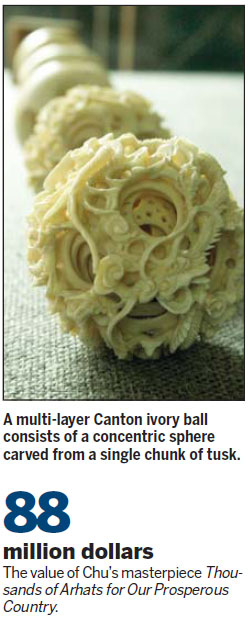
One of his largest works is Thousands of Arhats for Our Prosperous Country, the centerpiece of his Hong Kong exhibition. An "Arhat" is an enlightened individual in Buddhism; each Arhat has a different expression carved on his face. The 500-kilogram, 4.65-meter carving took more than a decade for Chu and a select team of craftsmen to finish. He claims it is worth an estimated 540 million yuan ($88 million).
According to Chu, only 10-15 years worth of mammoth ivory remains underground.
Chu's ornate style falls into the southern style of ivory carving. The style is synonymous with impossibly intricate details perfected in old Canton.
The Canton ivory ball - a design sometimes called "demon's work" - is possibly the southern style's most famous achievement. The design consists of a concentric sphere carved from a single chunk of tusk.
 |
 |
|
|
Putting heart into the art |

Copyright 1995 - . All rights reserved. The content (including but not limited to text, photo, multimedia information, etc) published in this site belongs to China Daily Information Co (CDIC). Without written authorization from CDIC, such content shall not be republished or used in any form. Note: Browsers with 1024*768 or higher resolution are suggested for this site.
License for publishing multimedia online 0108263 Registration Number: 20100000002731