|
 |
|
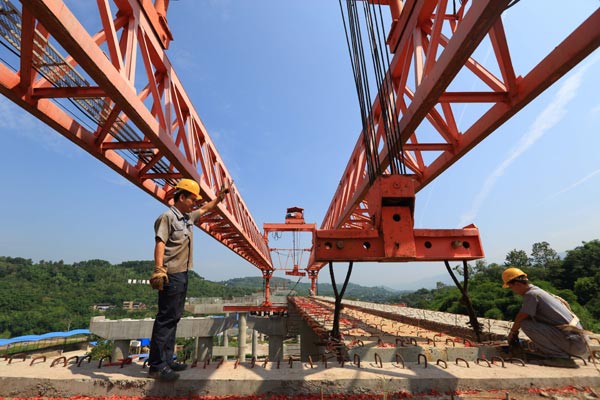
Construction workers complete a bridge project on the Chongqing-Guang'an highway on Thursday. Work on the 79-kilometer roadway is progressing steadily and is expected to be finished by the end of 2016. [Photo/China Daily] |
China's top legislature has adopted a revised Budget Law on Sunday to put government income and spending into a more stringent legal constraint, a move that is set to have a far-reaching effect on the country's fiscal balance and health.
The revision of the law, which is so important that it's dubbed the "Economic Constitution", will prove a milestone in China's fiscal history as it will make the government's collection of taxes and fees and distribution of its fiscal money to become more law-based and transparent.
Previously, the country's revenues and spending were in reality divided into budgetary and extra-budgetary. Under such a dual-structure budgetary regime, some government departments have a great leeway in managing government funds, which can possibly lead to corruption and abuse of public fund.
The revised law requires that all types of fiscal money should be put under the unified budgetary system and detailed budget information, including that of the central government, the local governments and government departments, must be publicized to invite public supervision.
Previously, budget information provided by some government departments was often too vague for legislators and the public to supervise the management of fiscal funds by the government. For example, during the annual National People's Congress meetings, many deputies complained that some government ministries only provided overall figures of their spending instead of detailed and categorized information, which made it virtually impossible for them to play out their supervisory role.
In 2014, China's fiscal revenue is budgeted to be 13.9 trillion yuan ($2.26 trillion) and government spending to be more than 15 trillion yuan. The revised law will play a better role in ensuring that such a colossal amount of money will be managed effectively so that taxes and fees are not willfully collected and public money not randomly spent.
Another ramification of the revision of the budget law is its clear control of government debt issuance. It has allowed the local governments to issue debts themselves, but the issuance must be put under strict control by the legislature and the central government.
So far, the local governments have to issue debts through the central government. To meet their demand for cash, which is used to build infrastructure and make other investments to expand local economic output, the local governments have established various companies and entities — the so-called local financing vehicles — to borrow from the banks. In many cases, the local governments act as providers of guarantee for those borrowings, which brews great financial risks for public finance.
China's local government debts have amounted to about 12 trillion yuan by the middle of last year, according to official estimates. Estimates by economists could be even bigger.
The local governments are shouldering a heavy burden of repaying those debts, especially as a large part of them become mature this year and in the coming two and three years. Lapse in managing the debts may lead to defaults and trigger a wider-range crisis.
By allowing the local governments to issue debts, the revised law also requires that the issuance must be put under control by legislators and the central government so that the issued local debts are repayable based on the revenue generating abilities of those local governments.
After the debt-issuing tap turned on, an imminent task is to clear the large amounts of government financing vehicles and cut the links between the local governments and those companies. Such financing vehicles brew serious financial risks since they are de facto cash-generating tools of the local governments. They are neither market-based nor under strict supervision like normal State-owned enterprises.
China revises law to better manage government money
Allowing local debt issues to promote finance and tax system
Local debt probe 'to release findings'
Local debt crisis not likely in China

Copyright 1995 - . All rights reserved. The content (including but not limited to text, photo, multimedia information, etc) published in this site belongs to China Daily Information Co (CDIC). Without written authorization from CDIC, such content shall not be republished or used in any form. Note: Browsers with 1024*768 or higher resolution are suggested for this site.
License for publishing multimedia online 0108263 Registration Number: 20100000002731