 |
|
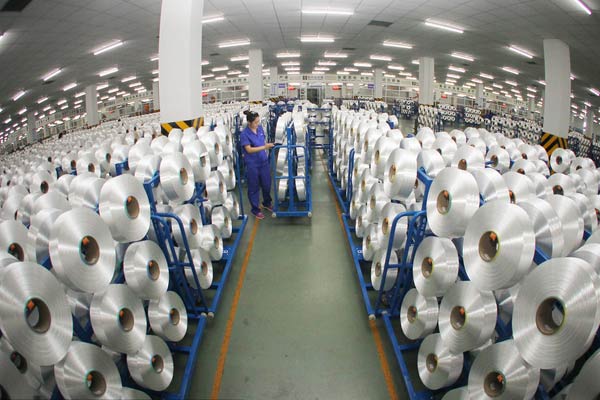
A worker conducting routine checks at a spinning workshop of Hengli Group in Nantong, Jiangsu province. The latest social responsibility report issued by the China National Textile and Apparel Council focuses on the new normal state, in terms of environment, confronting the industry's transformation and fulfilling of its social responsibilities. Provided to China Daily |
Apparel industry makes significant advances in clean, green campaigns
Many labor-intensive manufacturing industries in China have declined with the country's economic slowdown. But China's textile and apparel industry is determined to resist the trend by becoming more efficient, innovative and environmentally friendly, according to the industry's 2013-2014 social responsibility report.
The growth in sales and exports of China's textiles and apparel industry from January to July decelerated by 1.5 percentage points and 1.2 percentage points, respectively. But the industry's net profit in the first seven months hit 58.69 billion yuan ($9.83 billion), up 14.29 percent year-on-year. The profit ratio of sales was 5.28 percent from January to July, 0.2 percentage points higher than the same period last year.
"The current decrease in sales is not the same cyclical decline as before, but a new normal state. The new situation means the industry must take the initiative to adapt to changes and make breakthroughs to realize stable growth," Chen Dapeng, vice-chairman of the China National Textile and Apparel Council, said when the council published the report in Beijing recently.
The 2013-2014 report focuses on the new normal state in terms of the environment, product safety, human resources, fair competition and international trade that the industry confronts amid economic transformation while fulfilling its social responsibilities.
ASEAN (Association of Southeast Asian Nations) members replaced Japan as the third-largest market for China's textile and apparel products last year after the European Union and the United States. And the gap between ASEAN and the two leading markets is shrinking fast.
"The enterprises must develop core competitiveness in research and development, design, production, management and marketing. The old, scale-based strategies and homogenous competition are doomed to fail in the new normal state," Chen said.
Last year, China implemented binding environmental protection codes and higher standards on wastewater and waste gas discharged from reeling, wool and flax spinning, dyeing and printing enterprises.
Textile and apparel enterprises must make more transparent their use of 51 textile dyestuffs and 17 dye auxiliaries, which were added to a list of dangerous chemicals in response to media exposure of apparel safety issues. This change is aimed at forcing the companies to make their products safer and more environmentally friendly.
The council has published the textile and apparel industry's social responsibility report annually since 2006, when the report was regarded by many as a "trade barrier" imposed on Chinese enterprises by the West.
"Today, social responsibility and sustainable development are not only musts for enterprises but also principles of China's national development strategy and governance," said Wang Tiankai, chairman of the council. "Social responsibility is now a core element of enterprises' quality and competitiveness in the global market."
A new form of social responsibility report in the textile and apparel industry in China is based on a group of enterprises in a county. Since 2009, Pinghu, in Zhejiang province, has published its annual report for countywide industry. It serves to unite an otherwise slack industrial cluster and as well as improving efficiency and raising social responsibility awareness.
Thanks to the council's efforts, 64 Chinese textile and apparel enterprises have published 171 social responsibility reports, among which 58 were published through the council. In fact, the textile and apparel industry has published the most of such reports out of all manufacturing sectors over the past five years.
 |
 |
|
|

Copyright 1995 - . All rights reserved. The content (including but not limited to text, photo, multimedia information, etc) published in this site belongs to China Daily Information Co (CDIC). Without written authorization from CDIC, such content shall not be republished or used in any form. Note: Browsers with 1024*768 or higher resolution are suggested for this site.
License for publishing multimedia online 0108263 Registration Number: 20100000002731