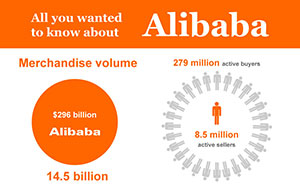
After its initial public offering (IPO) on New York Stock Exchange, Alibaba is expected to become the third-biggest Internet company listed in the United States in terms of market value. Although Alibaba's IPO is expected to fetch between $154 billion to $169 billion and could turn out to be the largest of its kind in US history, many Chinese might be asking a question: Why did Alibaba founder Jack Ma seek to list on the NYSE rather than seeking A-shares on the Chinese mainland?
A lot of Chinese could also be asking: Why other Chinese Internet giants such as Tencent, Baidu and JD.com have chosen to list overseas despite making it big due to domestic customers? Have they been unfair to their clients, the domestic stock market and the national economy?
Yes and no. Since Alibaba is registered in the Cayman Islands as a foreign company, China's current stock market policies are not in favor of its listing on the country's bourse. To get listed in China, Alibaba has to redesign its preparatory plan to accommodate the auditing standards of the country - a very costly affair - apart from paying huge amounts in taxes. Plus, it will have to spend a considerable amount to transfer its overseas rights and interests to China to fulfill the numerous legal requirements to abolish and terminate previous agreements.
Like many Chinese Internet companies, Alibaba relies on a legal structure known as a variable interest entity (or VIE), which allows it to bypass the Chinese government's restrictions on foreign ownership of businesses in certain sectors, including information technology. So, it would have been very difficult - legally as well as financially - for Alibaba to "re-register" in China, which is mandatory for any company seeking listing on Shanghai or Shenzhen stock exchange.
Besides, to retain the decision-making powers in Alibaba, Ma and other top executives could look to only New York to launch the IPO. For the moment, Ma and his partners, who are authorized to nominate most of Alibaba's board members, own only 10 percent of the company's shares - 7 percent of which belongs to Ma. With the Hong Kong Stock Exchange refusing to allow a company with dual-class structure to be listed, Alibaba had no choice but to go to the NYSE. Also, the US stock market - because of its strict regulations, sound supervision and the system of class action - is more conducive to Alibaba's further growth.
Given the not-so-market-savvy management of the A-share market, it is not surprising that Ma did not choose Shanghai or Shenzhen to launch the IPO. According to the licensing system of the A-share market, most Chinese IT companies, including Tencent and JD.com in their initiative years, were not qualified for listing going by their profit margins, growth and assets size. Moreover, an A-share listed company's refinancing avenues are strictly limited and expensive, whereas a US-listed enterprise continues to enjoy a wide range of financing options.
Perhaps worse, the China Securities Regulatory Commission has been overcautious in managing the domestic stock market, especially when it comes to approving IPOs. Quite a few large private companies in China are not even close to getting listed despite being in business for years and investing huge amounts of capital. For an Internet giant like Alibaba, which requires massive financing, it would have been even more difficult to fight over the IPO under current market policies.
Alibaba's listing in New York somehow reflects that China's stock market is no longer suited to meet the demands of the country's economic growth. Essentially, the auditing system for listed Chinese enterprises, which controls companies' entry to the stock market, is nothing but a means to ensure the survival of the weakest. Also, by seeming to lose the grip on advanced technologies and changing business modes, the CSRC-led auditing system creates a big problem for investors and enterprises alike. And it is because of such restrictions that an increasing number of companies from emerging industries have to plan their listing overseas, leading to considerable financial loss and public rage.
Therefore, the CSRC has to work out an auditing system that would allow the market to decide which companies could be listed in China. In fact, this should be the CSRC's principal urgent task, because as administrative supervisor of the market, it is supposed to focus on law enforcement, and not decide the fate of companies and bourses.
The author is a professor at the School of International Trade and Economics, University of International Business and Economics, Beijing.
 |
 |
|
|
Alibaba options expected to be listed on Sept 29: exchanges |

Copyright 1995 - . All rights reserved. The content (including but not limited to text, photo, multimedia information, etc) published in this site belongs to China Daily Information Co (CDIC). Without written authorization from CDIC, such content shall not be republished or used in any form. Note: Browsers with 1024*768 or higher resolution are suggested for this site.
License for publishing multimedia online 0108263 Registration Number: 20100000002731