 |
|
Provided to China Daily |
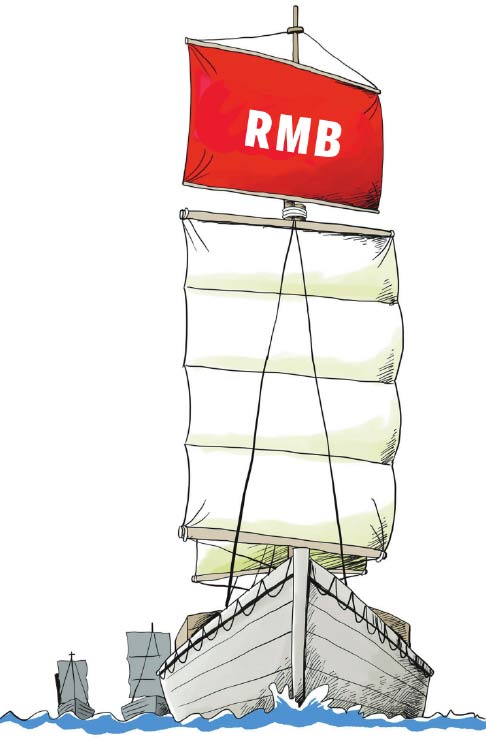
Since June this year, the People's Bank of China, the central bank, has designated yuan clearing banks in London, Frankfurt, Seoul, Paris, Luxembourg, Doha, Toronto and Sydney.
It has also signed bilateral currency swap agreements worth more than 3 trillion yuan ($488 billion) with 28 central banks and monetary authorities, Hu Xiaolian, deputy governor of the People's Bank of China, told the Caijing Annual Conference 2015 on Nov 27.
Hu said cross-border yuan settlement totaled almost 8 trillion yuan from January to October 2014, up from 3.58 billion yuan in 2009.
According to the Society for Worldwide Interbank Financial Telecommunication, over the past two years, international renminbi payments between offshore trading centers excluding the Chinese mainland and Hong Kong have grown by 837 percent in value.
Overall, the yuan has now strengthened its position as the seventh-ranked global payments currency and accounted for 1.72 percent of global payments.
In September, the value of yuan global payments increased by 13.2 percent, well above the average 8.1 percent growth for all currencies, SWIFT said.
"Payments, FX and trade finance are the markers to watch for growth in yuan internationalization," said Alex Medana, director of Asia-Pacific Securities Markets at SWIFT.
"The yuan is primarily used as a trade settlement currency, but it is worth noting that it is steadily making progress as an investment currency. In the first nine months of 2014, 28 percent of securities settlement confirmations in renminbi were done outside of the Chinese mainland and Hong Kong, compared to 16 percent during the same period two years ago."
This rapid development of the offshore renminbi market does entail a degree of risk, however, especially at a time of transformation in China's financial system.
That risk can be broadly divided into two types: market development risks, and financial stability risks, the International Monetary Fund said in a recent report.
It said, for instance, the Chinese financial market cannot sustain huge reflows of capital in yuan due to a lack of market depth and diversified products.
Short-term foreign capital inflows are also likely to bring more shocks to asset prices.
Zhang Zhiwei, chief China economist and head of China equity strategy at Deutsche Bank, says one of the most notable issues along the road to renminbi internationalization is capital account liberalization, which could lead to more volatility in capital flows.
However, "the risk can be managed and there are many tools to deal with it", Zhang says.
"The government can introduce prudence measures if volatility is too high and there may be discretionary measures to counter capital outflows.
"For instance, if there is too much outflow, authorities can lift the quota on the inflow side and allow long-term investors to invest in China's onshore market."
Zhang says next year the currency is expected to remain stable, although "with some two-way volatility".
"In offshore yuan centers and the China (Shanghai) Free Trade Zone, we expect to see rapid deposit growth and more financial infrastructure developments. The development of South Korea as another yuan offshore center will take place and we expect rapid progress there."
Song Ke, a research fellow at the International Monetary Institute at Renmin University of China, says the risks are not big at present because China is still promoting the internationalization of the yuan mainly in terms of trade settlement and laying the ground rules, such as establishing clearing banks and currency swap mechanisms.
"Risk can be prevented as long as China steadily rolls out reforms to liberalize its capital account," Song says, adding that he expects China to accelerate its opening up of capital account moderately over the next few years.
"Apart from signing more agreements on renminbi clearing and settlement, China is likely to increase quotas of the Qualified Foreign Institutional Investor scheme and the Shanghai-Hong Kong Stock Connect program," he says.
"It might also establish a bilateral mechanism similar to the Shanghai-Hong Kong Stock Connect with Singapore."

Copyright 1995 - . All rights reserved. The content (including but not limited to text, photo, multimedia information, etc) published in this site belongs to China Daily Information Co (CDIC). Without written authorization from CDIC, such content shall not be republished or used in any form. Note: Browsers with 1024*768 or higher resolution are suggested for this site.
License for publishing multimedia online 0108263 Registration Number: 130349