 |
|
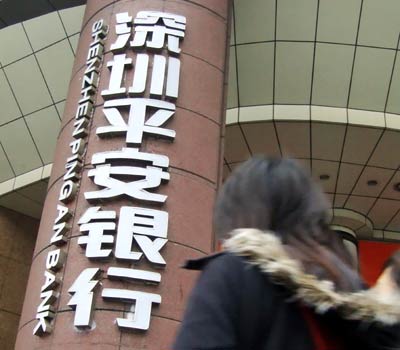
A customer walks past a Shenzhen Ping An Bank branch in Beijing. During the first 11 months of this year, new deposits of Chinese lenders were 23 percent lower than last year. [Provided to China Daily] |
Lenders in China, desperate to attract customers who are finding alternatives for their savings, are turning to giveaways. On offer at one branch in Beijing: An iPhone 6 Plus or a Mercedes-Benz.
Cash rebates, trips abroad, interest rates at the highest premium ever over the official benchmark rate, even free vegetables are among other goodies banks are dangling to get Chinese savers to deposit their yuan in savings accounts. The competition is expensive.
"Chinese banks are hemorrhaging their deposits," says Rainy Yuan, a Shanghai-based analyst at brokerage Masterlink Securities Corp. "There is no fix for this. All the efforts they made to win savers back will only push up the costs, so it's a losing battle to fight."
Higher returns from Internet funds and investment products such as trusts, combined with the promise of a soaring stock market, have China's banks feeling the drain. They lost 950 billion yuan ($153 billion) of deposits in the three months through September, the first quarterly drop since 1999. In the first 11 months, new deposits were 23 percent lower than in the same period last year, People's Bank of China data show.
The iPhone promotion, by Shenzhen-based Ping An Bank Co in October at a branch in Beijing, offered a 128-gigabyte iPhone 6 Plus in lieu of interest payments for depositing 38,000 yuan for five years. For parking 903,000 yuan for the same period, savers could pick one of four Mercedes-Benz models. A Mercedes A180, which costs 252,000 yuan, would give investors the equivalent of an annualized return of almost 7 percent, compared with the benchmark rate of 4 percent on five-year deposits.
The China Banking Regulatory Commission in September banned what it called "illicit" deposit-gathering practices, including gifts and rebates on deposits. Banks that flout the curbs could face punishment, the regulator said, without clarifying whether product giveaways in lieu of interest payments qualify as gifts.
China's investors have been pouring money into online money-market funds offered by the likes of Alibaba Group Holding Ltd and Baidu Inc. Yu'ebao, pioneered last year by Alibaba affiliate Alipay, drew 535 billion yuan in its first 15 months of existence from 149 million customers, more than the populations of France and the United Kingdom combined.
Users simply tapped a few buttons on their mobile phones to secure an annual rate of return that soared as high as 6.8 percent before falling to about 4 percent recently.
Meanwhile, households put 12.9 trillion yuan into high yield trust products as of Sept 30, making them the fastest-growing segment of what China defines as shadow banking, or financial activity outside the banking system. Trusts, which allow individuals to invest in real estate and other projects for returns of more than 10 percent, saw assets under management surge more than 10-fold since the start of 2009.
The Shanghai Composite Index's 43 percent surge over the past six months also has savers plunging into equities. In the first week of December, Chinese investors opened almost 600,000 stock-trading accounts, a 62 percent increase over the previous week, according to China Securities Depository and Clearing Co.
To stimulate the economy, the central bank on Nov 21 announced a cut in benchmark interest rates for the first time in more than two years, to 2.75 percent from 3 percent on one year deposits. At the same time, the maximum interest rate banks can pay customers was raised to 20 percent over the benchmark from 10 percent, allowing lenders the biggest leeway to set their own rates in modern Chinese history.
Ping An Bank, China CITIC Bank Corp and Bank of Ningbo Co immediately alerted customers through text messages that they would offer the highest interest rates allowed, or 3.3 percent.
While Beijing-based Industrial & Commercial Bank of China Ltd and its four closest State-controlled peers first decided to pay 3 percent, their plan lasted just two weeks. Some branches in major cities, including Shanghai and Beijing, then boosted one-year deposit rates to the 3.3 percent ceiling.
Zhou Xiaochuan, the central bank governor, had in March pledged to deregulate interest rates fully in one or two years. Moves toward that goal are eroding the cheap deposit base that has for decades helped buoy Chinese banks' profits. Rates fixed by the government created a spread of about 3 percentage points between savings and lending rates. The benchmark one-year lending rate was cut to 5.6 percent in November.
Mid-size and regional lenders will be most affected because unlike State-controlled banks, they lack extensive branch networks to lure retail customers and have to rely on more expensive and volatile funding from wealth-management products, company deposits and interbank borrowings, says Liao Qiang, the Beijing-based director of Standard & Poor's.
"The battle for deposits will only get worse as China moves ahead with interest-rate liberalization, which will drive up banks' funding costs and hurt profit," Liao says.

Copyright 1995 - . All rights reserved. The content (including but not limited to text, photo, multimedia information, etc) published in this site belongs to China Daily Information Co (CDIC). Without written authorization from CDIC, such content shall not be republished or used in any form. Note: Browsers with 1024*768 or higher resolution are suggested for this site.
License for publishing multimedia online 0108263 Registration Number: 130349