Internet financing platforms make hay as hinterland market grows and opens up
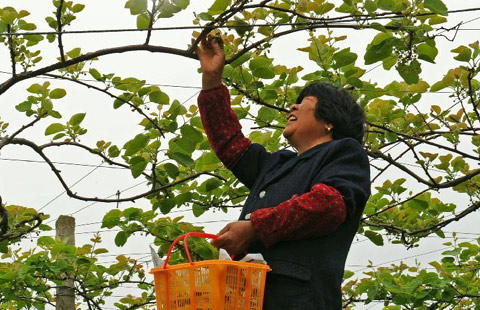
Han Peng, a farmer from Yangyuan county, Gansu province, had never heard of online financing or peer-to-peer platforms till the day he happened to walk into one.
Like most of his peers, Han was finding it hard to make a living from farming alone and was supplementing his income by selling fruit on the streets. To compound his woes, he was struggling to find enough money to expand his business.
In September 2009, Han applied for a loan of 20,000 yuan ($3,204) from CreditEase, a leading Chinese P2P lending and wealth management company, for business expansion.
P2P platforms differ from others, in that they lend money to unrelated individuals, or peers, without using a traditional financial intermediary such as a bank.
That marked a turning point for Han. After repaying the loan, he borrowed another 20,000 yuan from the platform to further expand his business. Currently, Han owns a 90-square-meter store and his fruit business has prospered.
"The timely support that I got from the Internet platform has helped sustain my family and business. There is no doubt that I would recommend it to other families also," said Han.
Tang Ning, CEO of CreditEase Corp, said: "Rural areas are strategically important avenues for us to expand our business and to provide diversified financial services. We are looking to set up an exclusive cloud-based rural financing platform with 1,000 service outlets in rural areas over the next five years."
Chen Huan, chief strategy officer of CreditEase, said the platform would utilize the data gained from the past five years through spot investigations and analysis, and use big data technology to perfect the credit capabilities of farmers and risk control. "Needless to say, our endeavors will be to rope in as many peers as possible," he said.
Chen said that its studies in Gansu province revealed that about 70 percent of the people in rural areas use smartphones. "This shows that the foundation for Internet finance is already there."
Since it started tapping the rural areas in China from 2009, CreditEase has set up service outlets in Gansu, Shaanxi, Yunnan, Sichuan provinces and Inner Mongolia autonomous region. The cumulative lending through the CreditEase platform in China's rural areas has reached more than 900 million yuan.
Besides small loans, CreditEase also conducts leasing operations to help farmers access high-quality agricultural equipment.
Another Chinese P2P company, Beijing Tongcheng Eloancn Network Co Ltd, is also banking on "agriculture, farmers and rural areas". It primarily provides individual unsecured loans to farmers in grassroots villages and towns to satisfy their fund requirements for planting, breeding and crop management.
Mao Xiangqian, CEO of Beijing Tongcheng Eloancn Network Co Ltd, said: "This year, we expect to cover at least 70 percent of the counties in China through our original 'city O2O' (online to offline) mode and expect transaction volumes to exceed 10 billion yuan."
Eloancn covered 500 counties in 2014 and the transaction volume last year was about 2.1 billion yuan, reaching more than 35,000 farmers. The maximum amount disbursed by the platform was about 60,000 yuan.
The "city O2O" model of Eloancn hinges on close cooperation with local partners. The initial fee for each local partner at the city level is 2 million yuan, and that at county level is 500,000 yuan.
"We chose this mode because it is difficult to find credit information of farmers, and local partners know their information well and are good at dealing with them," said Mao.
The local partners evaluate the loan repayment capability and willingness of farmers and record their data on the Eloancn system, subsequent to which the lending decision would be made. The normal annual lending rate is about 24 percent and that for lenders is about 19 percent.
Local partners are also responsible for management of the loan. If a loan with more than 30 days is overdue, local partners will have to pay the lenders first and the funds will come from their initial fees to Eloancn.
Mao said that though the rural Internet finance market is huge, it is not easy to do business.
"Risks involving local partners are the biggest challenge for us and we are carrying out a series of measures to prevent them, such as using telephone follow-ups and big data technology, " said Mao.
According to data from wangdaizhijia, a portal offering Internet lending information, there were 1,575 Internet lending companies in China by the end of 2014. However, only a few of them such as Eloancn and CreditEase did business in the rural areas.
Although traditional financial institutions have made similar efforts in rural areas, more than 70 percent of rural loan applications could not be approved.
A key constraint is that credit information of most farmers cannot be found in the credit information system of the People's Bank of China, and many farmers also do not have collaterals, said Xinhuanet.com.

Copyright 1995 - . All rights reserved. The content (including but not limited to text, photo, multimedia information, etc) published in this site belongs to China Daily Information Co (CDIC). Without written authorization from CDIC, such content shall not be republished or used in any form. Note: Browsers with 1024*768 or higher resolution are suggested for this site.
License for publishing multimedia online 0108263 Registration Number: 130349