China's imports of soybeans will continue to grow in the coming decade because of limited farmland and a rising population.
An official report on Monday showed that China, the world's largest soybean importer, is forecast to import 82.66 million metric tons of soybeans by 2024, up 15.8 percent from 2014. At the same time, consumption of soybeans will rise 12.7 percent in 2015 to 96.71 million tons by 2024, according to the China Agriculture Outlook 2015-24.
Experts said that limited farmland and a rising population would force China to seek more soybean imports from Brazil, Argentina and the United States.
Ding Lixin, a researcher at the Chinese Academy of Agricultural Sciences in Beijing, said that the country was still well placed to meet its needs in soybeans, rapeseed and sorghum through imports to produce edible oil and animal feed.
While imports of soybeans will rise, staples such as corn will remain steady. Corn imports are unlikely to surpass 7.2 million tons in 2024 due to quota restrictions. But corn consumption in the next decade will continue to increase with an annual growth rate of 3.1 percent, the report said.
These estimates came after the US Department of Agriculture cut its import estimates to 7.2 million tons from China because of the rising stockpiles which have supported domestic prices, damping demand for overseas supplies.
Ding said that China is determined to keep staple grain output at 97 percent which will slow demand for imported products. "The country also plans to introduce potatoes into its list of staples to diversify the category," he said.
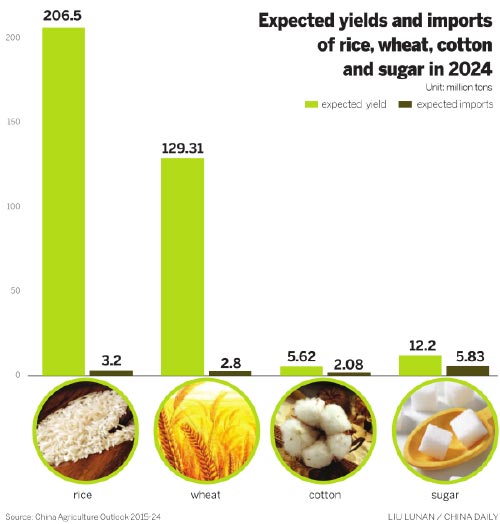
Wheat imports will climb up to 2.8 million tons from 1 million in 2014. Cotton imports in 2024 are estimated at 2.08 million tons, down 14.8 percent from 2014, because of lower Chinese textile exports and a greater use of cotton substitutes, the report said.
Dairy imports are also expected to grow 3 percent a year during the coming decade to 16 million tons. This is lower than the average of 15.5 percent growth during the past decade as a result of increased production at home, the report said.
Imports of pork, lamb and beef are likely to slow by 2024 compared with the past decade as the growth in meat consumption declines. This will restrict pork imports to less than 1 million tons a year by 2024, while those of beef and lamb will be less than 500,000 tons each.
"The stable growth of China's agricultural output and rising national incomes have provided diversified access to food with a higher protein content and better taste," Ding said.
Changes in food consumption also reflect greater economic vitality. Urbanization and an upwardly mobile population are key elements that have shifted Chinese diets from being mostly grain-based to ones that include more meat and dairy products.

Copyright 1995 - . All rights reserved. The content (including but not limited to text, photo, multimedia information, etc) published in this site belongs to China Daily Information Co (CDIC). Without written authorization from CDIC, such content shall not be republished or used in any form. Note: Browsers with 1024*768 or higher resolution are suggested for this site.
License for publishing multimedia online 0108263 Registration Number: 130349