 |
|
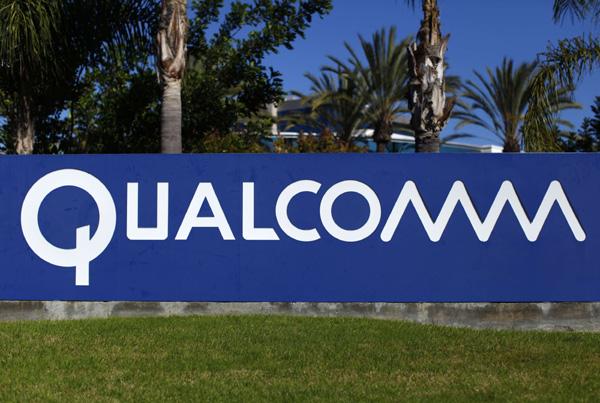
A Qualcomm sign is pictured in front of one of its many buildings in San Diego, California November 5, 2014. Qualcomm Incorporated, the world's largest chipmaker was fined 6.08 billion yuan ($975 million) in China for violating the country's Anti-Monopoly Law. [Photo/Agencies] |
Official: Balance needed between patent protection and monopolistic practices
The National Development and Reform Commission, one of the three agencies that deal with antitrust activity and investigations, is drawing up guidelines covering monopolistic conduct and the abuse of intellectual property rights, an official involved in the effort said on Thursday.
The Anti-Monopoly Committee of the State Council, the top antitrust supervisor, has ordered the NDRC to draw up the draft guidelines within one year, said the official, who attended the first preparatory meeting held on Wednesday.
The guidelines will affect IPR products and service providers, a broad group that includes the information technology and telecommunications industries, the medical sector, vehicles, machinery and seeds for the agriculture sector and other technology-intensive activities.
In April, the State Administration of Industry of Commerce, one of the three regulators, announced a set of rules collectively called the Prohibition of Abuse of IPR to Eliminate or Restrict Competition, which will take effect on Aug 1.
China's Anti-Monopoly Law is enforced by three agencies: the Ministry of Commerce handles merger provisions and the SAIC focuses on non-price-related activity, while the NDRC takes on pricing monopolies.
The NDRC's guidelines will carry the authority of the cabinet's Anti-Monopoly Committee, which will represent the three antitrust regulators. The SAIC's new rules will serve as the basis for those guidelines, said the NDRC official who requested anonymity.
"Patent protection is important for promoting innovation, but the abusive use of IPR is rampant worldwide. Meanwhile, excessive antitrust enforcement may also hurt innovation. It's important to strike a balance," he said.
Jessica Su, an antitrust scholar and associate professor at the Institute of American Studies at the Chinese Academy of Social Sciences, said the SAIC's rules address only the non-price-related abuse of IPR.
The NDRC's guidelines are expected to cover three major types of monopolistic conduct: IPR-related monopoly agreements, abuse of dominant market positions and business concentration. The latter occurs when a few companies overwhelmingly dominate an industry or activity.
China has stepped up its antitrust law enforcement in the past two years and many of the cases have been related to the abuse of IPR. The NDRC has been actively investigating antitrust cases in the IPR field over the past few years, including the investigations into InterDigital Inc and chipmaker Qualcomm Inc. The SAIC's antitrust investigations into Microsoft Corp also fall into this category.
Steve Harris, Washington-based partner of Winston & Strawn LLP, a global law firm, said that the intersection of antitrust regulations and IPR is a complex and controversial issue, not only in China but around the world.
According to Harris, the SAIC rules are in some ways consistent with the approaches taken to certain issues by antitrust agencies in some other large economies, but in a number of important respects, the rules differ in ways that raise serious concerns about the extent to which China's Anti-Monopoly Law may be used to lessen protections that patents and other IPR receive in most leading jurisdictions.
Antitrust laws have been implemented for many years in developed countries, and regulators in China could use other countries' experience as a guide, said Su.
As for the issue of multiple regulators, Zhu Jingwen, a Hong-Kong based partner of Winston & Strawn, said: "The jurisdiction issue once again goes back to the long-debated question of whether China's three antitrust enforcement agencies should merge into a single agency that would apply a singe uniform set of rules."

Copyright 1995 - . All rights reserved. The content (including but not limited to text, photo, multimedia information, etc) published in this site belongs to China Daily Information Co (CDIC). Without written authorization from CDIC, such content shall not be republished or used in any form. Note: Browsers with 1024*768 or higher resolution are suggested for this site.
License for publishing multimedia online 0108263 Registration Number: 130349