 |
|
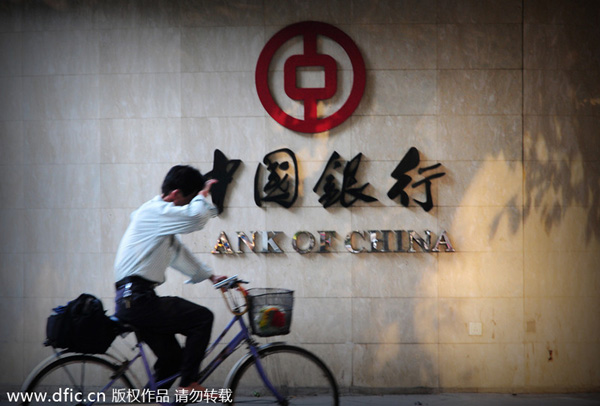
A man rides in front of a Bank of China branch in Fuzhou, Fujian province, July 10, 2013. [Photo/IC] |
The hullabaloo from Chinese Internet users about newly published salary statistics is fairly predictable as only the average numbers are given without giving the median.
Latest figures show that Beijing tops the list of salaries among the 20 provinces and municipal cities that have recently published their income statistics, with average annual pay of 77,560 yuan ($12,510) in 2014.
More eye-catching is that the average annual salary of urban public employees in Beijing exceeded the threshold of 100,000 yuan for the first time last year, symbolizing the fruits of China's remarkable economic growth over more than three decades.
However, many netizens claim they have been misrepresented by the average salary levels, and suggest the statistics have either been deliberately inflated or they have been left behind as incomes have risen across the country.
Given that the majority of Chinese netizens are younger workers, it is perhaps not that surprising that many of them earn a salary less than the average.
Nevertheless, while their complaints about the higher than expected average salaries may be misplaced, their worries about the country's income inequality may well be justified given the absent median numbers.
Usually, the median salary refers to the salary of the employee standing right in the middle of all surveyed workers who are ranked from low to high based on their salary level. It will not be inflated by the big salary increases for the few super rich that can easily boost the average income level to create an illusion that a rising tide lifts all boats.
Statistics officials have often cited technical difficulties to explain why they cannot provide the median salary level. So some people will continue to complain that their salary is not as high as the published statistics indicate and they are "dragging the average salary down".
Chinese policymakers may not need to take such ritual exchange of words too seriously, but the underlying uneven distribution of wealth that persists amid China's rapid economic growth should be a major concern.
A report by US-based research firm Boston Consulting Group states that China had four million millionaire households in 2014, the second-highest in the world after the United States, as the country's stock market boom boosted private wealth. One million new millionaires were created in the country last year, the highest increase among all nations.
Since the Chinese economy is slowing down considerably to constrain fast salary growth, such a surge in the number of super rich in China only adds to the yawning wealth gap in the world's most populous country.
It is widely believed that government efforts to substantially boost income growth for the poor, increase the number of middle-income households and rein in the growing salaries of the top earners will help promote consumption-led growth to rebalance the Chinese economy away from excessive dependence on investment and exports.
But recent reports that Foxconn Technology is in talks to manufacture Apple's iPhone in India, an ostensible attempt to mitigate accelerating wage inflation in China, where it currently makes the majority of iPhones, should also alert Chinese policymakers to the possible dire consequences of unchecked salary growth.
Instead of the median salary level that can help individuals to gauge their climb along the social ladder, it is the average income level that defines labor costs and thus competitiveness for many enterprises in this country.
Few enterprises will complain loudly over the average salary statistics as netizens have. But their responses matter a lot for the economy. Chinese policymakers should take into full account the impact of rising labor costs on businesses while taking necessary measures to address income inequality.

Copyright 1995 - . All rights reserved. The content (including but not limited to text, photo, multimedia information, etc) published in this site belongs to China Daily Information Co (CDIC). Without written authorization from CDIC, such content shall not be republished or used in any form. Note: Browsers with 1024*768 or higher resolution are suggested for this site.
License for publishing multimedia online 0108263 Registration Number: 130349