 |
|
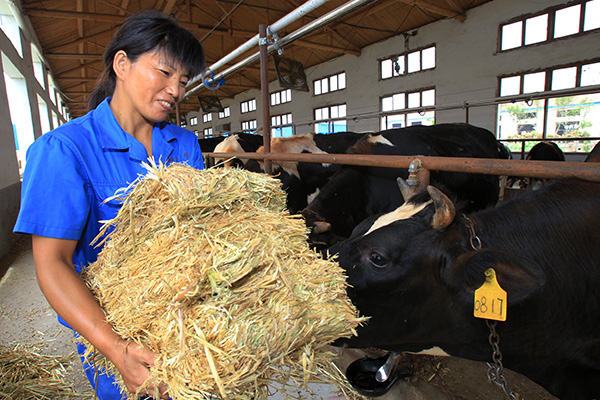
A worker feeds cows oat hay imported from Australia at dairy farm in Nantong, Jiangsu province. China imports forage from the United States, Australia and Mongolia to support its stockbreeding industry. [Photo provided to China Daily] |
Shipments have already started with eight trucks carrying 200 tons of forage reaching the Zuunkhadavchi Land Port of Xilin Gol League in North China's Inner Mongolia autonomous region on Wednesday. This is also the first time that China is importing forage from Mongolia.
Since Mongolia's eastern region is rich in stockbreeding resources, the government of Xilin Gol League signed an agreement with three Mongolian provinces-Omnogovi, Dornogovi and Suhbaatar-to import forage.
China will import 100,000 tons of forage from Mongolia by the end of this year and the annual import volume of forage is expected to exceed 400,000 tons in 2016.
Limited by its poor forage crop production, China used to import forage from the United States and Australia to support its stockbreeding industry. Rising prices of imported forage, alfalfa and corn silage have affected the nation's raw milk output in the past two years. Most of the Chinese dairy farms lack access to quality feed for their cattle and cows.
"Since most of the farmland in China is used for growing grains and vegetables, the cultivation of forage crops is far behind that of developed countries. The country largely depends on imported forage and alfalfa to supply domestic dairy and cattle farms," said Navchimaa, deputy head of Dong Ujimqin Banner of Xilin Gol League.
She said demand for milk, beef and mutton in China's western region, particularly in the Ningxia Hui and Xinjiang Uygur autonomous regions, and Qinghai and Gansu provinces, has grown in the past five years, as it is becoming more expensive to raise cattle and cows in western China, where the economy and livestock industry are less developed than in the eastern provinces.
Due to the limited grazing lands and breeding cycle, China's sheep breeding sector has also lagged behind consumer demand, resulting in higher lamb prices over the past five years, according to a report released by Beijing-based Chinese Academy of Agricultural Sciences in June.
Eager to meet domestic demand for various foodstuffs, the Chinese government has increased international trade in food products through trading arrangements such as free trade agreements or non-tariff deals for certain agricultural products with its trading partners in Central Asia, Europe and South America.
"As China has found it impossible to grow all of the food it needs and has consequently formed closer ties with its trade partners, demand for dairy products, beef and mutton will certainly provide many opportunities for forage suppliers and other agricultural businesses in Mongolia," said B Bayanmagnai, director of Mongolia's Bichigt Custom district.
Under the agreement, Xilin Gol League and Mongolia will also start horse trading in each other's land ports. The two sides plan to trade 20,000 horses next year, as well as open more market channels for breeding cattle and sheep.

Copyright 1995 - . All rights reserved. The content (including but not limited to text, photo, multimedia information, etc) published in this site belongs to China Daily Information Co (CDIC). Without written authorization from CDIC, such content shall not be republished or used in any form. Note: Browsers with 1024*768 or higher resolution are suggested for this site.
License for publishing multimedia online 0108263 Registration Number: 130349