 |
|
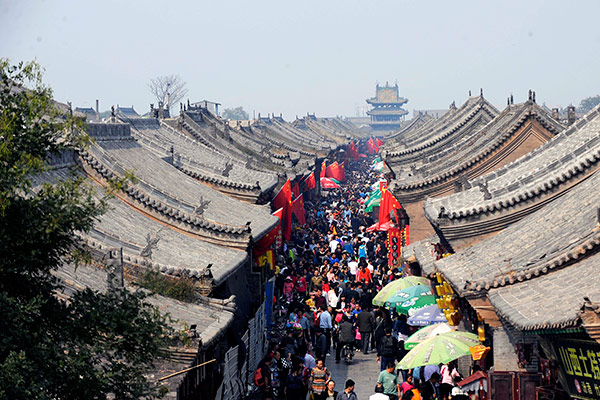
Visitors crowd into the Pingyao ancient city, in Shanxi province, during the National Day holiday.[Photo/Xinhua] |
I was surprised to find that local officials think tourism promotion could be more beneficial for the province than the extraction of highly polluting raw materials like thermal coal.
In fact, local officials told me tourism is now the engine for the province's economic growth.
That change in strategy made perfect sense as the restoration and conservation of historic sites meant that more investments were made in the province, creating local employment.
During my trip, I had the opportunity to visit the ancient city of Pingyao, one of the best-preserved ancient county in China, according to the World Heritage Committee.
I witnessed local workers' intense restoration and conservation works in the city. I noticed many of the materials and components used in their work were sourced from local industries.
I feel strongly that economic benefits from such work should not be limited to creation of jobs alone. Such work should also encompass recycling.
In the past, it was wrongly assumed that when a historic building or its structures no longer met the demands of the marketplace, it was better to tear it down and build a more efficient building on the plot.
But demolishing a historic building entails loss of cultural value as well as wastage of materials that were used to built it.
As rapid urbanization took hold over the decades, economic progress and poverty reduction were often favored over conservation of cultural heritage and environmental protection.
Like other countries, China faced a key dilemma: Whether to continue promoting rapid economic progress that could hurt its historic heritage, or opt for a sustainable development that will protect its cultural patrimony.
Sustainable development and heritage conservation are still in early stages in China. Yet, attitudes have started changing. China's new position as an economic powerhouse is bringing about a gradual change in the country's priorities.
The challenge now is to balance perfectly a healthy economic development that would include social responsibility and an environmental conscience.
The Chinese government is increasingly realizing that adapting and reusing historic sites can also increase the economic value of a district.
The positive economic impact of conservation can be easily observed in the rise in property prices in historic districts in some of China's older cities.
Property prices in districts where sites are designated historic generally appreciate at rates greater than the local market's, meaning they can be economically more competitive than non-designated areas.
Take the Beijing traditional hutongs as an example. The monthly rent of a restored courtyard house can climb to as high as 200,000 yuan ($31,600).
What's more, some of the newly restored hutong areas such as the one close to the Lama Temple in Beijing have become chic neighborhoods that are home to many boutiques and fashionable restaurants.
So, it is still possible to harness the full potential of fast-changing cities in an economically competitive manner while maintaining their cultural resources.
Although there are increasing efforts in China to promote cultural conservation, there is still a significant lack of awareness of the potential economic benefits of protecting and promoting heritage.

Copyright 1995 - . All rights reserved. The content (including but not limited to text, photo, multimedia information, etc) published in this site belongs to China Daily Information Co (CDIC). Without written authorization from CDIC, such content shall not be republished or used in any form. Note: Browsers with 1024*768 or higher resolution are suggested for this site.
License for publishing multimedia online 0108263 Registration Number: 130349