 |
|
CAI MENG/CHINA DAILY |
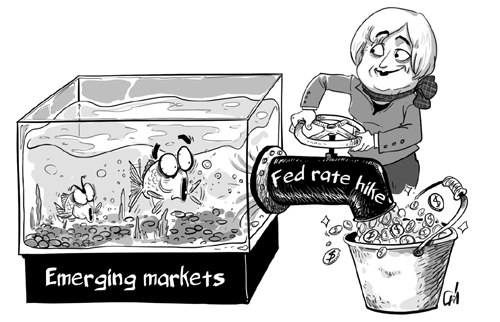
The US Federal Reserve raised interest rates by 25 basis points last week, taking the first step away from its near-zero interest rate policy. Led by its chairman Janet Yellen, the Fed sought to defuse market tensions by signaling a "gradual" pace of rate hikes to come. Yet the Dow plunged 367 points, while the S&P 500 and the Nasdaq lost 1.5 to 2 percent.
In the United States, rising rates will reward investors but increase the borrowing costs for consumers amid the earnings and revenue slump, and sluggish growth. At the Fed, concerns linger over China's growth slowdown. Besides, rate hikes will reinforce the sharp plunge of energy prices, while sending the US dollar climbing.
So, what will be the impact on China?
When the Fed began its rate hikes about a decade ago, the Chinese economy was about one-fourth of what it is today and its financial markets were largely insulated from the outside world. These privileges are now gone. Today, China is the world's second-largest economy and the renminbi has been included in the International Monetary Fund's basket of elite currencies. And despite controls, it is far more exposed to global capital flow risks.
And what about the impact of the Fed's actions on China's external trade and international investments? US critics claim that a weakening RMB will make Chinese exporters more competitive. Yet things are now a bit more complex. In the past, the mainland's growth relied on trade. Today, with the slump of world trade and the rebalancing toward consumption, net exports play a less vital role in GDP growth, while Chinese direct investment has soared internationally.
Ever since early 2014, the US dollar has strengthened relative to the RMB, which is expected to weaken over the next year as well. That is partly because of a slower 6.5 percent growth target for the 2016 to 2020 period and partly because of the Belt and Road Initiative, which implies more outward direct investment from China. In November, China's foreign reserves fell by $87 billion, though it still has $3.44 trillion in reserves.
In the short term, that means moderate weakening and occasional volatility of the RMB; in the longer term, it means strengthening of the Chinese currency's resilience.
If the Fed's rate hikes will test the endurance of China's rebalancing and its "long landing", the impact will be a lot worse in many emerging and developing economies.
Over the past three decades, the Fed's rate hikes have reduced US employment and output far more than anticipated, while causing "collateral" damage across the world. In the early 1980s, Paul Volcker, then Fed chief, resorted to harsh tightening that devastated US households. In Latin America, it resulted in a "lost decade".
Later, former Fed chief Alan Greenspan's rate hikes undermined the struggling savings and loans associations, forcing Washington and US state governments to bail out insolvent institutions. In the early 1990s, Greenspan again seized tightening but then reversed his decision, which undermined expansion. In the first case, global growth decelerated to less than 1 percent; in the second, it plunged to 4 percent below zero in developing nations.
In the 2004 to 2007 period, the rate hikes by Greenspan and his successor Ben Bernanke contributed to the Great Recession across the world. In low-income economies, growth stayed at 5 to 7 percent thanks to China's contribution to global growth.
After traditional monetary policies were exhausted, the central banks of advanced economies opted for new rounds of quantitative easing, driving "hot money" - short-term portfolio flows - into high-yield emerging markets, which had to cope with asset bubbles, elevated inflation and exchange rate appreciation.
Now US hikes will attract "hot money" outflows from emerging markets that are struggling with asset shrinkages, deflation and depreciation. In 2015, net capital flows for emerging economies will be negative for the first time since 1988.
Today, the world economy is more fragile than ever. It does not need unilateral actions with global consequences but without international accountability. What the multipolar world needs is truly global monetary cooperation.
The author is the research director of international business at the India, China and America Institute (USA) and a visiting fellow at the Shanghai Institutes for International Studies (China) and at EU Centre (Singapore).

Copyright 1995 - . All rights reserved. The content (including but not limited to text, photo, multimedia information, etc) published in this site belongs to China Daily Information Co (CDIC). Without written authorization from CDIC, such content shall not be republished or used in any form. Note: Browsers with 1024*768 or higher resolution are suggested for this site.
License for publishing multimedia online 0108263 Registration Number: 130349