 |
|
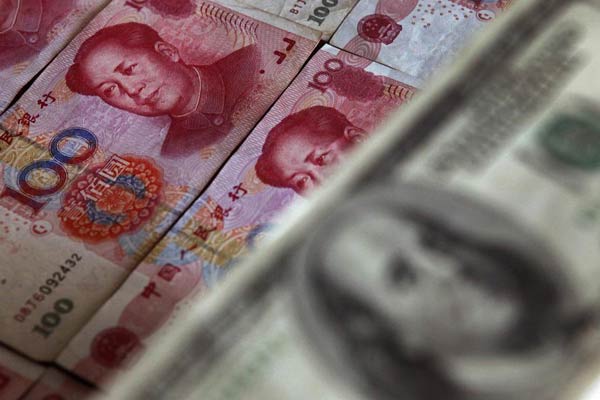
A photo illustration shows a $100 banknote placed above Chinese 100 yuan banknotes in Beijing in this May 10, 2013 file photo. [Photo/Agencies] |
WASHINGTON -- China will seek to maintain the country's currency renminbi, or the yuan, relative stable to a basket of currencies in 2016 as investors adjust to the start of a new rate hike cycle in the United States, US experts said.
The US Federal Reserve raised its benchmark interest rates to a range of 0.25 percent to 0.5 percent on Dec 16 of 2015, the first rate hike in nearly a decade, marking the end of the central bank's extraordinary monetary easing measures in response to the recent global financial crisis and the beginning of a new era of a Fed tightening cycle.
While the Fed's initial rate hike was welcomed in the United States as the central bank is confidence about the underlying strength of the world's largest economy, it poses challenges for emerging market economies like China to balance currency stability with economic growth.
The divergence of monetary policies between the US and other major economies has driven investment flows into the US and pushed the US dollar higher against most major currencies around the world.
The Fed's anticipated more rate hikes in the coming year will further increase attractiveness of the greenback and put downward pressure on emerging market currencies. The central parity rate of the RMB has weakened to the lowest in more than four years against the dollar in recent weeks.
The People's Bank of China (PBOC), China's central bank, said Monday that it will keep the RMB exchange rate basically stable at a reasonable and balanced level as it seeks to maintain a prudent monetary policy and continue the market-determined exchange rate reform.
"I think Chinese policymakers would like the environment to be stable. They don't want to have any abrupt movements in the currency that could be destabilized," Charles Collyns, managing director and chief economist at the Institute of International Finance (IIF), told Xinhua in a recent interview.
"If the market comes to think that the RMB is going to be very weak, then you could have very strong capital outflows that would require interventions by the PBOC," he said.
China's foreign exchange reserves fell by 87.2 billion dollars to 3.43 trillion in November of 2015, the lowest level since early 2013, suggesting that an exodus of capital was occurring ahead of a widely-expected Fed's rate hike on Dec. 16.
Collyns said it's "a smart move" for China to release the CFETS RMB Index, a RMB exchange rate composite index that measures the currency's value relative to a basket of other currencies, on Dec. 11, a few days before the Fed's decision to raise interest rates.
The new index, released by China Foreign Exchange Trade System (CFETS), is calculated by comparing RMB to the average value of the 13 foreign currencies, including the U.S. dollar, euro and Japanese yen, weighted according to the trade volume with China.
In explaining the reason for the index, the PBOC said it "will help guide market participants to shift their focus from the bilateral RMB/USD exchange rate to the effective exchange rate, which is based on a basket of currencies."
The PBOC noted that valuing against a basket of currencies does not mean a peg to the basket, but it "will contribute to maintaining the RMB exchange rate basically stable at an adaptive and equilibrium level."
"I think now they can argue that, look, we're managing against a basket of currencies, we're going to keep the currency broadly stable relative to the basket," Collyns said, adding that this strategy would involve a degree of depreciation against the dollar and some appreciation against other currencies like the euro and yen.
"That gives the Chinese policymakers more flexibility, because if the dollar appreciates against the euro, the RMB doesn't have to appreciate fully with the U.S. dollar," Collyns explained, warning that pegging to a strengthening dollar would cause further loss of competitiveness for China and hurt the exports.

Copyright 1995 - . All rights reserved. The content (including but not limited to text, photo, multimedia information, etc) published in this site belongs to China Daily Information Co (CDIC). Without written authorization from CDIC, such content shall not be republished or used in any form. Note: Browsers with 1024*768 or higher resolution are suggested for this site.
License for publishing multimedia online 0108263 Registration Number: 130349