 |
|
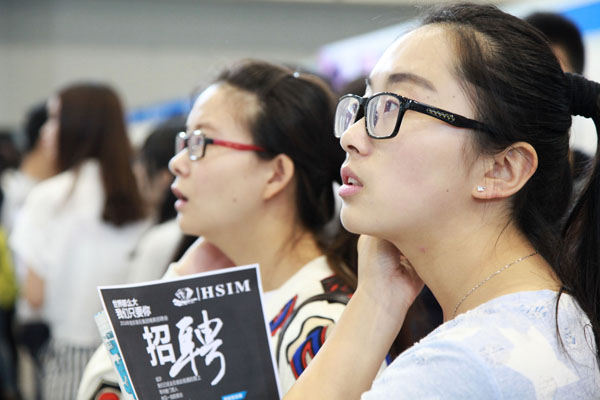
College graduates at a job fair in Nanjing, capital of East China's Jiangsu province, June 5, 2016 [Photo/VCG] |
BEIJING - Stable economic growth, continued progress in structural reform, and policies supportive of entrepreneurship and employment generation have offered new opportunities for college graduates.
A survey conducted by education research company MyCOS Institute, released on Sunday, showed that the employment rate of college graduates in 2015 was 91.7 percent, basically flat compared with 92.1 percent in 2014 and 91.4 percent in 2013.
Breaking the numbers down, 92.2 percent of university graduates and 91.2 percent of graduates from junior colleges and vocational colleges and senior high schools found jobs, according to the survey.
Some 250,000 college graduates in 30 provincial-level regions on the Chinese mainland were interviewed six months after they graduated last year.
"Generally speaking, the employment rate for Chinese college graduates remained stable," said Zheng Dongliang, dean of the Institute of Labor Science affiliated with the Ministry of Human Resources and Social Security (MHRSS).
In particular, the survey found that more graduates were starting their own businesses after graduation, with 3 percent registering startup businesses in 2015, up from 1.2 percent in 2009 and 2.9 percent in 2014.
The average monthly income of university graduates who started their own businesses was 5,131 yuan ($789), according to the survey.
The findings showed that more and more college graduates were riding the wave of the country's innovation-driven development strategy, said Zheng.
"Initiatives such as 'Made in China 2025' and 'Internet Plus' helped the development of the service sector and facilitated upgrades in traditional industries to create ample job opportunities for college graduates," he said.
China started to expand enrollment of college students in 1999 to stimulate a weak economy and ease employment pressure. In a similar program, the country encouraged postgraduate enrollment in 2009.
These measures resulted in spikes in graduate numbers. Under the ambitious programs, the number of graduates is estimated to surge to 7.6 million in 2016, the highest in history.
To boost employment and sustain growth, which slowed to 6.7 percent in the first quarter of this year, the central government is modernizing the economic model, which will feature new systems and business models, promote mass entrepreneurship, and bolster the service sector.
A wide range of measures have been unveiled, including financial support, facility construction and administrative assistance for startups.
The government allocated 40 billion yuan last year to startup initiatives, official data showed.
China witnessed a startup boom in the first 11 months of 2015, when newly registered enterprises jumped 19 percent year on year to 3.9 million, equal to 11,700 new companies every day, official data showed.
China now boasts more than 200 makerspace projects, 1,600 business incubators, and 129 high-tech zones or science and technology parks, which help allocate resources and support innovative companies.
For college graduates who lack experience and funding, favorable policies covering training, industrial and commercial registration, financing and taxation have been rolled out, according to a circular issued by the Ministry of Education in 2015.
As part of an employment security scheme, the MHRSS announced last year that it would help 800,000 college students start their own businesses by 2017.
Chen Yun from the Institute of Labor Science suggested that colleges could develop special courses on starting businesses and open them to all students.


Copyright 1995 - . All rights reserved. The content (including but not limited to text, photo, multimedia information, etc) published in this site belongs to China Daily Information Co (CDIC). Without written authorization from CDIC, such content shall not be republished or used in any form. Note: Browsers with 1024*768 or higher resolution are suggested for this site.
License for publishing multimedia online 0108263 Registration Number: 130349