E-commerce is now a melting pot of shopping cultures


 |
|
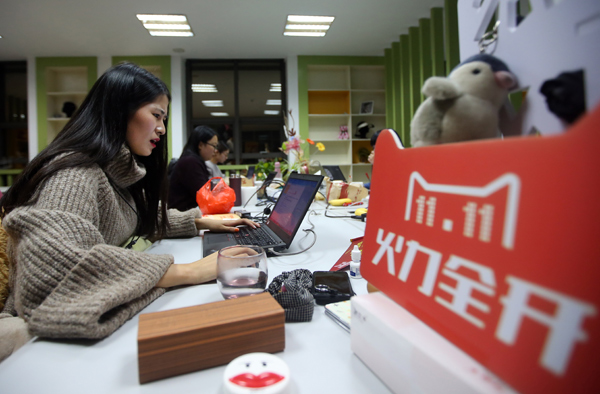
Customer service employees of an online store work to answer potential buyers' questions in Nantong, Jiangsu province. Xu Peiqin / For China Daily |
I buy certain Indian groceries, including unusual vegetables, from stores on Taobao that specialize in such commodities.
In Sanya, Hainan province, some retailers cater to Russians (even their signboards are in the Russian language). These days, Australians and Africans in China buy on Tmall.com. Chinese consumers in China buy foreign products on platforms such as xiji.com and ymatou.com on Black Friday and Cyber Monday.
Conceivably, the next trend could be something like this: Indian consumers in China will buy Indian products directly from Indian online marketplaces, even as their compatriots back in India buy Chinese gadgets directly from Alibaba.
That appears possible because e-commerce has innovated traditional festive shopping like Christmas sales imaginatively. Hitherto limited by geography, shopping festivals are becoming borderless online.
Singles Day is no longer a deal bonanza just in China. Black Friday and Cyber Monday are not limited to Western markets either. India's Diwali is a festival for Chinese, South Korean and European manufacturers, too.
Here's proof: in India, Chinese products were bought online by millions during the annual shopping frenzy in festive October. On Nov 11, products made the world over, including in China, and worth an estimated over $20 billion, were bought from Chinese online marketplaces by consumers in the Chinese mainland, Hong Kong and Taiwan province (Alibaba alone netted over $17 billion).
Evidently, e-commerce has become a melting pot of shopping cultures: In the United States, popular year-end sales started not with the Black Friday-Cyber Monday period but much earlier, with 11-11, an Alibaba invention that has become an export item itself, an extension of China's soft power.
Double-11 is being customized for markets outside the mainland, just as Black Friday and Cyber Monday are getting a new character in China (and a Chinese touch in the United States - this year's Thanksgiving Day parades in Chicago and New York were enriched by Chinese cultural elements Monkey King, Sichuan Opera and pandas).
This is perhaps best exemplified by Dealmoon.com, a US-based brand aggregator run by Chinese-Americans. Dealmoon celebrates 11-11 in the US through offers on products that "Alibaba/JD typically don't have": luxury goods such as handbags and skincare brands.
Dealmoon's main targets are Chinese-Americans. Apparently, they have already splurged an estimated $100 million on US brands since 11-11, suggesting that diaspora groups are transitioning to a new mindset.
As voters in the US, Chinese-Americans "are turning a bit to the right", as one adviser to the Donald Trump campaign told China Daily. As consumers, they are turning a bit to Western luxury products, even as Chinese goods find ways to reach the US faster.
Brands and online sellers are desperately trying to make sense of this phenomenon and exploit it, according to a Dealmoon spokesperson. She was among the e-commerce executives who attended Luxury Interactive, a three-day conference in New York in October.
"They (e-commerce executives of luxury brands from Louis Vuitton to Ferrari) are all dying to sell their products to Chinese consumers, including those living in the US and China."
Such precision-targeting will become essential as new trade agreements promise to increase the flow of human resources, and as cross-border shipping becomes free/affordable. Markets within national boundaries will likely become even more segmented into country-wise consumer groups.
So, Alibaba, JD and their ilk need to be aware that, in China, their patrons include both Chinese and non-Chinese consumers. Ditto for Amazon in the US, Flipkart in India, and others elsewhere.
To serve such groups better and grow their businesses, e-commerce labels need to make their online marketplaces, digital payment systems, product manuals and customer service multi-lingual. Companies such as Xiaomi, Huawei and Amazon also need to consider integrating their global operations, in terms of product customization.
They also need to ponder: Could a non-Chinese consumer in China be able to buy a laptop or an e-book reader with English-language operating system? Could a customer who bought an Oppo, OnePlus, Gionee or vivo smartphone in India, and then relocated to China, get free service and repairs in China?
The coming 12/12, Christmas and New Year sales will globalize online shopping further. And, thanks to China, 2016 will go down in history as the year that pushed cross-border e-commerce past the tipping point.