From plans to progress: the first year of China's supply-side reform


BEIJING - A year ago, "supply-side structural reform" was just a buzzword among Chinese economists and government officials. However, solid progress this year has proved it is more than a slogan.
The revival of Huaibei Mining Group is a case in point.
Located in central China's Anhui province, the nearly 60-years-old company had been struggling in a glutted coal industry for years, suffering huge losses and unable to cover workers' salaries. But reform measures have brought it new hope.
Following official guidelines, Huaibei Mining shut down inefficient mines, introduced advanced techniques and helped with the re-employment of excess staff elsewhere. These changes, adopted across the mining industry, were part of a nationwide production capacity cut that has started to rejuvenate the sector.
In the first ten months, the company raked in 260 million yuan ($37 million) in profits -- a sharp contrast with the 1.64 billion yuan in losses during the same period of 2015.
"The overcapacity reduction is actually an opportunity for us," Huaibei Mining chairman Kong Xiangxi said, adding that transformation is the only way out for businesses trapped in sluggish heavy industries.
Huaibei Mining is typical of traditional companies in China searching for a new start amid the country's economic overhaul. From steel smelting to equipment manufacturing, industries plagued by overcapacity and lagging technology are gradually recovering.
Major economic indicators illustrated the trend.
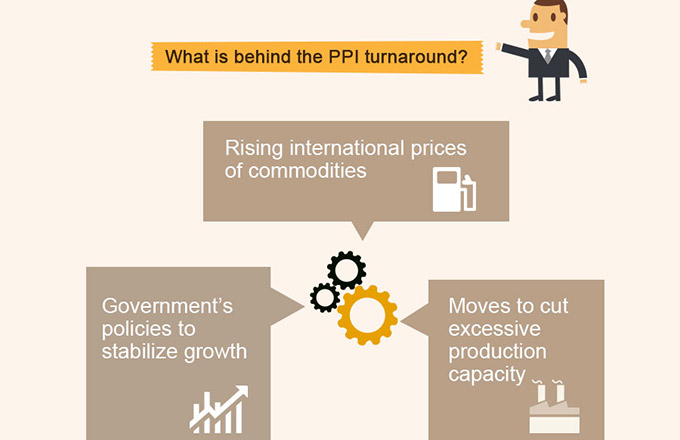
China's factory-gate inflation in November stood at its highest since late 2011, and the official manufacturing Purchasing Managers' Index came in at 51.7, rising for a third straight month. China's aggregate industrial profits rose 8.6 percent year on year in the first 10 months, with the growth rate at a record high since August 2014.
"The reform brightened market expectations and built business confidence," said Wang Yiming, deputy director of the Development Research Center of the State Council, adding that economic growth has remained within a reasonable range and the conditions exist for the economy to level up from the slowdown.
China's policymakers started to press ahead with reforms on the supply side at the end of 2015 in hopes of solving economic structural problems and fostering new growth drivers, as demand-side support, such as investment stimulus, had become less effective.
Shi Hongxiu, a professor of economics at the Chinese Academy of Governance, described the reform as "an innovation in macro economic regulation." Economic development should not only rely on short-term demand policies, but also turn to long-term restructuring for sustainable momentum, Shi said.
Throughout the year, China closed outdated steel mills and coal mines, reduced unsold homes in small- and medium-sized cities, brought down corporate debt levels, rolled out more tax breaks for businesses, and fixed weak links in the economy.
"The supply-side structural reform will improve China's growth potential and then inject vitality into the global economy," said Wei Shangjin, a professor at Columbia University.
However, across-the-board reform is no easy task, and challenges have continued to pop up during the process.
Unexpected home price spikes in the first nine months, partly due to the housing inventory reduction, pushed up residential leverage and swelled asset bubbles. The downsizing of the steel and coal sectors led to shrinking supply and shored up short-term prices, which in return impeded further reform moves. The closure of "zombie companies" caused risks from unemployed workers and unresolved debts.
"Given all the difficulties, reform cannot be completed in one kick, but requires resilience and composure," said Li Yang, a researcher with the Chinese Academy of Social Sciences.
Despite the obstacles, policymakers have decided to carry on with reform.
China will deepen supply-side structural reform in the next year, expanding reform measures to more areas: overhauling the supply-side of agriculture, reviving the real economy and stabilizing the property sector, according to the tone-setting Central Economic Work Conference, which ended Friday.
"Reform will remain a main theme of the country's economic work in the 13th Five-Year Plan period (2016-2020)," said Yang Weimin, deputy head of the Office of the Central Leading Group on Finance and Economic Affairs.
Peng Sen, president of the China Society of Economic Reform, suggested policies should remain market-oriented and let innovation and competition play a bigger role.
Hopes from emerging industries
Besides the upgrades of traditional heavy industries, the supply-side reform will also support businesses in emerging sectors, ranging from new energy vehicles to internet technology, to generate fresh economic momentum.
In fact, growth drivers can be as small as a mobile app.
Huochebang, a mobile platform that helps truck drivers find goods to transport, is improving logistics efficiency in China. Launched in 2014, the app is growing rapidly, and 20 million tons of goods are matched with transporters via the platform each day.
"We helped reduce the number of empty trucks on the road by 6 percent in China last year, and the total fuel saved each day can power a truck for 10 million km," said Huochebang president Luo Peng.
Analysts said growth businesses like Huochebang are increasingly important to sustain a slowing economy.
The government expects the output of emerging sectors to account for 15 percent of GDP by 2020, up from the current 8 percent.
Supply-side reform generates opportunities for ambitious entrepreneurs and venture investors, said Clark Hu, founding partner of Joynt Capital. Hu's investment in big data, mobile health services and other new business models has brought him lucrative returns.
China's economic growth held steady at 6.7 percent year on year in the first three quarters, with the tertiary industry contributing 52.8 percent of GDP, up from 51.2 percent a year ago.