Doom-mongers get it wrong on China's economy


 |
|
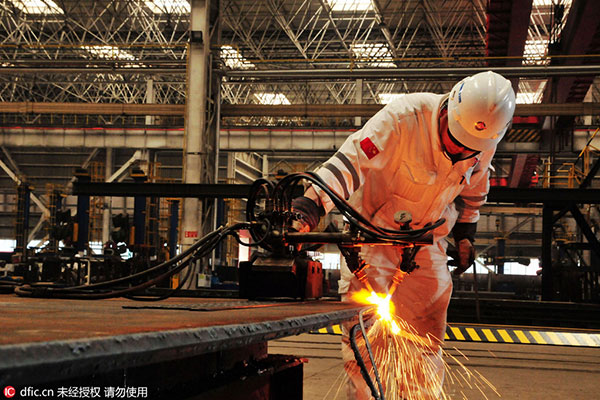
A Chinese worker processes steel at a factory in Qingdao city, East China's Shandong province, July 1, 2016. [Photo/IC] |
BEIJING - The doom-mongers continue to get it wrong on the Chinese economy, time and time again.
There were frustrations when the world's second largest economy shifted gear to allow for structural reforms, but many of the doomsday scenarios predicted -- total economic collapse, a local debt meltdown, a burst property bubble, the yuan in freefall -- were a step too far and, as ever, wide of the mark.
There has also been a lot of finger-pointing, alleging that China has dragged down the world economy. Blame has been piled on China for the uphill struggles facing troubled industries worldwide.
Here is a list of scare-mongering proved wrong by the realities of the Chinese economy in 2016.
A hard landing
The same old predictions about China's economy suffering a hard landing provide perfect fodder for media sensation year after year, especially amid the country's recent economic slowdown.
However, they were all proved false alarms, as shown by the economy's steady growth of 6.7 percent in the first three quarters, within the government's annual target range of 6.5 to 7 percent, and the envy of most other countries.
China has not only made a hard landing near-impossible, but also taken strides in lifting the quality of its economy, evident from the bigger contribution made by consumption and services in the economy.
By steering the economy on a quality and sustainable path, the country will secure a smooth transition to a medium-high level of growth and avoid a hard landing, much to the disappointment of the China bears.
Yuan tumbling out of control
Persistent weakness in the yuan at the beginning of 2016 fueled concerns that China's policymakers might have lost control of the currency, which would tumble in the year.
Although the yuan weakened about 7 percent against a strong US dollar, it remained relatively stable against a basket of currencies and even gained value against some major currencies.
For the year ahead, China plans to "keep the yuan basically stable, while improving the flexibility of exchange rates."
It believes that despite short-term fluctuations, the yuan will maintain overall stability, and the chance for a sharp depreciation can be ruled out, backed by China's stable economic growth, balanced fiscal conditions and ample foreign exchange reserves.
China dragging down the global economy
It is true that China has slowed from its previous double-digit growth, but as the Chinese economy transitions to what some have dubbed the "new normal," China remains the world's major growth engine.
If China's GDP grows 6.7 percent in 2016, in line with the official target, it would account for 1.2 percentage points, or 39 percent, of world GDP growth, according to economist Stephen Roach.
Fraught with growing economic uncertainty and geopolitical instability, the world needs a stable Chinese economy more than ever.
China's ongoing transition from an export and investment-driven growth economy to one based on consumption, services and innovation, will be of huge benefit to the world, without a doubt.
Local government debt bomb
China's local government debt woes have been depicted by the Economist as a "bomb" that needs to be defused.
Local governments had issued 1.13 trillion yuan ($162 billion) of bonds by the end of September this year, using 96.2 percent of the annual quota of new issuance, with the debt rate expected to stay flat with last year.
A debt level of about 90 percent is relatively low when compared with other major or emerging economies, and authorities have reacted promptly with debt swap programs and deleveraging measures.
The caps and tightened supervision imposed by the finance ministry in November will help curb debt, and contingency plans have been introduced to allow for fiscal rebalancing.
China's debt calculation is open and transparent and the risks remain controllable, Vice Finance Minister Zhu Guangyao said in October.
A burst housing bubble
A number of market analysts expected a crash to hit China's housing market, predicted to have a disastrous impact on the economy.
However, policymakers have always been alert to the risks in the market, and have introduced measures to cool an overheated property market and keep asset bubbles at bay.
Latest figures show the market is stabilizing, with total floor space of sold apartments in major Chinese cities in November experiencing the first year-on-year decline in 21 months.
The recently concluded Central Economic Work Conference reaffirmed that houses are to be built for living in, not for speculation, vowing to adopt financial, fiscal, tax, land and regulation measures to build a long-term system that provides housing for all people.
China culprit of global steel woes
Throughout the year, China has faced anti-dumping probes from many trade partners, the EU in particular. Along with these trade remedy measures is the allegation that China is an irresponsible exporter of cheap steel, causing instability in the global steel sector.
However, it is unfair to accuse China of being the cause of the global steel sector's woes, and finger pointing will not solve the problem.
A sluggish world economy and shrinking demand is the root cause of the steel sector's troubles, and the world should work together through the difficult times, said Wang Hejun, head of the trade remedy and investigation bureau of the Ministry of Commerce.
As the world's largest steel consumer and producer, China is pressing ahead with cutting excess capacity in steel, aiming to reduce 100 million to 150 million tonnes of crude steel capacity by 2020.
China less welcoming to foreign investment
The United States sensed an increasing reluctance among China's economic planners to pursue further reforms, said Chris Wilson, deputy chief of the US mission to the WTO, in July, citing concerns of "more and more" US companies about "a less welcoming business and regulatory environment for foreign enterprises" in China.
Gone are the days when foreign firms can make easy money in China with abundant cheap labor, land and other resources. It is understandable that these firms are not finding it as easy to do business in China as before.
However, the Chinese market has not lost its gloss, and its charm is not waning, but radiating across different sectors.
In the first 11 months, 24,355 new foreign-funded firms were established in China, and US and EU investment in China grew by 55.4 percent and 43.9 percent year-on-year respectively. Meanwhile, foreign investment in the high-tech service sectors almost doubled.
China strives to make it easier for foreign investment, having expanded a negative-list approach in approving foreign firms setting up branches in China and streamlining the registration process for investment this year.