 |
|
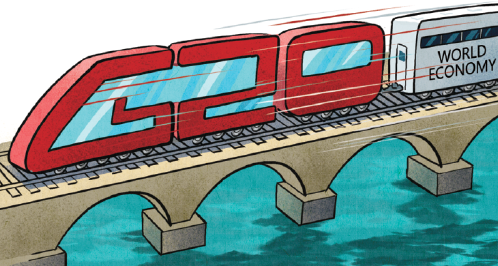
LUO JIE/CHINA DAILY |
Slow and unpredictable economic growth is the greatest challenge we face today. But to identify new sources of growth we have to understand some fundamental challenges in the global economy and how to address them.
The first one is demographic changes. New labor force growth is concentrated in low-income countries, as almost all high-income countries and many middle-income countries face the challenges of an aging population.
The second is the narrowness of technological advances, which are concentrated in information and communications technology and are not yet impacting the bulk of the real economy. The digital economy only accounts for 4-5 percent of GDP and 1-2 percent of jobs.
Economists and government leaders have increasingly recognized that these are structural problems, and pro-cyclical monetary policies have reached their limits. Pro-cyclical fiscal policies are not the answer either, as debt-to-GDP ratio continues to rise in both rich and developing countries.
Therefore, new sources of growth must be found by stimulating innovation, more investment in new industries, and more labor participation.
The private sector cannot be forced to spend, but will do so when G20 leaders create a more favorable business environment, while continuing to maintain political and macroeconomic stability.
The Chinese economy is so large today that its recent slowdown is another fundamental structural challenge that the global economy is still having a difficult time dealing with, particularly resource rich emerging markets that used to rely on exports to China as a growth engine.
Therefore, maintaining growth itself will be the biggest contribution that China can make to help the global economy recover.
Business and personal decisions on whether to invest and to spend are largely based on expectations of the future, so China's ability to maintain growth will boost confidence all over the world.
China must strike the balance between letting its old economy go and allowing the new economy to grow.
When you go to the Northeast region, you see the sunset industries such as coal and steel under heavy debt with little demand for their output, but when you go to Shenzhen then you see a very exciting new technology sector booming.
The challenge today is that the new economy has a smaller base, and although it is growing fast, it's not enough to compensate for the decline and stagnation of the old economy.
This is not just a problem for China. It's the same for most G20 countries. So if China's transitional experience is successful, it can be a useful lesson for others.
When the forum was formed during the Global Financial Crisis in 2008/9, the G20 leaders demonstrated their determination and willingness to make joint efforts to prevent the global economy from falling off a cliff.
We are not facing an imminent global crisis, but the challenges we face today are very serious. It is the structural issues that if not addressed could bring a bigger crisis further down the road, whether its debt sustainability or income inequality.
So I believe China's call to focus on long-term governance is correct. The difficulty is how to motivate the political will to make tough choices when there is no strong economic pressure.
I think one thing we can do is to increase the exposure of government performance in governance and other areas, and deepen the understanding of how effective government and other structural issues impact investment, innovation and resources mobilization.
When people can clearly see in which areas they lag among peers, and how much reward can be expected when the tough work is done, then they will be more motivated to act, and if they don't, they will face more public pressure to act.
The author is chief economist at the International Finance Corporation of the World Bank Group.


Copyright 1995 - . All rights reserved. The content (including but not limited to text, photo, multimedia information, etc) published in this site belongs to China Daily Information Co (CDIC). Without written authorization from CDIC, such content shall not be republished or used in any form. Note: Browsers with 1024*768 or higher resolution are suggested for this site.
License for publishing multimedia online 0108263 Registration Number: 130349