Making China FDI-friendly again


 |
|
MA XUEJING and SU JINGBO / CHINA DAILY |
In: opening up of some sectors and contracts; new powers for provinces to okay proposals, and for foreign firms to issue bonds
The Chinese economy is on the threshold of a new era of consumption-led growth that will be driven by increased foreign direct investment or FDI in strategic sectors, according to business leaders and industry experts.
Thanks to governmental resolve to attract more FDI, segments newly identified as key to sustained growth-automation, digitalization, financial services, railway equipment, environmental technology and renewable energy-are expected to benefit.
In January, the central government released a document outlining 20 measures to spur investment activities that have been sluggish. Among the measures are opening up of manufacturing, services and financial industries to FDI. Foreign businesses will be encouraged to bid for infrastructure projects through local franchises.
Eager to enhance the country's profile as an FDI destination, the National Development and Reform Commission, the country's top economic planner, recently took an unprecedented step. It delegated power to provincial governments to approve proposals for foreign investment up to $300 million in areas not in the negative list, which specifies sectors where foreign investors are barred.
Foreign companies will also be entitled to participate in bidding for government procurement contracts, as long as their products are made in China. The government will also allow them to go public and issue bonds in local markets to diversify financing channels.
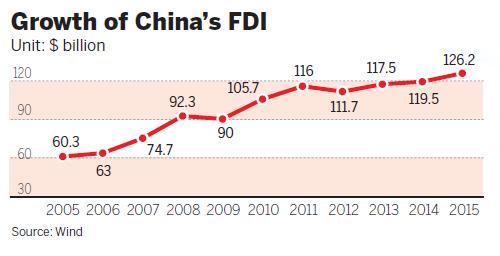
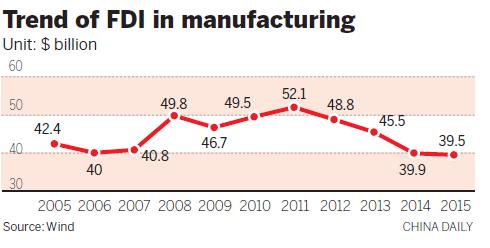
These measures suggest the government is not content with steady FDI growth in 2016 on the back of strong investment in services. FDI rose 4.1 percent year-on-year to reach $118 billion, according to data from the Ministry of Commerce, the government branch in charge of the country's outbound and inbound investment.
"Pushed by rising labor costs and weak global market demand, China is planning to have its growth depend more on domestic consumption and less on exports," said Zhang Yunling, director of International Studies at the Chinese Academy of Social Sciences in Beijing.
Zhang said companies from Europe, Japan and the United States have already discovered that it is time to invest more in China's research and development or R&D, design, science and technology or S&T businesses. New growth points will present themselves as the economy becomes more sophisticated.
Under government policies, foreign companies will be encouraged to invest in high-end, smart and green manufacturing; set up R&D centers; and strengthen cooperation with domestic peers. They will also be allowed to join national S&T programs.
Things have already started happening on this front. For instance, Germany's Siemens AG opened an industrial facility at its Wuhan Innovation Center in Hubei province last month. It will work together with local companies to build digitalization laboratories, intelligent water-testing laboratories, industrial hardware and software platforms, and expert networks from a long-term perspective.
"The Wuhan facility will be geared to the situation and needs of local industries to provide such services as innovation project incubation, professional training and technical consulting for small and medium-sized enterprises," said Zhu Xiaoxun, senior vice-president of Siemens China.
The company kicked off the Siemens China Innovation Center initiative in China last year, focusing on research in the field of digitalization. Under the program, Siemens has opened innovation centers in Qingdao, Wuhan and Wuxi to develop digitalization technologies in the country.
China is now intent on persuading global corporate majors to emulate companies such as Siemens. "The government had noticed that the country's capacity to attract FDI had in recent years been challenged by a number of elements, including the monopoly of State-owned enterprises and disappearing cost advantages of domestic production," said Ma Yu, a researcher at Beijing-based Chinese Academy of International Trade and Economic Cooperation.
Worse, changing global political scape-the Trump administration is keen to restore health of the manufacturing sector in the US; many countries in Europe will go to polls later this year-and slower economic growth in both Africa and South America, can affect global capital flows.
So, China must further revise its negative list to better protect investment from developed markets, as well as offer their companies the right to acquire or merge with domestic companies, instead of building only Chinese-dominated joint ventures, Ma said.
Industries not on the negative list are expected to treat overseas and Chinese companies equally. Such measures have acquired a competitive dimension of late.
"Neighboring countries such as Vietnam and Thailand have been initiating their own moves to entice more foreign investment to their shores," said Huo Jianguo, former president of the Chinese Academy of International Trade and Economic Cooperation.
China believes any drop in FDI due to competition from the neighborhood may prove temporary. The Ministry of Commerce has repeatedly said that "because of its huge market size, industrial infrastructure foundation and logistics network, China is, in the long term, the most attractive market for global companies."
Such confidence stems from the effectiveness of measures adopted so far. Johnson Controls Inc, the US-based manufacturer of energy storage, building equipment and control systems, will open its second global headquarters with a capacity for 1,200 employees in Shanghai in April.
"The Chinese government is seeking new solutions to improve energy efficiency and cut carbon emissions to design healthier environments in its cities," said Trent Nevill, vice-president of Johnson Controls and president for the company in the Asia-Pacific region.
"With incentives put in place and high demand from the market, we can experience fast growth in our energy efficiency solutions."
The US company experienced fast growth in its battery business in China over the past five years, thanks to surging demand for replacement and original equipment manufacturing. It invested $200 million to build a plant in Shenyang, capital of Liaoning province, to produce batteries for start-stop vehicles.
This type of vehicle battery can help automakers meet increasingly strict fuel economy and emissions regulations.
It will be a primary focus for the new facility. The Shenyang plant is scheduled to launch in late 2018 and will produce 6 million batteries annually, with the majority for start-stop vehicles.