Renminbi not to stall on road to being market-based


BEIJING — For those who assert that China artificially devalues its currency to gain a trade advantage, the kindest interpretation is they are out of date and need to get a grasp on reality.
The renminbi has held steady against the US dollar after withstanding mounting depreciation pressure. So far this year, yuan's central parity rate against the dollar has strengthened mildly.
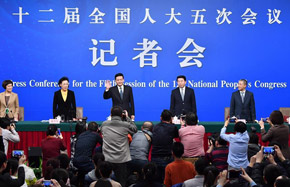
At the country's annual parliamentary meeting, China reassured the world the renminbi exchange rate would liberalize and that it would never wage a trade war to devalue the yuan to boost exports.
China's central bank governor Zhou Xiaochuan reinforced the view on Friday that renminbi's value will stabilize this year, but fluctuations will be normal considering uncertainties both at home and abroad.
More liberalization points to a greater role for the market in price setting. As it marks a key part of China's market reforms, the country will never hold back on this bumpy journey fraught with twists and turns.
The latest evidence is China shortening the reference period for yuan's trading against a basket of currencies. This technical adjustment has brought price setting closer to the market.
Persistent depreciation of the yuan simply does not serve China's best interest.
Any depreciation would widen gaps with the US dollar, prompting undesirable capital flow out of the country at a rate that could undermine China's financial security in what is a precarious global environment.
Such a move could also disturb China's rebalancing just at the moment it is trying to build an economy driven by consumer spending instead of trade and investment.
China has paid a heavy price in terms of environmental damage and labor shortages amid its unabated advance as an industrial power. Accordingly, policy makers have abandoned cheap exports as a key foundation for seeking growth.
Instead, they are looking towards supply-side structural reform and cutting-edge innovation for inspiration. It takes time and there will be growing pains, but in the long run it will empower the country, showing its inner strength.
Progress has been noteworthy. China has seen steady growth in the export of sophisticated equipment, while trade in low value-added processing is on the wane.
As China move up the value chain and converts its growth model from something not just substantial but to something genuinely sustainable, pursuing a cheap currency is simply not an option. The rest of the world ought to rise above old ideas and open-up to new horizons.
Any effort to delay a market-based exchange rate will undermine China's ambition to turn the renminbi into a truly global currency. A market-based renminbi is not just good for China, but for sovereign and private investors throughout the world.
China's reform is reflected in the International Monetary Fund's verdict that the renminbi is no longer undervalued, and the US treasury has resisted temptations to name China a currency manipulator.
However, this has not stopped a handful of cranky US politicians calling China the "grand champion" of currency manipulators. As David Dollar, a senior researcher with the Brookings Institution, has put it, these are "ironic accusations considering that China has actually been keeping the value of renminbi high, not low".
With the US Federal Reserve poised to raise interest rates as soon as this month, mounting depreciation pressures weigh on the renminbi. So, if the yuan weakens afterwards, isn't this just evidence that the exchange rate is market-driven?
China watchers would be well-advised to focus on the yuan's natural movement in the market, rather than conjuring up pictures of excessive government interference.
As Eswar Prasad, professor of international finance and Chinese economy at Cornell University, has pointed out, considering the fact that paper money was invented in China, it is no surprise that the renminbi is on the rise.
A glorious past is no guarantee of a bright future, but China's consistent progress on exchange rate reform deserves a fair and even-handed judgement.
- How does the Chinese government view recent changes in the foreign exchange rate of the renminbi?
- Renminbi internationalization to continue, despite setbacks
- No restrictions on cross-border renminbi receipts, payments: Central bank
- China launches first OTC renminbi emission derivatives in Shanghai
- Renminbi steadier as central bank's remedies take hold