Dropping currency spat produces mutual gains for China, US


 |
|
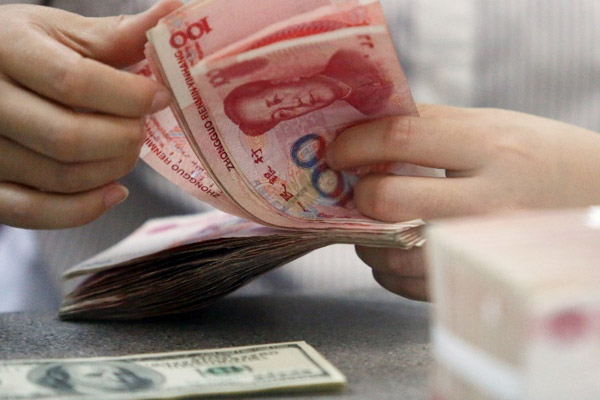
A worker counts Chinese currency Renminbi (RMB) at a bank in Linyi, East China's Shandong province, Aug 11, 2015. [Photo/Xinhua] |
In a semiannual report to the US Congress published late Friday, the Treasury Department declared that no major trading partner of the US, including China, was manipulating its currency.
While it is a sharp reversal from the rhetoric of US President Donald Trump's campaign trail, nearly three months into his presidency, this different tone chimes with a more realistic view of China's currency.
It shows his tough talk on China was only campaign rhetoric, said Wei Benhua, a senior researcher at Chongyang Institute for Financial Studies at Renmin University.
Economists have argued that China currently does not merit the label of currency manipulator, and the Chinese currency, RMB, has been at equilibrium level in recent years.
The Treasury uses three measures to decide if a country is being manipulated: whether the country runs a sizeable surplus in trade with America; whether its current-account surplus exceeds 3 percent of GDP; and whether it spends more than 2 percent a year to buy foreign assets to suppress the value of its currency.
China only meets the first criteria by running over $20 billion of trade surplus with the United States, said Zhu Jianfang, chief economist with the Citic Securities.
China has spared no efforts to keep the RMB at a stable level over the past few years; exactly the opposite of currency manipulation, he added.
Over the last decade, China's effective exchange rate has appreciated more than any other major currency, rising more than 40 percent, said David Dollar, a senior fellow at the Brookings Institution.
Brad Setser, a researcher with the Council on Foreign Relations, noted that the RMB exchange rate is now close to equilibrium. He expects the RMB will remain stable at the current level with China's current account surplus and its efforts to deal with capital outflows.
The US administration's new stance on the currency issue was likely influenced by the recent meeting of the leaders of the two countries in Florida, where they were able to better understand each other, said Zhao Xijun, a finance professor with Renmin University.
With the currency spat subduing, economists said the chance of a trade war between the world's two largest economies will be slim at most.
"The possibility of a trade war could be ruled out as the US government has dropped the manipulator claim, " Zhu Jianfang said, adding the two countries have huge space for cooperation, which is good for both sides.
"It would be hard for me to imagine a full on trade war between the US and China as it would be too damaging to the two greatest economies in the world, and it could easily pull the rest of the world into the biggest recession we will ever see," said John Ling, president of the Council of American States in China.
As many of the new US cabinet members have experience in the private sector working with China, he said, it was a positive sign that there would be disputes and issues, but both sides will try to maintain a relationship that will benefit the citizens in both countries.
Economists also foresee that the news will help keep the RMB stable.
It seems the market was given a stable expectation for the RMB trading and big fluctuations of the RMB will not occur, as the market could always be greatly influenced by significant government talks, Zhao Xijun said.
Observers also said the RMB's exchange rate is essentially decided by China's economic fundamentals which currently do not warrant a weaker RMB.
Thanks to China's consistent efforts to allow the market to decide the exchange rates, the International Monetary Fund declared the RMB as no longer undervalued in 2015.
Under Obama administration, the Treasury also dropped its previous assessment that the RMB was "significantly undervalued".