Summer's for travel, learning, fun


 |
|
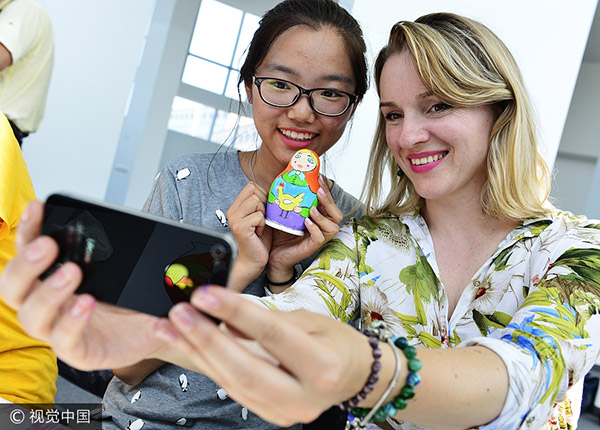
Chinese students attend masterclass on how to paint matryoshkas in Vladivostok, Russia. [Photo/VCG] |
Parents with schoolgoing children wring value out of the annual vacation
This summer, 30 million Chinese travelers will go abroad, and not all of them are driven by wanderlust alone.
As many as 40 percent of them will visit overseas destinations with their families, so that their kids could mix business with pleasure-that is, learning with fun.
The figures are from Ctrip, China's largest online travel agency. There's more to this business of summer travel.
According to a study by Tuniu, an online travel agency based in Nanjing, the combination of travel and education is now more popular than ever before.
Around 100,000 travel firms across China have designed overseas trips that incorporate summer courses for Chinese kids at 2,000 institutes and schools in more than 200 cities of over 100 countries and regions.
More than 70 percent of traveling parents gift such foreign trips to their children who took the tough National College Entrance Exam.
On average, they spend more than 10,000 yuan ($1,470) on the kid's trip, according to Ctrip. About 15 percent are willing to spend more than 20,000 yuan.
That could mean, if one-third of the 9 million students who took the exam travel overseas and spend an average 5,000 yuan, the summer trip market could be worth more than 15 billion yuan.
Such trips are not just for grown-up children. Even kids as young as seven are getting to travel abroad. Sight-seeing and summer courses are now seen as necessary to broaden ken, sharpen mind, pick up new skills (like communication ability) and mold "character", helping kids to grow up into global citizens, ready to succeed in a globalized world.
For instance, last summer, Wang Xiaoli, 40, a senior manager at a US food company in Shanghai, flew her two children to attend a two-month summer course in Chicago, US.
Wang booked the courses five months in advance to choose popular courses. Her two kids, 14 and 7, actively participated in summer school activities, including sports and experience trips involving painting, swimming, handicraft work, riding and even cooking.
"They had so much fun every day at the summer schools," said Wang.
She said they would spend a day baking pizza or riding bicycle. The most significant gain from the trip was that they were not as spoiled as they used to be.
After returning home, they complained less when they met challenges. The course for the two kids cost Wang around $5,000, but such courses could cost a lot less, depending on their content.
Industry studies suggest more than half of parents in China surveyed are willing to spend on short-term self-improvement courses for their children during the summer vacation.
According to the Tuniu study, parents prefer 12-to 14-day jaunts to the east and west coast of the United States, especially those that include visits to the campuses of top universities. Summer courses at local schools in the United Kingdom and Canada are also popular.
Industry data have thrown up lots of interesting insights and patterns that mark the new trend.
According to the 2017 International Study Bluebook published by New Oriental Corp, there are about 200 million people aged between 6 and 18 in China. The travel-and-learn market targets at least 80 million in this group.
This year, summer study trips to international destinations organized by New Oriental School have attracted more than 7,000 students. China's outbound travel grew 14 percent year-on-year last year, with the international study tours segment up more than 20 percent.
Girls outnumber boys by 56 percent to 44 percent among children taking summer courses.
Students in middle schools take up 49 percent, and those from high schools 24 percent. This shows teenagers are still the majority of overseas studies market.
Increasingly, the lowest age of outbound summer children is falling, with primary students taking up 11 percent, said the Tuniu report.
Why, pre-school children now account for 6 percent of the total number of outbound summer students!
Some 65 percent of summer course students travelling within and outside China do so to "broaden their horizons", 58 percent to improve their language ability, 55 percent to build up inner independence and self-confidence, and 52 percent to experience the differences between Chinese and Western cultures, the report said.
Most (62 percent) of them prefer to be part of student groups while going abroad for short-term studies; only 25 percent go solo, and 13 percent are accompanied by their families on a tour.
There are many factors that Chinese young students and their families consider before selecting their summer destination. Cultural diversity, campus locations, climate, convenience in visa application, local security and cost of living play a significant role.
So, the US, the UK, Germany, France and Australia have emerged as the top five summer destinations for Chinese students.
The rise in the frequency of direct flights between China and Australia has prompted more trips to the country. The growth in visiting students is also visible in the number of students flying to Canada, Japan and Singapore.
Tuniu found that nearly half of students going abroad during the summer stay there for two to four weeks; 30 percent stay one to two weeks; and 20 percent more than a month. Less than 5 percent of students go for a week.
Most of the students arrange to stay with host families or on campus with a global diversity of students. This helps them to better immerse themselves in the local environment and build up a network of friends.
Of those who have pals overseas, more than half are first-time outbound travelers.
Mid-level priced summer trips are most well received among parents, given that almost half of them would consider spending between 20,000 yuan and 30,000 yuan. About 37 percent of parents select products lower than 20,000 yuan and only 16 percent choose high-end products costing 30,000 yuan or more.