Turbines may spin without subsidy


 |
|
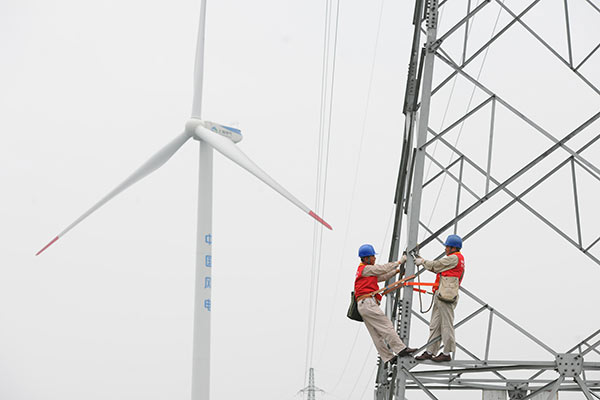
Technicians check wind power facilities in Tianchang, Anhui province.[Photo by Song Weixing/for China Daily] |
Considering that turbine costs should decline further and new generation turbines should produce more kilowatt-hour for the same capacity, it is highly likely that the wind power sector will continue its healthy development without governmental subsidy support, said Joseph Jacobelli, a senior analyst of Asia utilities at Bloomberg Intelligence.
The suspension of subsidy has been discussed for many years, and 2022 might be the time when that would really happen, he said.
Beijing plans to phase out subsidies for wind turbine makers by 2020 or 2022. An unidentified government official was quoted by several media outlets that manufacturers should "actively improve technology to cut costs in order to gain market share, instead of depending on government subsidies".
According to the 13th Five-Year Plan (2016-20) for wind power development, by 2020, electricity prices from wind power will be reduced to 0.4 yuan per kWh, those from solar to 0.6 yuan per kWh, similar to the cost of traditional power sources.
"China can stop providing subsidies for wind power by 2020, as the price of wind-based electricity is already relatively low. That would make it more competitive compared with electricity generated from other sources," said Han Xiaoping, chief information officer of China Energy Net Consulting Co Ltd.
"An alternative to government subsidy would be to require electricity retailers to buy renewable energy certificates from producers of wind and solar power," Han said.
According to Liang Zhipeng, vice-director of the New Energy and Renewable Energy Department, which is a part of the National Energy Administration, China has made significant progress in terms of wind power technology, which directly reduced the cost of wind-based electricity.
"We have manufactured bigger, taller wind turbines with larger installed capacity," said Liang. "Wind turbines with a diameter of 110 meters, height of 120 or even 140 meters, have been widely used in offshore wind farms in China. They have 5 gigawatts of capacity and some companies are developing wind turbines with 10 gigawatts of capacity," he said.
According to Jacobelli, the growth of China's wind power generation has been astonishing in terms of absolute capacity, to over 150,000 megawatts in 2016 from about 10 mW in 2006.
China had 157,000 mW of installed wind power capacity at September-end, up 13 percent year-on-year, according to the National Energy Administration.
"The very high pace of growth created some unique challenges, especially curtailment. But the majority of the issues should not be regarded as long-term problems, but more like teething troubles," Jacobelli said.
Other challenges that wind power generation currently faces include addressing the funding of the subsidies, ensuring that wind power does not disrupt supply stability and low share of wind power in the energy mix.
The wind power's contribution to total generation only accounted for 4 percent in 2016, according to the NEA.
However, in certain provinces and regions, wind power made up more than 10 percent of the total energy mix.
In the Inner Mongolia autonomous region, the Xinjiang Uygur autonomous region and Gansu province, the figure even reached 16 percent.
However, these are also regions with high curtailment rate, meaning that wind power is not bought by the grid for use by customers.
NEA data showed 10.4 billion kWh of wind power in Gansu province was curtailed in 2016, accounting for 43 percent of the total wind power generation, making it the region with highest curtailment rate.
Xinjiang ranked second with 38 percent of wind power wasted, followed by Jilin with 30 percent and Inner Mongolia with 21 percent.
In response, the government made great efforts to address these issues. On the curtailment front, authorities are making good progress in ensuring that more output from existing production facilities is dispatched.
In the first three quarters of this year, national average wind curtailment decreased by 10.3 billion kWh, down 6.7 percent year-on-year.
On subsidy funding, the government is working hard setting up the green certificates market.
On supply disruption, there is much better coordination now between the developer and the provincial or central planners, which should help ensure safe supply, industry experts said.