Comments
  Print
Print  Mail
Mail  Large Medium Small
In Invisible Cities by Italian novelist Italo Calvino, Marco Polo tells Kublai Khan stories about 55 cities he visited and the dialogue between the Italian traveler and Chinese emperor touches upon a wide range of topics, mostly in prose form. The two men seem to take different meanings from what the other is saying.
I never read Calvino's poetic book, first published in 1972. But Chinese novelist Xue Yiwei's book, Traveling Along With Marco Polo - Thoughts about Invisible Cities, an interpretation of Calvino's novel, provided me with some insight.
What I find is both strange and interesting is the fact that Marco Polo, as a traveler, talks about cities with an emperor who led his nomadic cavalry to conquer a large part of Asia and Europe. Kublai Khan was definitely not an urban man and in Xue's interpretation, the 55 cities are ones of lust, power and violence, more in keeping with what the emperor envisages.
I appreciate Xue raising Marco Polo's division of cities into two types: those that stay in harmony with desire and those that split with desire. The former does a good job in meeting urban dwellers' demands for a better life and creates a demand for consumption among residents. Two different fates await cities that split with desire. One makes cities centers of greed and material gain by giving free rein to people's lust for whatever they want instead of whatever they need. The other possible fate is inertia where over-development stifles rather than fosters.
I wonder if an association can be established between Calvino's cities and Xue's interpretation, and the current urbanization in China.
If urbanization is an inevitable process for a country's development, leaders' understanding of what kind of city urban dwellers should have makes a great difference to whether the process will be conducive to the country's long-term sustainable development.
It is impossible for local leaders to have the fired-up imagination of Calvino, who died in 1985 aged 61, concerning the cities. But it is possible, and within their discretion, for them to harbor the notion that urban development should be for the benefit of urban dwellers.
Rather than Calvino, who let his imagination run as wild as possible in describing the cities Marco Polo talks about to Kublai Khan, local leaders, along with urban designers, must take into consideration various factors that should help make a city a pleasant place for residents to enjoy life. They must think about the adequate size of a city for its ecological capacity, the number of parks and the proportion of green areas and, of course the less poetic aspects, such as waste disposal and sewage.
I wonder whether there should be both a visible city and invisible one in the minds of local leaders. An invisible city should be an ideal place where people can enjoy the merits of a city without the congestion, or other drawbacks. A visible city will always benefit from the visions of its invisible twin.
In other words, an invisible city is the ideal of urban planners and policymakers while the visible one is where its invisible counterpart has to be materialized. If the former gets the better of the latter, construction of a city may likely be impeded by too much concern for problems that will compromise the quality of urban life. Of course, there is also the possibility of going too far beyond the capacity of the physical conditions in the process of making the ideal come true.
Given the urban development plans quite a number of cities have unveiled, it seems that a visible city has got the better of its invisible counterpart or else local urban planners did not have an invisible city in their mind.
That too much concern has been placed on the size of a city and on the prospects of developing certain types of cities (such as world city, first-class provincial capital and so on) speaks volumes for what they have in mind.
When wider roads, higher buildings and huge squares within an increasingly larger-sized city are seen as the priorities for urban development, I strongly doubt whether urban planners have an ideal in mind for a desirable urban life for its dwellers.
The downside of such urbanization has been looming large. The larger a city is, the more chances are for various kinds of jobs that make them attractive only in terms of money-making, but at the same time, they have more problems such as traffic jams.
Striking a balance between a visible city and an invisible one may be a way for urban planners to redefine the urbanization road map to the sustainability of cities and benefits of urban dwellers.
 Beijing suburb to hold 2014 APEC meeting
 Belgian, British scientists share 2013 Nobel Prize in Physics
 Model with modified BMW X6 M SUV
 'Golden Week': No pain, no gain
 Car firms shifting focus
 A slice of paradise lures tourists
 Tibet expected to witness bumper harvest
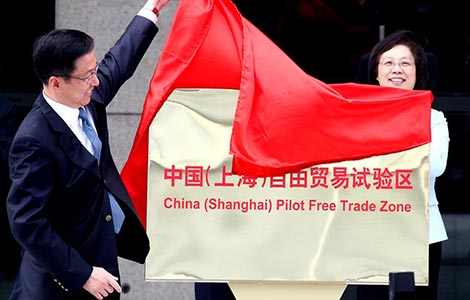 Shanghai inaugurates Free Trade Zone
Copyright 1995 - . All rights reserved. The content (including but not limited to text, photo, multimedia information, etc) published in this site belongs to China Daily Information Co (CDIC). Without written authorization from CDIC, such content shall not be republished or used in any form. Note: Browsers with 1024*768 or higher resolution are suggested for this site.
License for publishing multimedia online 0108263 Registration Number: 20100000002731