|
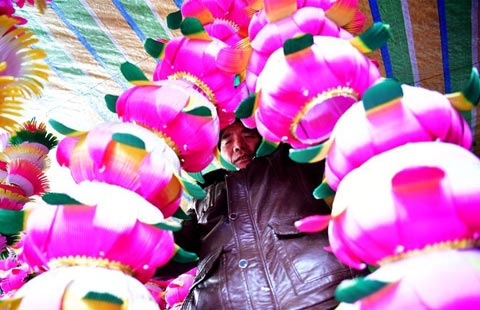
Farmers dance on the street in Lhasa, capital of the Tibet autonomous region, on Thursday to celebrate the Serfs Emancipation Day. [Photo/Xinhua] |

A flag-raising ceremony was held on Thursday morning in Lhasa, capital of the Tibet autonomous region, to mark the 54th anniversary of the abolition of feudal serfdom.
Some 3,000 people watched the ceremony at the square in front of the Potala Palace following a week of celebratory activities including dancing, singing and Tibetan opera.
Thursday marks the fifth Serfs Emancipation Day. In January 2009, Tibet's lawmakers designated March 28 as a memorial day for the 1959 democratic reform in Tibet.
The reform ended the era of feudal serfdom and freed about 1 million serfs and slaves, who at the time accounted for more than 95 percent of the region's population.
Tsering Phel, 72, of Damxung county on the outskirts of Lhasa, was born a serf. She said she remembers the eight serf families in her hometown used to suffer from hunger, cold and bullying by slave owners.
"After the reform, our fate changed," she said. "There are no more serfs. Women and men have equal status."
She said it was the fifth time she had attended the national flag-raising ceremony.
"By watching the ceremony, I want to show my support and gratitude. I also taught my children and grandchildren to be grateful for their comfortable lives today," she said.
Kunsang, 63, a retired soldier in Lhasa who also attended the ceremony, said his parents used to be serfs and his childhood years were dominated by hunger and poverty.
"The bygone hardships are unimaginable today," he said. "With favorable policies from the central government, retirees like me are taken care of, with basic living necessities and healthcare guaranteed."
Bandetso, 14, is a junior high school student in Lhasa. It was the second time that she came to the flag-raising ceremony.
"My parents told me our life today was hard-earned. I am glad to be in the crowd to commemorate this occasion," she said.
Bandetso said her family welcomed the policy in Tibet that waived tuition fees for students before college.
"It eases my parents' burdens. I don't have to worry if my family can't afford my education," she said.
Dradul, a monk from Tsurphu Monastery in Doilungdeqen, another county in suburban Lhasa, said monks and nuns in Tibet enjoy improved living conditions, as electricity, running water and medical insurance have been offered to them.
Dradul made the remarks at a forum in Lhasa on Thursday.
In recent years, monks and nuns have been given higher representation and greater influence in the political arena, occupying more seats at legislative and political advisory bodies in regional, prefecture and county-level governments, he said.
Tibet saw its gross domestic product soar to 69.56 billion yuan ($11.19 billion) in 2012, more than 100 times that of 1959. The region's economy has maintained double-digit growth for 20 years, Losang Jamcan, chairman of the Tibet regional government, said in a televised speech on Wednesday.
Some 88 percent of the farmers and herdsmen have moved to new houses with better conditions. Their per capita net income reached 5,719 yuan. They have fewer worries about children's education costs, as Tibet is the first provincial level administrative region in China to provide 15 years' education free of tuition fees, Losang Jamcan said.
People's average life expectancy in Tibet rose from 35.5 years in 1959 to 71 years. Tibet has a universal healthcare system based on free medical services that have cost more than 2 billion yuan over the past 10 years. A strong emphasis is placed on environmental protection in Tibet, which is home to 47 natural reserves and 21 ecological conservation areas, which account for 34.5 percent of Tibet's area, the highest ratio in China, Losang Jamcan said.
He said further efforts will be made to strengthen the competitiveness of agriculture and animal husbandry, improve people's livelihoods and public services in Tibet, and maintain social stability and national sovereignty.
daqiong@chinadaily.com.cn and liyao@chinadaily.com.cn
Wang Huazhong in Lhasa contributed to this story.


Copyright 1995 - . All rights reserved. The content (including but not limited to text, photo, multimedia information, etc) published in this site belongs to China Daily Information Co (CDIC). Without written authorization from CDIC, such content shall not be republished or used in any form. Note: Browsers with 1024*768 or higher resolution are suggested for this site.
License for publishing multimedia online 0108263 Registration Number: 130349