Editor's note: The relaxation of China's decades-old family planning policy to allow more couples to have a second child has been hailed as one of the key events of 2013. China Daily sent reporters to examine how the policy change is expected to affect people’s lives.
 |
|
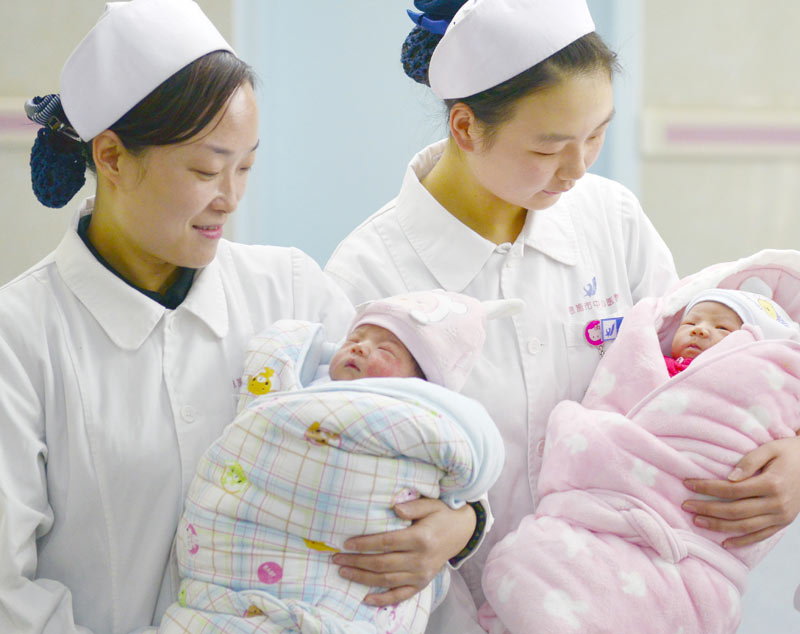
Obstetric nurses in the Central Hospital of Enshi, Hubei province, take care of newborns at the hospital. Couples in Enshi are allowed to have two children. Li Yuanyuan / for China Daily |
Many residents in pilot area opted against adding to family, often due to finances
|
 |
|
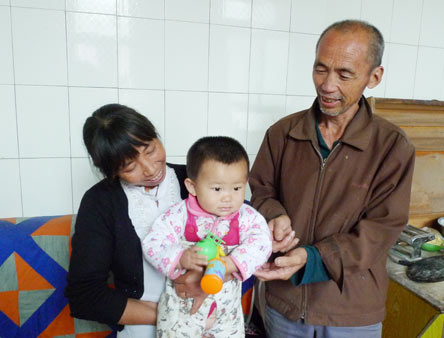
Su Meiling and her father-in-law play with her second child at their home in Yicheng county, Shanxi province. Su and her husband Qiao Weijie had the daughter last year. Xu Wei / China Daily |
However, the couple changed their minds in 2011 and had a daughter, even though, according to the rules, they had to give back the subsidies —more than 4,000 yuan in total.
"We just realized one child is not enough," said Su, 38. "If we had two, we knew they'd be companions for life."
Su and Qiao live in Yicheng, a typical rural county in Shanxi province rich in coal resources. It is one of four areas chosen by the central government in the 1980s to test a policy allowing families to have two children.
In November this year, a decision was made to relax the one-child policy across the whole country. Couples in which one partner is an only child will be allowed to have a second child, according to a decision by the Communist Party of China leadership.
Despite fears of a population boom, demographic indicators from Yicheng suggest giving couples the option to have a second child does not necessarily lead to robust population growth.
Between 1982 and 2010, a time span that encompassed the third and sixth national census, the county's population grew by 22.8 percent, from 254,000 to 311,000, compared with the national average of 29.8 percent. In Shanxi it was 41.2 percent.
Yicheng has a gender ratio of 101.6 men for every 100 women, according to the 2010 census, while the national figure for men was 105.2.
Liang Zhongtang, a demographer with the Shanghai Academy of Social Sciences who helped facilitate the pilot program in 1985 and has monitored it since, said he has noticed a drastic change in people's concept of fertility since the 1980s.
"The lessons we can draw from the pilot program in Yicheng is that a loose population policy does not necessarily mean that the population will grow out of control," he said. "Plus, even though some areas enforce a strict one-child policy, the goal of population control has not been met."
|
|
|
|
|
|
|
|
Copyright 1995 - . All rights reserved. The content (including but not limited to text, photo, multimedia information, etc) published in this site belongs to China Daily Information Co (CDIC). Without written authorization from CDIC, such content shall not be republished or used in any form. Note: Browsers with 1024*768 or higher resolution are suggested for this site.
License for publishing multimedia online 0108263 Registration Number: 20100000002731