News
Shining light on China's solar energy
By Wan Zhihong and Liu Yiyu (China Daily)
Updated: 2010-09-27 09:17
 |
Large Medium Small |
|
 |
|
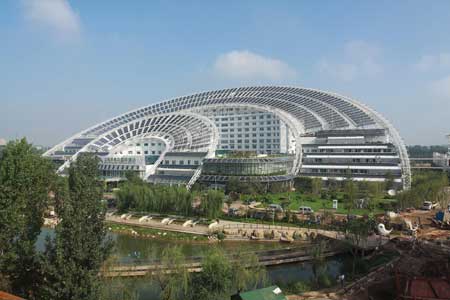
A building fully-equipped with solar power facilities in Dezhou. The city in East China's Shandong province was the venue for the 4th International Solar Cities Initiative Congress from Sept 16 to 19. Zhou Jianxin / for China Daily |
Dezhou saves 640,000 tons of coal a year by using green resource
BEIJING - Dezhou, a city located in the northwest of Shandong province, used to be famous in China for its braised chicken products. Today, it is branding itself as China Solar City, a national center using green energy.
From street lighting to tourist carts, solar energy has now become an integral part of the city's economy. More than 120 solar power companies have invested in Dezhou, making it a hub for clean-tech manufacturing, said Li Xixin, vice-mayor of the city.
Because of the use of solar power, 640,000 tons of coal-equivalent are saved each year. Carbon dioxide (CO2) emissions are also reduced by 1.71 million tons per annum, he said.



Besides Dezhou, many cities in China are banking on the development of green energy as one economic growth engine. For instance, Tianjin municipality's Binhai new district has budgeted 130 billion yuan this year for the establishment of environmentally friendly projects.
They include the construction of nine sewage treatment plants, a greenbelt and water desalination facilities.
The development of new energies has become the most dynamic industry in China. "Although compared with conventional energies such as coal and oil they are still small-scale sectors, these industries are expanding at an unprecedented pace," said Li Junfeng, deputy director-general of the Energy Research Institute (ERI) under the National Development and Reform Commission (NDRC).
China has already made remarkable strides in some industries, such as nuclear and wind power, said Li. According to the National Energy Administration (NEA), China has the world's largest number of nuclear reactors under construction at present.
The country is now building 25 reactors with a total capacity of 27.73 gigawatts (gW). The government has also approved the construction of 34 other reactors, which will have a combined capacity of 36.92 gW, according to the NEA.
Development of new energy is indispensable for the country to achieve its two primary targets in energy and environment, said analysts. China aims to increase the use of non-fossil energy to 15 percent of its primary energy consumption by 2020. It also pledged to reduce its carbon intensity by 40 to 45 percent by 2020 from the 2005 level.
The country reaffirmed its intention to promote seven new strategic industries this month, including new energy and biotechnology. The State Council, China's cabinet, said on Sept 8 it will pilot the development of these industries by formulating industrial standards and creating a sound market environment.
The other five industries are new-generation information technology, high-end equipment manufacturing, advanced materials, new energy vehicles, and energy-saving and environmental protection.
"This move can undoubtedly further boost the development of new energy industries, but it also shows that there have been many problems in the sector," said ERI's Li.
Cost effectiveness
Echoing Li's views, some industry insiders mentioned cost effectiveness as one problem in the industry.
China started public bidding for its second batch of solar power plants in August. This round of bidding includes 13 photovoltaic (PV) projects, with a total capacity of 280 megawatts (mW).
A total of 50 enterprises joined in the bid by submitting 135 project proposals. Winning bids ranged from 0.7288 yuan per kilowatt-hour (kWh) to 0.9907 yuan per kWh, less than the 1.1 yuan expected by some industry participants before the bidding process.
This year, more than 70 percent of the winning bids were won by large State-owned enterprises. China Power Investment Corp dominated with a total of seven successful bids.
"Such low bidding prices will hardly make any return for investors. A reasonable electricity tariff should be around 1 yuan," said Meng Xiangan, director of China Renewable Energy Society.
In 2009 China initiated the bidding for its first batch of solar power projects, a 10-mW project in Dunhuang in Gansu province. It was awarded to a bid with the second lowest tender price of 1.09 yuan per kWh.
A low price will squeeze many private solar companies out of the business because their pockets are not as deep as those of State-owned enterprises, industry experts cautioned.
Astronergy, the solar module-making unit of privately owned Chint Group, has bid to develop five solar projects of the 13 in total.
The Zhejiang-based solar company, which garners 85 percent of its business from overseas markets, said it won't win the projects by pursuing low tender prices, which may weaken the development of the industry.
"China's stand on the subsidy plan is uncertain now, hindering the industry's development," Hu Wanshu, marketing manager of Astronergy told China Daily.
Shi Jingli, a researcher with the ERI under the NDRC, said she did not hold the view that a low price would lead to a monopoly in the industry.
Grid capacity
Companies in the solar power industry should work together to reduce their costs. The government is utilizing the bidding system to find out a reasonable price range, said Shi.
China's current grid capacity is another major problem damaging the growth of the new energy industry, according to many analysts.
For instance, electricity generated by many wind power plants in Inner Mongolia autonomous region cannot be connected to the grid, which makes a big waste of resources and hurts the industry, they said.
"The issues with the grid aren't expected to ease in the near term but should improve with the development of smart grid investment over time," said ERI's Li.
China will spell out clear strategies for developing smart grids in its 12th Five-Year Plan (2011-15) for the energy industry, as part of its steps to foster use of more clean energy.
The State Grid Energy Research Institute and the global wind energy leader Vestas are now making a joint study on the coordinated development of wind power and the electricity grid. The research project brings together international experience coupled with local Chinese expertise to seek to develop an holistic tactical solution to solve the current grid challenges in China.
As a global player in the wind energy industry, Vestas has substantial experience in many different markets. As an integrated part of China's wind energy industry, it is important that the company uses its global experience to contribute to the further development of China's wind power industry, said Jens Tommerup, president of Vestas China.
Bao Chang and Du Juan contributed to the story.
?