China's new-energy sector is facing an uncertain future after the US imposed swingeing import tariffs and demand for equipment dwindles, as Jiang Xueqing and Hu Yongqi report from Beijing.
On Dec 18, the US Department of Commerce imposed stiff tariffs on Chinese-made wind towers imported at prices deemed to be unreasonably low. The department determined that Chinese exporters have sold utility-scale wind towers in the US at dumping margins of 44.99 percent to 70.63 percent. In response, the department set deposit rates for cash, used as surety for goods, ranging from 34.33 to 60.02 percent on the towers and additional countervailing duties of 21.86 to 34.81 percent to offset Chinese government subsidies.
 |
"With rates of duty like this, it's impossible for the products of Chinese wind tower manufacturers to enter the US market," said Zheng Kangsheng, secretary of the board of Titan Wind Energy (Suzhou) Co. "The company's US market share will definitely decline sharply," he added.
A 2012 US investigation into anti-dumping and countervailing duties found that Titan Wind Energy gained sales revenue of 363.91 million yuan ($58.4 million) from its US exports of utility-scale wind towers in 2011, accounting for 38.64 percent of its operating revenue that year. The company will now attempt to expand its market share in Europe, the Asia-Pacific region and Africa to offset the predicted losses in the US, said Zheng.
The department's decision has added to the tough times being experienced by Chinese wind power equipment manufacturers as a result of overcapacity.
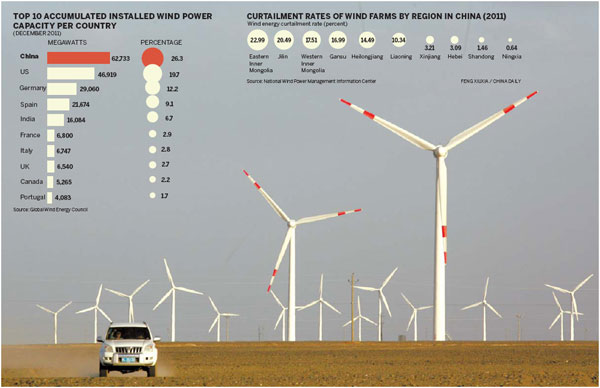
By the end of 2011, China's total installed wind power capacity was 62.36 gigawatts, the largest in the world. However, just 47.84 gW, or 76.7 percent, was connected to the grid, according to China Wind Power Outlook 2012, a report issued by the Chinese Renewable Energy Industries Association, Greenpeace and the Global Wind Energy Council.
"In the past few years, wind farm development has been too rapid and grid construction has not been able to keep up. The huge gap put a lot of pressure on the grid," said Ma Jinru, vice-president and secretary of the board at Goldwind Group, one of China's biggest manufacturers of wind power equipment.
The report also showed that more than 10 billion kWh of wind-generated power had been curtailed across China. The number of wind turbine working hours declined sharply in 2011. Full-load hours for the year came to 1,903 hours, a decline of 144 hours, or 7 percent, from the 2,047 hours recorded in 2010. Wind farm operators suffered combined losses of more than 5 billion yuan as a result of the curtailment, which cut profits in the sector by half.
China Ming Yang Wind Power Group, one of the world's top 10 wind turbine manufacturers by sales, reported a gross profit of 137.2 million yuan in the third quarter of 2012, a fall of 55.1 percent from 305.6 million yuan for the corresponding period in 2011, blaming weak demand for wind turbine generators in China. Sinovel Wind Group Co, another leading Chinese manufacturer in large-scale onshore, offshore and inter-tidal wind turbines, reported a net loss of 280.3 million yuan during the same period.
Indefinite 'vacation'
In November, Sinovel announced that it had put 350 workers on indefinite "vacation", accounting for 12 percent of its total workforce. For the first month of the suspension, the employees received full salary, but after this the payment declined sharply to 1,008 yuan, around 80 percent of the minimum monthly wage set by the Beijing municipal government. No one knows when the "holiday" will end, but the number of staff members "on vacation" has risen to approximately 500, according to employees.
"We were not told when to return to the office, and many workers like me are looking for a new job," said 24-year-old Wang Yiran, who has worked in Sinovel's marketing department for 18 months. He said the so-called holiday actually meant unemployment for him.
In 2011, Wang declined a number of good job offers in his hometown of Harbin, capital of Heilongjiang province, and opted to work for Sinovel in Beijing.
"I didn't know much about Sinovel until I signed the contract with the company. The only thing I knew was that it's one of the largest wind turbine manufacturers and it offered me a good salary," he said. "The day I started with the company, I was impressed by the smiles from the receptionists, the free lunch and the professional training. I thought I had made the right decision."
His opinion changed when 15 colleagues in the marketing department were made redundant in November after falling profits prompted cutbacks. The office was full of rumors that more employees would be "let go", leading around 40 members of the marketing staff to find alternative employment in the first six months of 2012, according to Wang.
"At that time, I still had hopes of living in Beijing because I could make 6,000 to 8,000 yuan a month, depending on my performance. But now I've moved back to Harbin because 1,000 yuan was nothing in Beijing," he said. "Many colleagues said the company just wanted us to quit our jobs so it wouldn't have to pay redundancy compensation."


Copyright 1995 - . All rights reserved. The content (including but not limited to text, photo, multimedia information, etc) published in this site belongs to China Daily Information Co (CDIC). Without written authorization from CDIC, such content shall not be republished or used in any form. Note: Browsers with 1024*768 or higher resolution are suggested for this site.
License for publishing multimedia online 0108263 Registration Number: 130349