|
 |
|
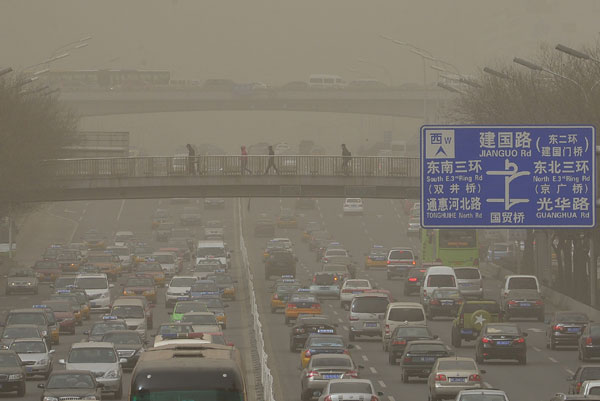
Smog obscures the sky in Beijing on Thursday. Beginning on Friday, all vehicles that cannot meet the latest emissions standard will be banned from being sold in Beijing. [Photo/China Daily] |
Domestic automakers to face more pressure, analysts say
Stricter emissions regulations in Beijing to ease severe air pollution will add pressure to struggling domestic automakers, and push the development of new-energy vehicles, according to auto trade analysts.
The Beijing municipal government has faced complaints from the public over heavy smog due to severe air pollution that plagued the capital this winter.
|
|
The new standard calls for lower nitrogen oxide, carbon monoxide and hydrocarbon emissions.
Beginning on Friday, all vehicles that cannot meet the China V standard, which is based on the Euro V standard and which replaced the China IV standard introduced in 2008, will be banned from being sold in Beijing.
Li Kunsheng, director of the Beijing Environmental Protection Bureau's department of motor vehicles, said this week the city will introduce the China VI emission standard in 2016, to ease severe pollution in the capital.
On Thursday, the concentration of PM 2.5, or airborne particles measuring 2.5 microns or less in diameter that can deeply penetrate the lungs, reached 469 micrograms per cubic meter at 10 am near Tiananmen Square, the Beijing municipal government reported.
The World Health Organization says 24-hour exposure to PM2.5 should be no higher than 25 micrograms per cubic meter.
Analysts said they believed the new measures for vehicles, in addition to the temporary closure of heavy-polluting factories, are not sufficient to end the high levels of pollution, but will help improve the upgrading of China's automobile industry, especially by posing more challenges to automakers that have been losing local market share in recent years.
Yan Jinghui, assistant general manager of the Yayuncun Automobile Trade Market, the largest in Beijing, said the new emission standard will "wash out" some of the domestic automakers in one of the biggest vehicle markets in China, as they cannot provide models to meet China V emission requirements.
"This includes Chongqing Lifan Group, BYD Co Ltd and SG Automotive Group, which currently have no China V standard models," said Yan.
"Some popular models, for example, the locally produced Ford Focus, Peugeot 207 and Suzuki Swift will also leave the Beijing market," he added.
Tony Wang, principal China powertrain analyst at IHS Automotive in Shanghai, said: "We think the measures will help Beijing reduce pollution, but the effect will not be as great as the public expects because lots of old China I and China II emission standard cars still run on the road."
Thus, the number of vehicles causing pollution will not be reduced, and the new regulation will only affect new, additional vehicles in Beijing, he said.
"The measures are only being introduced in Beijing, which means that all the other cities across China are not affected by the new legislation to raise emission levels to China V," Wang said.
Previous estimates show that Beijing has around 240,000 new cars on its roads annually on average, while there are 5 million vehicles in the city. The government will need to strictly curtail the use of old models across China, while enforcing higher-level emission regulations nationally, he added.
Namrita Chow, manager and senior analyst at IHS Automotive, said that should the government push forward any measures to reduce pollution nationwide by enforcing higher emission standards, the automakers expected to suffer the most will be the State-owned automakers, which lack the technology to adapt their models to meet the requirement.
"This would also make their models more expensive and push them out of reach for Chinese customers," Chow said.
As a result, the gradually improved emission standards may hinder the fast growth of local auto brands, she said.
"The Chinese government would have to initiate subsidies to encourage sales of China V vehicles across the country, and also help State-owned automakers to fast-track their products to meet higher standards." Chow also said new standards may provide an opportunity to help improve the development and use of new-energy vehicles in China, and encourage automakers to make more efforts in this sector.
China has set a target in its 12th Five-Year Plan (2011-15) of selling 500,000 electric vehicles by 2015. However, only 12,791 electric and hybrid vehicles were sold in 2012, contributing 0.7 percent of the nation's total passenger car sales.
lifangfang@chinadaily.com.cn

Copyright 1995 - . All rights reserved. The content (including but not limited to text, photo, multimedia information, etc) published in this site belongs to China Daily Information Co (CDIC). Without written authorization from CDIC, such content shall not be republished or used in any form. Note: Browsers with 1024*768 or higher resolution are suggested for this site.
License for publishing multimedia online 0108263 Registration Number: 20100000002731