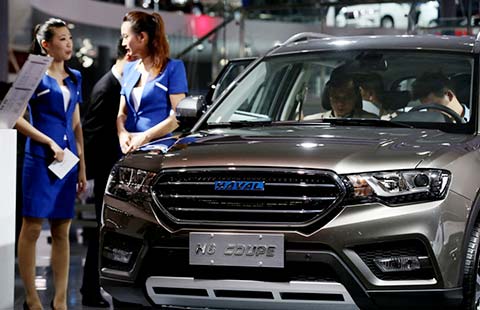
Great Wall Motors, China's largest SUV manufacturer, announced earlier this month that it will raise a fund of up to 16.8 billion yuan ($2.7 billion) in a private share placement to pay for the research and development of new-energy vehicles, intelligent vehicles and auto parts.
Based in Baoding, Hebei province, the company plans to spend 5.08 billion yuan on the research and development of new-energy vehicles, 4 billion yuan on transmission of NEVs, 1.7 billion on electric motors and 1 billion on battery systems for NEVs.
The Hong Kong-listed company said it would develop the new-energy models based on the current bestselling models. The automaker's first plug-in hybrid models are expected to hit the market in 2017.
Like many carmakers in China, the world's largest vehicle market and second-largest NEV market, Great Wall Motors entered the NEV market in the faith that it holds great potential.
Emerging market
With a growing number of incentive policies and tightening fuel standards, China's NEV market is growing rapidly and industry insiders believe it will soon surpass the United States as the largest in the world.
In Beijing, 5,091 new-energy cars received license plates in the first half of this year. More and more people are buying e-cars and in June, 1,955 license plates were issued.
According to Beijing authorities, there were 6,454 people competing for 5,697 new-energy car plates in June. This meant the success rate for receiving a NEV number plate fell for the first time, from 100 percent to 88 percent.
According to the Ministry of Industry and Information Technology, China's NEV production hit 78,500 in the first six months of 2015, a three-fold annual increase.
Production of pure electric passenger cars in the same period hit 36,300 units, also a three-fold annual increase.
Production of plug-in hybrid passenger cars saw a four-fold annual increase during the same time to 20,400 units.
During the same time, 15,500 pure electric commercial vehicles were produced, a five-time year-on-year rise. The production of plugin hybrid commercial vehicles was 6,406 units, rising 74 percent year-on-year.
Last year was called "the first year of the new-energy vehicle era" in China, as the output and sales of NEVs in the country were 78,499 and 74,763 respectively, 3.5 and 3.2 times the figure in 2013.
Preferential policies
Policymakers in the country are promoting new-energy vehicles.
The ministries of finance and science and technology is reportedly to set up a fund for new-energy vehicles with first-phase capital expected to hit 500 million yuan to 700 million yuan in the near future.
The National Energy Administration also announced it would abolish its investment threshold for pure electric cars this month.
The State Council announced recently that one-third of newly procured government vehicles for the use of central government authorities should be new-energy vehicles.
The proportion is expected to rise further in the future.
In May, the State Council unveiled its "Made in China 2025" strategy, which hopes to upgrade the country's manufacturing power in the next 10 years.
According to the program, the government will transform the nation into a more competitive global player by offering special funding and tax incentives to 10 industrial sectors including the new-energy vehicle industry.
Local governments are implementing preferential policies in response to the central government's appeal to popularize NEVs across the nation.
In April, Beijing exempted pure electric cars from the city's number plate bans, which restrict cars with certain numbers plates from being on the road between 7am and 8pm from Monday to Friday within the capital's fifth ring road.
Many big cities in China imposed such restrictions on vehicles in recent years, to ease traffic and reduce pollution.
Beijing plans to build up a charging network for new-energy cars in the city and plans to install charging posts within a five-kilometer radius inside the sixth ring road by the end of this year.
Beijing authorities also announced that the city would be friendlier to new-energy car owners, by allowing them to pay lower parking fees and highway tolls in the near future.
The country is also gradually raising its emissions standards to control car exhaust pollution.
The government is taking action to reduce auto-related nitrogen and sulfur emissions and plans to implement the National V standard in the whole country by Jan 1, 2018.
The incentive policies have moved an increasing number of people in China to buy electric cars.
"I really like my new car. It is very convenient to drive in the city, and using it is much cheaper than normal cars," said Yan Ping, a Beijing resident who bought a BYD E6 pure electric car last month.
According to Yan, his new car only costs him 60 to 70 yuan to fully charge, which allows it to run for about 320 km.
Increasing debates
Last month, the National Development and Reform Commission and Ministry of Industry and Information Technology issued new regulations for newly established pure electric passenger vehicle enterprises.
The regulations lowered the financial entry standard for e-car makers, but raised the technology standard.
Despite the seemingly positive outlook for the e-car market, industry insiders said there are risks.
"You cannot really be a player unless you have more than 10 billion yuan. All investments are risky, investing in electric vehicles is no exception, but it is even more risky," said Wu Wei, an official from the industry coordination department of the National Development and Reform Commission, the country's economic planner.
According to Wu, innovation ability and the level of research and development are key for enterprises producing or wanting to produce electric cars.
Wu said that companies should think "very carefully" before making a move and entering the market.
"There is no need for investors to only focus on auto manufacturing. In fact, the auto parts business for electric cars has more potential to grow and is much more profitable," he said.
Yang Cheng contributed to the story.

Copyright 1995 - . All rights reserved. The content (including but not limited to text, photo, multimedia information, etc) published in this site belongs to China Daily Information Co (CDIC). Without written authorization from CDIC, such content shall not be republished or used in any form. Note: Browsers with 1024*768 or higher resolution are suggested for this site.
License for publishing multimedia online 0108263 Registration Number: 20100000002731