 |
|
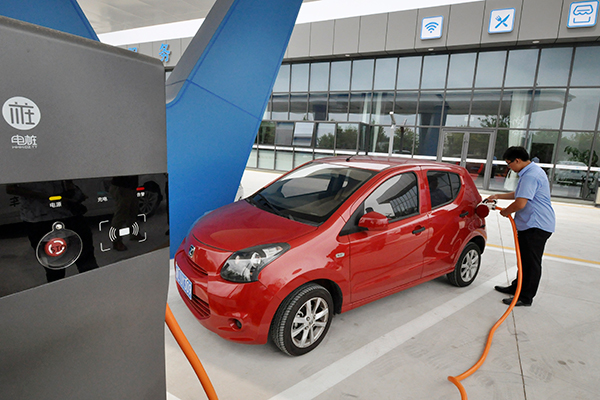
A man charges his new energy vehicle in Rizhao, Shandong province. The sector sees rapid growth in China. [Photo/China Daily] |
Policies aim to encourage competition and sustainability by ultimately cutting the number of manufacturers
China is set to introduce a range of financial stimuli aimed at encouraging competitive new energy carmakers in another move designed to ensure the sustainable growth of the country's fast growing yet chaotic sector.
Song Qiuling, an official with the Ministry of Finance, said that the ministry, together with the Ministry of Industry and Information Technology, is considering raising the threshold at which carmakers qualify to receive subsidies from the central government.
She made the remarks on Aug 21 at a forum held in Zhengzhou, Henan province by China EV100, a non-profit organization dedicated to promoting the new energy vehicle sector.
China began offering subsidies to both companies in the sector and buyers in 2010 to stimulate the demand for and popularity of the vehicles. The government set a goal in 2009 to have 5 million new energy vehicles on the country's roads by the end of 2020.
A report by the State Council, China's Cabinet, showed that the central government gave 28.4 billion yuan ($4.25 billion) in subsidies to the sector from 2013 to 2015. During the same period, subsidies from regional governments totaled more than 20 billion yuan.
"The 'one-size-fits-all' subsidy scheme was effective in the early stages, and it is what is done internationally, but it may result in carmakers being over-reliant on financial stimuli and make them reluctant to do research and development, which would lead to poorer-quality products," said Song.
A report from the National Development and Reform Commission said that China has more than 200 manufacturers of new energy passenger vehicles, buses and special-use vehicles, but it lags behind global leaders in terms of quality, reliability and key technology.
Song said financial incentive packages require a radical overhaul to prevent companies from defrauding the system, a problem that came into sharp focus earlier this year.
Investigations into these fraud cases were completed in May and Song said the names of the companies involved would be made public in due course, and the country's list of approved carmakers and models would be trimmed in the future.
Zhang Zhiyong, an independent auto analyst in Beijing, said only the most successful companies deserved to thrive, but criteria should be carefully evaluated to ensure the desired outcomes are realized.
"For example, we cannot use sales as the criterion as good sales figures are not necessarily linked with advanced technology (used in the cars)," he said.
Last year, around 350,000 units of new energy vehicles were sold. Through the first seven months of this year, 207,000 new energy vehicles were sold, up 122.8 percent year-on-year. The China Association of Automobile Manufacturers expects total sales to hit 700,000 units this year.
Chen Qingtai, director of China EV 100, told the forum that the sector remains largely driven by favorable policies, which means that Chinese carmakers and the Chinese government must address the critical question of how the industry stays competitive. This is especially important, he stressed, as international rivals are introducing an increasing number of products into the market, while the government is curtailing stimulus measures for the domestic sector.
Breakthrough started
From this year, China is gradually cutting subsidies to the new energy auto sector, and will cease all subsidies at the end of 2020.
"A key to meet the challenge (facing the domestic industry) is to make further breakthroughs in core technologies and substantially improve our competitive edge," said Chen.
Besides the upcoming changes in financial incentives, the Ministry of Industry and Information Technology is canvassing public opinion on a new draft of regulations concerning new energy carmakers and auto models.
The draft released on Aug 12 is much stricter than the 2009 version and experts say it is aimed at both improving the sector's competitiveness and raising the overall standard of products produced by the sector.
The new draft has streamlined the definition of new energy vehicles to cover purely electric vehicles, plug-in hybrids and fuel-cell cars, and requires that automakers monitor the condition and reliability of cars during their entire lifespan.
According to the draft, carmakers will only be granted a license if they can successfully develop the car's control system and coordinate the power and drive systems. In the 2009 version of the draft, companies capable of meeting one of those three criteria were allowed to apply for a license.
Industry insiders believe the revised rules will prevent a repeat of previous cases in which companies attempted to fraudulently obtain government subsidies.
In addition to making it more difficult for newcomers to enter the sector, the revised regulations demand that those already on China's list of approved carmakers and auto products must reapply for licenses within two years of the issue date of their existing license.
Dong Yang, executive vice-president of the CAAM, said the government has set a target of slashing the existing 200-plus new energy car manufacturers to around 10 competitive ones.


Copyright 1995 - . All rights reserved. The content (including but not limited to text, photo, multimedia information, etc) published in this site belongs to China Daily Information Co (CDIC). Without written authorization from CDIC, such content shall not be republished or used in any form. Note: Browsers with 1024*768 or higher resolution are suggested for this site.
License for publishing multimedia online 0108263 Registration Number: 130349