E-car overcapacity looms large


 |
|
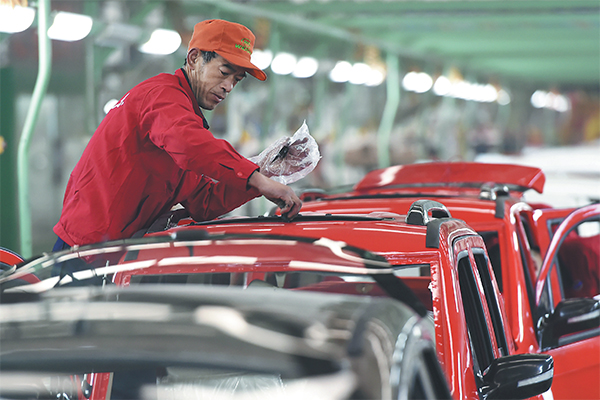
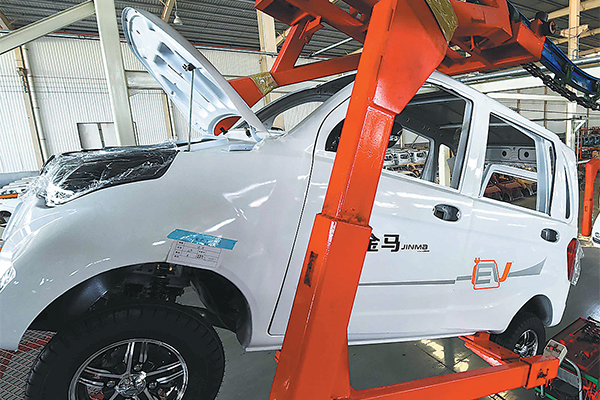
A worker works on electric cars at a plant in Zouping county, Shandong province. The fast-growing new energy vehicle sector now faces the risk of overcapacity. [Photo/Xinhua] |
Companies chasing new energy vehicle profits could crowd each other out
China's fledging new energy vehicle sector is confronted with the risk of severe overcapacity as traditional automakers and fresh faces are rushing to exploit the segment that is believed to be the largest gold mine of the automotive industry.
On Tuesday, Wanxiang Group won the nod from the authorities for its plant in Zhejiang province, which will be able to produce 50,000 electric cars per year when completed.
The move made the giant auto parts supplier the sixth company approved to jump on the wagon of electric car making in China this year.
The six newcomers' annual capacity will reach a combined 1.13 million units per year around 2020.
The figure exceeds 2 million units when coupled with those from NextEV, Chehejia and LeEco, all dotcom companies.
Traditional automakers have even more ambitious plans. Public statistics show that the combined annual capacity of 13 major passenger carmakers including BYD, SAIC Motor and JAC Motor will exceed 4 million units by 2020.
That means China will be able to produce about 7 million new energy vehicles a year by the end of the decade, more than three times the goal the country has set: 2 million units sold annually in 2020.
The simple math shows plants with a combined capacity of around 5 million units will stand idle even if China manages to fulfill the ambitious target, and some suggest an even worse scenario as the goal would be difficult to achieve considering the sector's current performance.
China sold 400,000 new energy vehicles from January to November this year for year-on-year growth of 60 percent, according to statistics from the China Association of Automobile Manufacturers.
 |
|
Due to declining subsidies, the market for new energy vehicles is unlikely to continue the momentum it has seen in recent years. [Photo/China Daily] |
Such vehicles are defined in China to consist of electric cars, plug-in hybrids and fuel cell cars but exclude hybrids like Toyota's Prius.
Despite a growth rate much faster than that of the industry's average of around 13 percent, Wang Binggang, an expert on China's new energy vehicles program, said: "It is mainly driven by government policies instead of market demand."
The central government offers a subsidy up to 55,000 yuan ($7,913) for an electric passenger car, 30,000 for a plug-in hybrid, and 500,000 yuan for an electric bus. Subsidies from local governments vary regionally.
The central government started offering subsidies in 2009 to stimulate the development of new energy vehicles.
By the end of last year, 33.4 billion yuan had been earmarked, according to the finance ministry.
But recently, things have started to change.
On Tuesday, the Ministry of Industry and Information Technology said the authorities will cut subsidies and totally withdraw them in four years now that some carmakers have been caught swindling the subsidies.
Ye Shengji, a CAAM deputy secretary-general, said the scheme was adjusted to ensure the steady and healthy development of the sector as it has grown rapidly in the past several years.
At a CAAM press conference earlier this year, Wu Wei, an official at the National Development and Reform Commission, said: "Due to rapid expansion in the sector, we have seen the problem of blind investment, which must be addressed in order to prevent risks."
A survey by the China Times newspaper says that 32 major automakers have announced plans to invest 311 billion yuan in new energy car and battery plants.
Yet even more are making forays into the already overheated segment.
Last Monday, telecom equipment and smartphone maker ZTE Corp announced that it has purchased a 70 percent stake in Granton Auto, which is located in Zhuhai, Guangdong province, and plans to build a manufacturing base with investment of 14.6 billion yuan.
Tian Feng, an executive in ZTE's car division, said it was not an impulse purchase.
"We tend to look at cars as smartphones with wheels. If you see from this perspective, you can find it is logical that we enter into the sector."
Three days before ZTE's announcement, Dong Mingzhu, chairwoman of China's leading appliances maker Gree Electric Appliances, and four partners including China's richest man, Wang Jianlin, made public their plans to invest 3 billion yuan in a carmaker called Zhuhai Yinlong New Energy Co.
The move came after Gree's plan to acquire the company was vetoed by its shareholders in November.
"Gree failed to buy it. But I, Dong Mingzhu, will do it," said Dong at a recent forum in Beijing. She said this time she invested as an individual and that she has "put all (her) money into the project".
Experts are not as optimistic as Dong. Cui Dongshu, secretary-general of the China Passenger Car Association, said: "It is easy to churn out cars but difficult to produce good ones. And a number of factors including declining subsidies will make it difficult for the market to see explosive growth."
John Zeng, managing director of LMC Automotive Consulting (Shanghai), said the newcomers have underestimated the difficulty of building a car brand.
"There may be chances in the auto parts sector if they can produce breakthrough technology. But car making is different.
"They have to win recognition from suppliers, dealers and customers. But if they insist on making cars, there is a 99 percent chance that they fail," he said.