


Competition to drive stability


 |
|
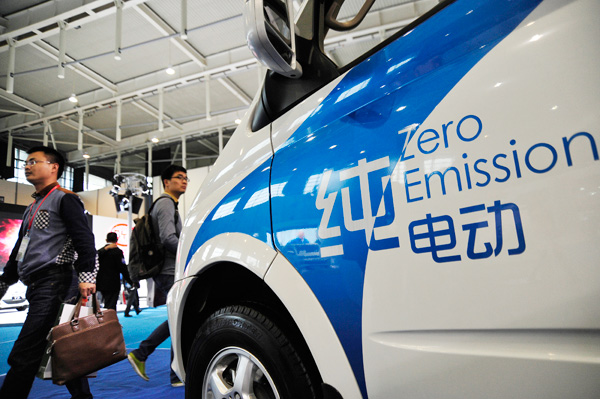
An electric vehicle on display at a car show in Nanjing, Jiangsu province. China's new energy car market shows strong momentum on the back of policies and competition. XING QU /FOR CHINA DAILY |
Govt allows more players to improve new energy vehicle market health
China is introducing more players into its fledging new energy vehicle sector, a move that analysts believe will help to encourage further competition and fuel the segment's growth.
On Feb 7, the National Development and Reform Commission released two documents via its website, revealing its approval in late January of two plants to be built by Yudo Auto in Fujian province and National New Electric Vehicle in Tianjin.
Yudo and NNEV are among 10 companies admitted into the segment since the first non-traditional automaker was approved in March. Eight of the companies were approved since the fourth quarter last year.
Altogether, the 10 companies have a potential annual production capacity of 530,000 new energy vehicles once fully operational.
John Zeng, managing director of LMC Automotive Consulting Shanghai, said the commission could be aiming to stimulate competition because traditional automakers' models are seeing lackluster performance. He added that very few volume joint ventures have yet launched electric cars.
"Under such circumstances, the authorities are hoping that introducing new players will produce the catfish effect, and so motivate weaker players to improve", said Zeng.
"After all, there are fewer than three years left for China to fulfill its goal that new energy cars will account for 12 percent of its total car sales by 2020," he added.
China has been the largest global market for new energy vehicles since 2015.
A total of 517,000 electric cars, plug-in hybrids and fuel cell cars were sold last year, a 53 percent rise year-on-year.
However, many industry insiders believe the sales are mostly the result of restrictive policies and bumper subsidies instead of organic demand on the basis of competitive products.
Xu Changming, a senior auto analyst at the State Information Center, said of the 330,000 new energy cars China sold in 2015, merely 80,000 were bought for family use, with 70 percent of them in cities where people have to go through a lottery system to win gasoline licenses.
"They bought those new energy cars because they failed to win gasoline car licenses, not because they wanted to," said Xu at a January forum organized by China EV100, the country's largest think tank on new energy vehicles.
Misuse of official subsidies
Government financial support has not produced the expected effects either, with some companies having been caught swindling subsidies.
Zhang Zhiyong, an independent auto analyst in Beijing, said some manufacturers had identified subsidies as a source of fast money from the very start and had no intention of producing competitive cars.
The Ministry of Industry and Information Technology has announced that 11 automakers have been uncovered in an official investigation that began in early 2016. Under the penalties the ministry handed down, the companies are barred from the official catalogue of recommended vehicles types that qualify for subsidies, which have been cut by 20 percent from 2016 levels and will come to an end by 2020.
MIIT has raised the threshold for automakers to receive subsidies and has replaced the 2016 catalogue of 2,198 models with a much shorter one of 185 models this year.
In the new catalogue, passenger cars account for 39 percent and buses for 41 percent of the total.
In previous catalogues, buses, which were entitled to the highest subsidies, accounted for 60 percent, according to Cui Dongshu, secretary-general of the China Passenger Car Association.
Industry and Information Technology Minister Miao Wei said policies during the next phases will favor companies which excel technologically, while preventing the repetitive construction of low-level companies.
Analysts believe the authorities' moves-with the National Development and Reform Commission allowing in more players while MIIT strengthens the screening of their products-are favorable for the sector's development.
Yale Zhang, managing director of consulting firm Automotive Foresight, said the "easy access but strict supervision" model holds the key to competitive products.
"The door should be wide open to all those who want to come but only those who can pass strict examinations can sell their products to the market," he said in an earlier interview with China Daily.
Zeng Yuqun, founder of Contemporary Amperex Technology, a battery producer in Fujian province, said at the China EV forum that competitive products are exactly what new energy carmakers need in the post-subsidy era. "The arch rival is gasoline cars. If we cannot compete with them, there will be no chance for us to survive in the market," he said.





