

Private firms blooming in business
Updated: 2012-10-26 13:48


Private enterprises fast becoming an important cog in China's industrial transformation
Private enterprises in China are playing an increasingly important role and fast catching up with their State-owned peers in terms of global expansion, analysts say.
That private enterprises are slowly catching up with their State-owned peers was evident when five private companies made it to the Fortune Global 500 rankings that were released in July. Though the US continued to be the largest nation in the Fortune rankings with 132 enterprises, for China it was a moment of pride as it zoomed past Japan to capture the second ranking with 73 companies. It was also the ninth consecutive year of growth for China, compared with 10 consecutive years of decline for the US, in the rankings list, in terms of number of companies.
"The rankings are a good indicator and proof that both the public and private sectors in China are growing, despite the global economic downturn," says Zhang Maiwen, senior editorial consultant of Fortune China.
Private enterprises have been and will continue to play an important role in outbound direct investment activities, and may even surpass SOEs as the major force of China's investment wave, says Shi Ziming, commercial counselor at the Department of Outward Investment and Economic Cooperation of the Ministry of Commerce.
Last year, about 45 percent of China's outbound direct investment in the non-financial sector came from non-State-owned enterprises. Though SOEs still account for about 90 percent of China's cumulative ODI by the end of 2011, the proportion by private investors will continue expanding as the government supports investors seeking overseas projects, Shi says.
The government has already made its intentions of boosting the private sector in the 12th Five Year Plan (2011-15), which emphasizes the need for private enterprises to scale up through global expansion.
The plan also outlines some detailed policies for high-tech companies, the catalysts for China's future innovation-driven industrial transformation, to spread their wings.
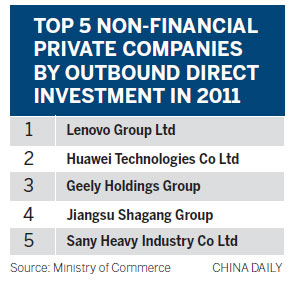
The best example of a Chinese private enterprise that has tasted success abroad is heavy machinery firm Sany Heavy Industrial Co Ltd. Earlier this year the Chinese company bought a 90 percent stake in German concrete pump manufacturer Putzmeister for 324 million euros ($407 million).
In terms of tapping the domestic market, private companies are also ideal partners for foreign companies.
Olivier Horps, president and chief executive officer of Club Mediterranean SA Greater China Region, says private enterprises in China are often the ideal partners for foreign companies that are looking to expand in China.
In June 2010, Fosun International Ltd, a privately owned Chinese conglomerate, acquired a 7.1 percent stake in Club Med, a French holiday resort operator. By the end of 2010, Club Med opened its first resort in China at Yabuli in Heilongjiang province with assistance from Fosun.
Though the influence of private companies has been increasing due to the booming domestic market, they are still faced with many constraints compared with SOEs, analysts say.
"In some sectors such as energy, SOEs are still in the lead, as these areas require huge investment. Compared with SOEs, private companies are usually 'prejudiced' and not favored to get large-scale funding from the banks," says Lu Jinyong, a professor at the University of International Business and Economics in Beijing. In terms of revenue and scale, private companies still lag behind the SOEs, Lu says.
But being small can also help as it affords more flexibility, and helps distinguish private companies from SOEs, says Yang Wei, vice-president of Accenture Greater China.
"Compared with SOEs, China's private companies are generally younger and more profit-driven. They usually are more determined on making decisions to pursue higher return on investment. From this perspective, it is quicker for them to tap into the international markets as the turbulence in these markets often necessitates companies to respond quickly for customer needs," Yang says.
Some experts believe that in advancing Chinese businesses internationally, private companies have a key role to play.
"Currently, Chinese companies are not capable of integrating resources globally. It will be a long time before they gain international recognition," Wang Zhile, director of Beijing New Century Academy on Transnational Corporations, was quoted as saying in a recent article in Fortune China.
"Private companies are the key to changing that, because they are totally market-oriented."
Patrick Nijs, Belgium's ambassador to China, said in a recent interview that it is common for private companies everywhere to face difficulties due to their small scale and tight financing.
"I admire the Chinese private companies' huge vitality and creativity. I believe that endowed with China's huge domestic market and favorable development conditions, these problems will not impede their development," Nijs says.
"There will be more and more world-famous private companies like Huawei and Lenovo that will come into existence in China in the near future."
huhaiyan@chinadaily.com.cn





- BYD exports three electric cars to Thailand
- Grid gets first jolt of residential solar power
- US now largest buyer of China's exports
- China's outbound M&As on the rise
- Tobacco control may entail price, tax rises
- Quanzhou becomes pilot financial reform zone
- New automobiles shine at Geneva Motor Show
- World's longest high-speed rail 'on track'
- Jiugui Liquor involved in plasticizer scandal again
- Accident reignites school bus safety concerns
- China to revise labor law
- Trademark registration under scrutiny
- Dinner ban takes toll on liquor firms
- CIC tables bid for London's Chiswick Park
- Property buyers eye overseas market
- Call for law to protect personal information
- China to cut train ticket prices
- Christmas business
- Solar industry to get jolt from new policies
- KFC chicken under spotlight
Survey & Comments