

Companies set sights on overseas markets
Updated: 2013-01-05 10:55


Entertainment equipment manufacturing companies from Zhongshan, in the south of the Pearl River Delta in Guangdong province, are striving to make the city a global design and manufacturing hub for the industry.
"We have been making aggressive strides into global markets recently," said Deng Zhiyi, president of the Zhongshan Game & Amusement Association.
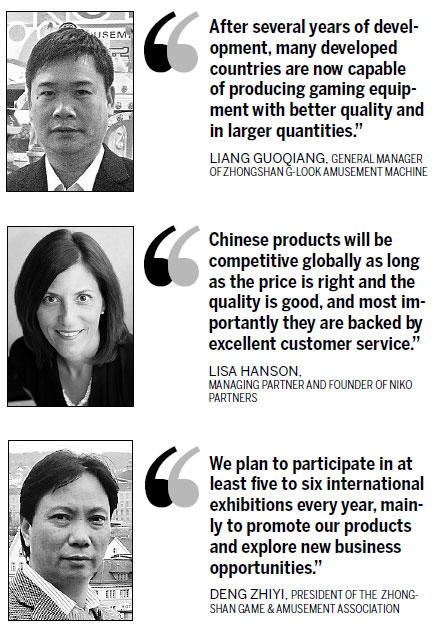
"As part of that, we plan to participate in at least five to six international exhibitions every year, mainly to promote our products and explore new business opportunities."
He also expects others from Zhongshan's gaming community to take part in a similar number of events.
Ye Weitang, president of Golden Dragon Amusement Equipment Co Ltd, a games and amusement equipment maker in the city, estimates the global market is worth around $100 billion, but Chinese companies account for just $6.4 billion of that, leaving ample opportunity for further growth.
He added that part of the reason why Chinese companies are still lagging others in the global market lies in the quality of Chinese products, and in the level of R&D enjoyed by countries like the US and Japan.
But with Chinese companies growing their output and putting more focus on quality, it is only a matter of time before they catch up with the competition, he said.
Golden Dragon has made considerable progress in markets such as the Middle East, Eastern Europe and the US, and overseas business accounts for more than 40 percent of its total.
"Our overseas business has been clocking annual growth rates of 20 percent to 30 percent, and going forward I expect it to be around 60 percent," Ye added.
He expects companies from Zhongshan to be key global players in the entertainment equipment market over the next five to 10 years.
Deng said that he believes Chinese companies can now make products that are as good or even superior to the ones made by Western counterparts.
He said that manufacturing still remains cheaper in China than in competing markets, due to lower labor and raw material costs.
"The price of products made in Europe can be three to five times more expensive than those made in China," he added.
Liang Guoqiang, general manager of Zhongshan G-Look Amusement Machine Co Ltd, said his company's long-term plan is to integrate more Chinese cultural elements into its products and export these overseas.
However, Liang added, that although Chinese production techniques are catching up fast with those in other markets, they still have a lot to learn from Western companies, especially on business operations.
"After several years of development, many developed countries are now capable of producing gaming equipment with better quality and in larger quantities.
"But the biggest advantage they enjoy over Chinese companies is their understanding of the business, gained largely from their advanced manufacturing techniques," he said.
"Even though several China-made products have achieved similar production levels, they still lag behind in terms of safety.
"We should learn from their techniques and make the necessary changes."
Though he agrees that Chinese companies need to add more cultural elements to their products, he thinks that higher levels of innovation and R&D are needed.
Part of the answer to that puzzle may come from companies in Zhongshan pooling their resources to form a cohesive group to tap global markets, experts suggest.
Ye from Golden Dragon thinks that while many small companies are keen to tap overseas markets, high exhibition costs can often prove a deterrent.
"They can run into hundreds of thousands of yuan and these amounts are often beyond the reach of small companies," he said.
Small or medium-sized companies can only expect to make sizable returns after they make considerable investment in overseas markets, he added, possibly with the help of local government and industry association funding.
Karl McCarrison, business development manager at Delta Strike, a manufacturer of laser tag equipment in the US, said that Chinese companies should invest more time to learn about target markets and how to develop or modify their products for them.
"Consumers or purchasers will identify more easily with products that reflect their culture and interests.
"If consumers are offered three different products at the same price they will obviously choose the product they identify with the most - but cost is crucial, too."
Lisa Hanson, managing partner and founder of Niko Partners, a consultancy focused on the Asian games market, said that it is vital for Chinese companies looking to enter a foreign market, to carry out thorough market research and due diligence.
"Chinese products will be competitive globally as long as the price is right and the quality is good, and most importantly they are backed by excellent customer service," added Hanson.
At the same time, it may not be easy for Western companies to promote their products in China, despite their success in other markets.
Hu Xiaochun, sales manager of Zone China System (Nantong) Co Ltd, said that there are significant cultural differences in the Chinese market.
"Unlike the West, Chinese teenagers are often burdened with studies and examinations. They do not have enough time to play. Even if they do have, there is still the process of market education."
Hu's company offers equipment packages for all types of laser tag equipment, and provides assistance and advice on facility design, installation of laser equipment and training.
Its best-selling product is a set that contains a vest and a laser tag gun, priced at about 10,000 yuan ($1,600). Its other hot product is a uniform and a laser tag gun for outdoor activities, at 6,000 yuan.
Zone China products are more popular in overseas markets like the US, the UK and France, and Hu said that overseas sales have been growing steadily.
"In the past few months, we have been able to sell at least 50 packages every day," she added.
"Laser tag players are relatively young, often aged between 10 and 30. Normally they play the game during a birthday party or kids camps or in shopping centers."
McCarrison from Delta Strike added that though such products are relatively new in China, it is only a matter of time before they gain market acceptance.
"Although our main focus has been international distribution, we know laser tag will soon be played in malls across China.
"We plan to have a quality assurance office in China to have better leverage in Asia."
The company believes that until the industry develops to reflect, or ideally to anticipate consumer behavior, there is very little potential for growth.
However, in the long run, the gaming and amusement industry will remain a key element of leisure spending.
Hanson from Niko Partners added that for foreign companies to succeed in China, they should have the right pricing strategy and also develop content that is acceptable to local authorities.






- BYD exports three electric cars to Thailand
- Grid gets first jolt of residential solar power
- US now largest buyer of China's exports
- China's outbound M&As on the rise
- Tobacco control may entail price, tax rises
- Quanzhou becomes pilot financial reform zone
- New automobiles shine at Geneva Motor Show
- World's longest high-speed rail 'on track'
- Jiugui Liquor involved in plasticizer scandal again
- Accident reignites school bus safety concerns
- China to revise labor law
- Trademark registration under scrutiny
- Dinner ban takes toll on liquor firms
- CIC tables bid for London's Chiswick Park
- Property buyers eye overseas market
- Call for law to protect personal information
- China to cut train ticket prices
- Christmas business
- Solar industry to get jolt from new policies
- KFC chicken under spotlight
Survey & Comments