Comments
  Print
Print  Mail
Mail  Large Medium Small
It's first step to set up a new financial architecture as the country pursues a new round of reform
An executive meeting of the State Council said that a draft plan to suspend certain laws in the Shanghai Free Trade Zone will be submitted for the approval of the National People's Congress.
The measure was expected to ease the administrative approval procedures for foreign investment. It's also a first step in setting up a new financial architecture as the country pursues a round of economic reform.
According to the Friday meeting, the FTZ will explore an innovative "blacklist" management system, which only regulate the forbidden areas and all the rest will be open for investors, in a bid to improve the efficiency of investment.
The establishment of the Shanghai FTZ was approved by the council on July 3, although no detailed plans have been announced yet.
The central government has delayed the announcement of new rules as government lawyers attempt to close potential legal loopholes, the South China Morning Post reported on Aug 5, citing unidentified government sources.
According to He Jun, a researcher with Anbound Consulting, disagreements between the Shanghai government and relevant ministries involve "dozens" of areas. These include the opening up of the service sector, reduced administrative approvals and reform of financial and tax policies.
"The biggest challenge for the legal remit in the Shanghai FTZ is with yuan reform. But the impact of such reform, the yuan's full convertibility and further opening up of the capital account will not be limited to one region," said He.
He said concern that financial reforms could "get out of hand" may be weakening decisionmakers' determination and thus interfering with the effect of the new policies.
Kenneth Leung, partner of tax and business advisory with Ernst & Young, said he expected that the Shanghai FTZ would be at the forefront of broad-ranging reform.
"There are many special areas in China, each with different functions and favorable policies. All these measures can be copied for the Shanghai FTZ," he said.
He suggested that recent tax incentives in Shenzhen's Qianhai, which said local high-end talent would only have to pay a 15 percent personal income tax, a similar level to Hong Kong, can be implemented in the Shanghai FTZ.
He went on to say that the value-added tax could also be eliminated in the Shanghai FTZ, which would be comparable with Hong Kong.
"This will create a miniature Hong Kong," he added.
However, Shanghai still lags far behind Hong Kong in many aspects. For example, to set up a company in is still very much more complicated than in Hong Kong.
According to a lawyer with a United States-based law firm, who specializes in facilitating foreign investment in China, setting up a foreign joint venture in the Chinese mainland would take two to four months, while in Hong Kong it only takes one week.
"In the meantime, the lower level of flexibility in foreign exchange in the mainland requires overseas companies to maintain a certain amount of capital within the borders, whereas in Hong Kong you can move in or out your capital anytime," the lawyer said.
"Many parts of the foreign investment laws, passed in the 1980s, are obsolete. But it is a complex procedure to amend the laws," said Ge Shunqi, deputy head of the Institute of International Economics at Nankai University in Tianjin.
The pilot Shanghai FTZ offers an avenue for China to amend these obsolete laws and eliminate barriers for further opening-up, Ge said.
Huo Jianguo, president of the Chinese Academy of International Trade and Economic Cooperation, a government think tank, said that further opening-up lies in easing the market access of foreign investment as well as facilitating the management.
"As for manufacturing, the catalogue for encouraged industries is subject to further expansion, while easing access to high-end manufacturing and strategic emerging industries will bring in new capital.
"The administration as well as approvals should be simplified. In addition, practical moves should be introduced to support foreign investment in the service sector," Huo said.
Last year, FDI in China declined 3.7 percent to $111.7 billion from a record $116 billion in 2011, according to the Ministry of Commerce. Investment increased 4.9 percent in the first half of this year to $62 billion.
"The key issue in the near future is not expanding FDI but diverting the spending into high-end and high value-added industries," Huo said.
 4th World Internet Conference concludes
 Starbucks Reserve Roastery set to open in Shanghai
 Smile to get discounts in Tmall's unmanned supermart
 Top 10 richest Chinese women in 2017
 World leading internet sci-tech achievements released in Wuzhen
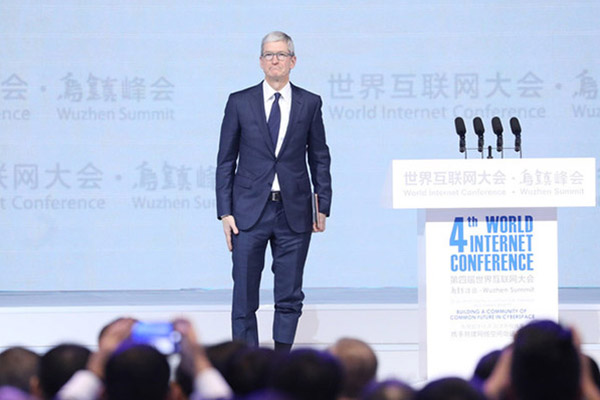 Top tech CEOs take to the stage as Wuzhen Summit opens
 Major topics at 4th World Internet Conference
 'Made in China' dinosaurs amuse the world

Copyright 1995 - . All rights reserved. The content (including but not limited to text, photo, multimedia information, etc) published in this site belongs to China Daily Information Co (CDIC). Without written authorization from CDIC, such content shall not be republished or used in any form. Note: Browsers with 1024*768 or higher resolution are suggested for this site.
License for publishing multimedia online 0108263 Registration Number: 20100000002731