



Information and news about China 3D print enterprises, 3-D print technology trend setters, consumer electronics, gadgets, geek stories, videos and photos about product reviews, fashion design, lifestyle and international tech events from China Daily and China Daily website.
A technology with potential to revolutionize manufacturing
Updated: 2013-06-25 06:59 Comments
  Print
Print  Mail
Mail  Large Medium Small
Imagine having a 3D food printer the size of a microwave oven that can "print" quick, customized meals with little or no effort on your part? This is not wishful thinking, for specialized 3D food printers that can print chocolate, cheese and cookies - with inputs such as flour, melted chocolate and sugar - have already gone on sale.
A Chinese company in Jiangsu province that specializes in bioscience application in 3D printing thanks to Yan Yongnian, a professor of mechanical engineering at the Tsinghua University, has even "printed" a chunk of meat by using ingredients like lab-cultivated cells and proteins.
3D printing transforms 3D digital files into physical objects by laying down successive layers of materials until the final shape of the desired three-dimensional object emerges. Instead of ink, a 3D printer uses materials such as plastic, metals, wax, ceramic, chocolate, mashed potato and even cell tissues.
Developed in the 1980s, 3D printing has been used in engineering since then. But now it has extended to myriad fields, from bioscience and medicine to auto parts, aerospace, clothing and fashion - and food.
"3D printing has the potential to revolutionize the way we make almost everything", said US President Barack Obama in his 2013 State of the Union address on Feb 12. Thanks to such official encouragements, 3D printing is drawing a lot of interest in countries like the US, Germany, Japan and the UK. It is catching on in China, too, for the country already has 8.7 percent of the world's industrial 3D printers, according to Wohlers Report 2013, which focuses on global 3D printing products, services and industry.
The new technology is exciting not only because it can be used to make all sorts of products, but also because of the powerful impact it can have on our lives. More and more end-use consumers in China, especially over the past year, have hailed 3D printing as a lifestyle technology with artistic values, and the scope for customization and innovation.
The technology has prompted some entrepreneurs and artists to explore new avenues in the innovative service market. Trained as a designer, Yang Bozhi, 29, has set up a company called 3DMONG Photo Booth that provides high-end users with customized full-color or silver 3D printed portraits and products. Since going online in February, the company has printed about 200 sets of 3D action figures every month. "The growth in orders and the market reaction are far beyond our expectations", says Yang.
Education is another area in which 3D printing offers a lot of scope. It can inspire children to design and have a physical prototype of their imagination. Small 3D printers, now available on Taobao.com, China's largest online retailer, may not necessarily make children interested in engineering, but they can surely encourage them to learn do-it-yourself tricks.
In the past, people may have shied away from 3D printers because of the cost and complex use of software to produce 3D graphics. But with 3D printers' prices going down and software becoming more user-friendly, the situation is changing. In a way, this could prompt even untrained people to try their hand at designing and innovation. For example, the software available on Google Play and App Store allows even people without specialized knowledge to do the basic customization for 3D printing.
Although public interest in 3D printing is increasing, it would take years to make it affordable enough for universal use. Its other limitations like efficiency, quality, and laser and material technologies are also preventing it from reaching a larger number of users.
So how far would 3D printing develop? Shi Yusheng, co-president of China 3D Printing Technology Industry Alliance, says traditional manufacturing techniques in China such as casting date back to the dynasties of Xia (c. 21st century -16th century BC) and Shang (c.16th century -11th century BC). People cannot readily accept 3D printing if it disrupts thousands of years of practice. So it has to complement traditional manufacturing techniques, for which it needs time.
Some industry insiders believe China's 3D printing technology is mature enough to compete in the global market at the industrial level. After all, in the long run high-end industrial machines will be the majority contributor to GDP growth. Besides, small 3D printers that enable people to try their hand at designing and manufacturing can also encourage innovation.
Perhaps it would take decades for 3D printers to win mass acceptance. But the technology offers plenty of opportunities in a wide range of fields, which will eventually draw researchers, inventors, entrepreneurs and amateurs to try their hand at innovation and thus stimulate the economy.
The author is a reporter with China Daily.
Email: dongfangyu@chinadaily.com.cn.
(China Daily 06/25/2013 page9)
-
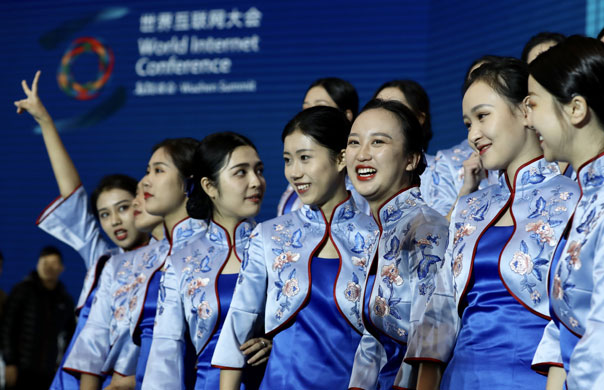 4th World Internet Conference concludes
-
 Starbucks Reserve Roastery set to open in Shanghai
-
 Smile to get discounts in Tmall's unmanned supermart
-
 Top 10 richest Chinese women in 2017
-
 World leading internet sci-tech achievements released in Wuzhen
-
 Top tech CEOs take to the stage as Wuzhen Summit opens
-
 Major topics at 4th World Internet Conference
-
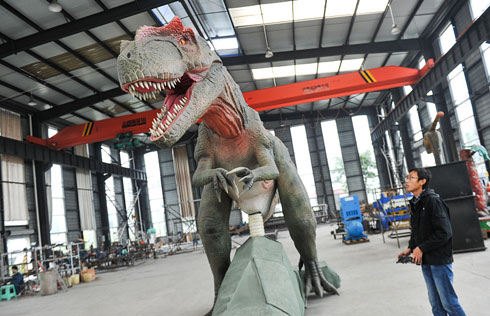 'Made in China' dinosaurs amuse the world










-
 China's internet industry: Racing ahead on superhighway
-
 Robots come to town, again
- ...
-
 Top 10 brands most relevant to China's Generation-Y
-
 Top 5 women billionaires in tech in 2016
- ...
-
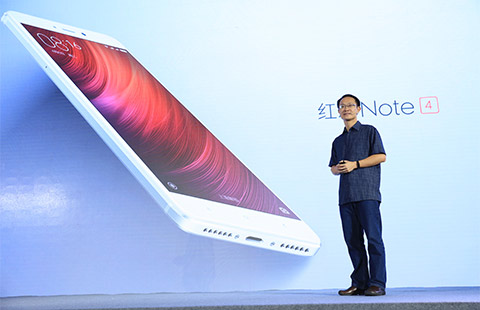 Xiaomi and China Mobile launch new Redmi Note 4 with hopes channels boost sales
-
 E-shopper experience to go high-tech with Buy+